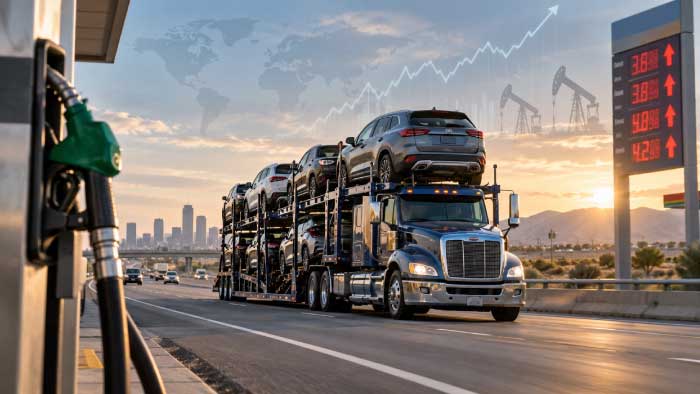
Gas prices remain unusually high in the United States as drivers head into October 2026. That matters if you are planning a long-distance move, buying a vehicle in another state, sending a car to a seasonal residence, or simply deciding whether to drive a vehicle across the country or have it transported.
But there are two different fuel questions to understand. The price of regular gasoline affects what you would spend to drive the vehicle yourself. Diesel prices, meanwhile, are more directly relevant to the trucks that move vehicles for auto transport carriers. Neither number by itself determines what a car shipment will cost.
As of October 1, AAA reported a national average of about $4.41 per gallon for regular gasoline after a record-setting September. The U.S. Energy Information Administration also reported elevated gasoline and diesel prices in its latest weekly data. For consumers comparing a road trip with vehicle transport, the useful question is therefore not simply whether gas is expensive. It is how fuel fits into the total cost of each option.
Gas Prices Remain High in October 2026
AAA reported on October 1 that the national average for regular gasoline had fallen by nearly seven cents from the previous week to about $4.41 per gallon. Even after that decline, September had just set a record for the month: AAA put the September monthly average at $4.33 per gallon, 50 cents above the previous September record of $3.83 set in 2023.
By October 5, AAA’s national average had eased further to roughly $4.37 per gallon. Prices can change quickly, however, and a national average is not the price every driver will see locally.
The EIA’s weekly data show that regional differences can be substantial. For the week ending September 28, the agency reported a U.S. average of $4.465 per gallon for regular gasoline. The same dataset showed lower averages in some regions and considerably higher prices in others.
That regional variation matters when estimating a long road trip. A route that crosses several states will not necessarily have one consistent fuel price from beginning to end.
Gasoline Prices and Diesel Prices Affect Different Parts of the Decision
When consumers see higher prices at a gas station, it is easy to assume that car shipping prices should move by the same amount. Auto transport does not work that way.
Gasoline affects your own driving cost
If you drive the vehicle yourself, your direct fuel expense depends on the trip distance, your vehicle’s real-world fuel economy, and the gasoline prices you encounter along the route.
A simple planning formula is:
Trip miles ÷ vehicle MPG × price per gallon = estimated fuel cost.
That calculation is useful for comparing scenarios, but it still represents fuel only. It does not include lodging, meals, tolls, parking, maintenance, added mileage, or the value of your travel time.
Diesel matters more directly to vehicle carriers
Most large highway vehicle transporters operate on diesel rather than regular gasoline. EIA data for the week ending September 28 put the U.S. average for on-highway diesel at $6.382 per gallon.
That does not mean a change in diesel prices is passed directly to one customer’s quote. A carrier is moving multiple vehicles, operating across a route network, managing empty and loaded miles, and balancing fuel with labor, equipment, insurance, tolls and available capacity.
For a deeper explanation of this side of the market, see our guide to diesel prices and car shipping costs.
How Much Gas Could a Long-Distance Drive Use?
Instead of treating a national gas-price headline as your personal trip cost, calculate a realistic scenario for your own vehicle.
Example: a 1,000-mile drive
Suppose a vehicle averages 30 miles per gallon and the trip is 1,000 miles. It would use approximately 33.3 gallons of gasoline.
At $4.40 per gallon, that works out to roughly $147 in fuel. A vehicle averaging only 20 MPG would need about 50 gallons for the same distance, or approximately $220 at the same assumed fuel price.
These are illustrative calculations, not forecasts of what a particular trip will cost. Actual MPG, traffic, terrain, weather, idling and local pump prices can all change the result.
Example: a 2,000-mile drive
At 30 MPG, a 2,000-mile trip would require approximately 66.7 gallons. Using the same illustrative $4.40-per-gallon assumption, fuel would be about $293.
At 20 MPG, the vehicle would consume about 100 gallons, making the same illustrative fuel expense about $440.
As distance increases, fuel becomes more noticeable, but it still should not be confused with the full cost of making the trip yourself.
The Cost of Driving Is More Than Gas
Fuel is the easiest road-trip expense to calculate, which is why it often dominates the comparison. For a realistic ship-versus-drive decision, however, consider the other expenses and tradeoffs created by a long trip.
Hotels
A long-distance drive may require one or more overnight stops depending on the route, weather, traffic, driver endurance and how many people can share the driving.
Meals and travel expenses
Food and other travel purchases may add to the trip budget. These costs vary too much to use one universal estimate, so calculate them based on your actual travel plan.
Tolls and parking
Some routes involve significant tolls, while others have few or none. Parking costs can also matter if the trip includes overnight stays in major cities.
Mileage and vehicle use
A 1,500-mile relocation adds 1,500 miles to the odometer before considering local detours. That is real vehicle use even if there is no immediate repair bill at the end of the trip.
Your time
Driving for one or several days has an opportunity cost. For some people, the road trip itself is worthwhile. For others, missing work, arranging childcare, changing flights or spending several days in transit makes driving less attractive.
Our dedicated ship a car or drive comparison looks at the full decision rather than fuel alone.
Route-specific planning
Planning to Ship a Vehicle?
Get a vehicle shipping quote based on your route, vehicle, and workable dates.
Get My Quote
Do Higher Gas Prices Automatically Raise Car Shipping Costs?
No. Gasoline and diesel markets are related to broader energy conditions, but a consumer gasoline increase does not translate mechanically into the same percentage increase in an auto transport quote.
Car shipping prices depend on multiple variables, including route distance, origin and destination, vehicle size, vehicle condition, open or enclosed transport, seasonal demand, pickup flexibility and current carrier capacity.
Fuel is one operating expense within that system. When diesel remains elevated for a sustained period, carriers face greater operating pressure, particularly on long-distance routes. But available trucks and vehicles on a lane can sometimes have a larger short-term effect on an individual quote than a small week-to-week movement in fuel.
See why car shipping prices vary for the broader pricing framework.
Why Car Shipping Does Not Have a Simple Fuel-Per-Mile Formula
Your personal road-trip fuel calculation is relatively straightforward because one vehicle is traveling from point A to point B. A multi-car transporter operates differently.
The truck may collect and deliver several vehicles along a corridor. Each vehicle uses part of the trailer’s capacity, and the carrier has to account for loading order, vehicle dimensions, pickup access, delivery access, deadhead miles and the next available load.
This is why dividing a truck’s diesel expense by the number of vehicles on board does not produce a reliable shipping quote.
If you are planning by mileage, our car shipping cost by distance guide explains how distance interacts with other pricing factors.
Does Higher Gas Make Shipping More Attractive Than Driving?
Sometimes, but not automatically.
Higher gasoline prices increase the fuel component of driving. The effect becomes more noticeable as trip distance increases or fuel economy decreases. A pickup or large SUV, for example, can require considerably more fuel than an efficient compact car over the same route.
But shipping has its own price. The correct comparison is therefore not:
gas cost vs. shipping quote.
It is:
total realistic driving cost and time vs. the current cost and convenience of shipping.
That distinction prevents a common mistake. If a 1,000-mile drive appears to require $150 in gasoline, it does not follow that driving costs only $150. At the same time, a higher pump price does not prove that shipping is cheaper.
When Driving May Still Make More Sense
Driving can remain practical when the distance is manageable, you already want to make the trip, you have enough time, the vehicle is reliable, and the additional travel expenses are limited.
It may also make sense when several people are traveling together and the vehicle is needed throughout the trip.
The point is not to force every calculation toward auto transport. The best choice depends on the actual route and circumstances.
When Shipping May Make More Sense
Shipping becomes more attractive when the drive would consume several days, the vehicle is a second or additional car, the owner has limited travel time, or adding a large amount of mileage is undesirable.
It can also be useful for seasonal moves, long-distance relocations, online vehicle purchases, college moves and situations where the owner is flying separately.
For coast-to-coast planning, see our cross-country car shipping guide.
What About Electric Vehicles?
An EV changes the personal travel calculation because gasoline is no longer the direct energy expense for the drive. Instead, the driver needs to consider charging prices, charging availability, charging time and how the vehicle’s real-world range changes with speed, temperature and other conditions.
That does not eliminate the ship-versus-drive decision. A long EV road trip still adds mileage and requires travel time, and an EV can also be transported by an auto carrier.
Gasoline prices therefore should not be used as the deciding metric for an electric vehicle. Compare the actual charging and travel plan with a current shipping quote.
Gas Prices vs. Car Shipping: What Should You Compare?
| Factor | Driving | Shipping |
|---|---|---|
| Fuel | Gasoline or charging paid directly by the traveler | Carrier operating costs are built into the transport market |
| Hotels and meals | May apply on longer trips | Usually not part of the customer’s vehicle transport trip |
| Added vehicle mileage | Full trip mileage added | Vehicle is transported rather than driven for the route |
| Travel time | Owner spends time making the trip | Owner can travel separately |
| Price certainty | Depends on fuel and trip expenses | Depends on the quote, route and carrier market |
How to Make the Comparison Using Current Prices
- Check your route mileage. Use the actual origin and destination rather than a generic cross-country estimate.
- Use realistic MPG. Your normal highway fuel economy is more useful than an idealized number.
- Check current gasoline prices. National averages provide context, but regional prices along the route are more relevant to your trip.
- Add the rest of the road-trip budget. Include likely hotels, meals, tolls, parking and other travel expenses.
- Consider time and mileage. Decide whether several days of driving and the additional vehicle use matter to you.
- Get a current shipping quote. Compare against today’s transport market rather than an old published price.
For broader pricing context, see our 2026 car shipping cost guide.
Frequently Asked Questions
Are gas prices high in 2026?
Gasoline prices were elevated entering October 2026. AAA reported a national average of about $4.41 per gallon for regular gasoline on October 1 after a record-setting September, while prices vary significantly by state and region.
Does a gas-price increase immediately make car shipping more expensive?
No. Large auto transport trucks generally use diesel, and shipping quotes depend on far more than fuel. Route demand, truck availability, distance, vehicle size, transport type and timing can all affect the price.
How do I estimate gas for a 1,000-mile trip?
Divide 1,000 by your vehicle’s expected MPG and multiply the result by the expected price per gallon. For example, 1,000 miles at 30 MPG requires about 33.3 gallons. The result is a fuel estimate only, not the total cost of the trip.
Is it cheaper to ship a car or drive it?
There is no universal answer. Compare the current shipping quote with fuel, lodging, meals, tolls, parking, mileage, travel time and the circumstances of your specific route. A shorter trip may favor driving, while the convenience of shipping can become more valuable on longer moves.
Do car shipping companies charge a fuel surcharge?
Pricing practices vary by company and shipment. Instead of assuming a particular surcharge structure, review the quote and terms you receive and ask what is included in the quoted price.
Will gas prices go down later in 2026?
Fuel prices can change quickly with crude oil markets, refinery conditions, seasonal fuel requirements, inventories, demand and other market developments. For current conditions, use recent AAA and EIA data rather than relying on a fixed forecast in a shipping decision.
Bottom Line: Compare the Full Trip, Not Just the Pump
High gasoline prices make fuel a more visible part of a long-distance driving budget, but the number on the gas-station sign is only one part of the decision.
If you are considering driving, calculate fuel using your route and vehicle, then add realistic travel expenses, time and mileage. If you are considering transport, compare that total with a current shipping quote and the convenience of having the vehicle moved separately.
For consumers planning a long-distance move in 2026, the most useful comparison is not simply gas versus shipping. It is the full cost and practical impact of each option.
Sources and Data Notes
This article uses current public fuel-price data available at publication time. Fuel prices change frequently.