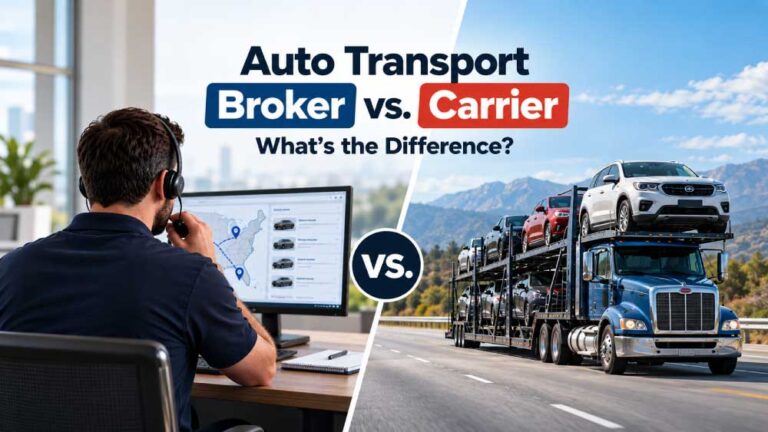
If you are asking how long does it take to ship a car, the most important distinction is between the pickup timeline and the transit time after the vehicle is loaded.
Those are two separate stages. Carrier availability affects when pickup can be coordinated, while distance, route conditions, stops, weather, and other operating factors affect the transit period after pickup.
Car Shipping Transit Time at a Glance
| Distance | Transit Planning After Pickup |
|---|---|
| 0–500 miles | About 1–2 days |
| 500–1,500 miles | About 2–4 days |
| 1,500+ miles | About 4–7 days |
These ranges are intended for planning only. They do not include the time required to coordinate carrier pickup and they are not guaranteed delivery windows.
Pickup Window vs. Transit Time
These two terms are easy to confuse.
Pickup Timeline
The pickup stage is the period before the vehicle is loaded onto the carrier. Its length depends on factors such as the route, requested dates, equipment requirements, vehicle condition, pickup location, and available carrier capacity.
There is no single pickup window that applies to every shipment.
Transit Time
Transit begins after the carrier has picked up and loaded the vehicle. The distance-based planning ranges on this page refer to this stage.
For example, a shipment may have a separate scheduling period before pickup and then a transit period after loading. Combining those two stages gives you the broader shipment timeline.
How Long Does It Take to Ship a Car Under 500 Miles?
For a route of up to approximately 500 miles, a useful planning estimate is:
About 1–2 days after pickup.
Shorter routes still depend on the carrier’s schedule and other planned stops. Therefore, mileage alone should not be treated as an exact delivery clock.
How Long Does It Take to Ship a Car 500 to 1,500 Miles?
For a medium-distance shipment between approximately 500 and 1,500 miles, a reasonable planning range is:
About 2–4 days after pickup.
At this distance, the carrier may cross several states and can have other pickups or deliveries along the route. If you are planning the complete move rather than only the timing, see our interstate car shipping guide.
How Long Does It Take to Ship a Car Over 1,500 Miles?
For long-distance or cross-country car shipping routes over approximately 1,500 miles, use:
About 4–7 days after pickup as an early planning range.
A coast-to-coast shipment can involve long driving distances, multiple stops, changing road conditions, and operating requirements. As a result, the actual delivery timing can vary from the planning estimate.
For long-distance pricing information, see our cross-country car shipping cost guide.
Route-specific planning
Planning to Ship a Vehicle?
Get a vehicle shipping quote based on your route, vehicle, and workable dates.
Get My Quote
What Affects Car Shipping Delivery Time?
Distance is important, but several other variables can affect the actual timeline.
Carrier Availability
Before transit begins, a carrier must have suitable capacity for the vehicle, route, equipment, and requested timing.
A route with more compatible carrier capacity may be easier to schedule than one with limited availability.
Route and Other Stops
Auto carriers frequently transport multiple vehicles. The driver may have additional pickups and deliveries before reaching your destination.
That does not necessarily mean the carrier is taking an inefficient route; multi-vehicle transport is planned around several shipments.
Traffic and Road Conditions
Congestion, construction, road closures, accidents, and other conditions can affect progress.
Because these conditions can change during a trip, they are one reason delivery times should be treated as estimates rather than fixed appointments.
Weather
Severe weather can slow or temporarily interrupt transport when continuing would not be safe.
The effect depends on the actual route and conditions, so there is no universal number of hours or days that weather adds to a shipment.
Vehicle Condition
An inoperable vehicle can require additional loading equipment or handling.
If the vehicle does not start, steer, brake, or roll normally, disclose that before pickup. See our inoperable vehicle shipping information for more detail.
Pickup and Delivery Access
Large auto carriers need enough room to operate safely and legally.
If the requested address is not accessible, the driver may need to coordinate a nearby meeting point. This usually affects local coordination rather than the long-haul mileage itself.
Read door-to-door vs. terminal-to-terminal car shipping for more detail.
Does Open or Enclosed Transport Take Longer?
Neither method should automatically be treated as faster in every situation.
Open transport and enclosed transport use different equipment, and carrier availability can vary by route and date.
The road distance may be the same, but scheduling availability can differ. Therefore, evaluate the actual carrier options for the shipment rather than assuming one transport type always produces a shorter timeline.
How Long Does Door-to-Door Car Shipping Take?
Door-to-door service does not create a separate universal transit time.
It describes how pickup and delivery are coordinated: as close to the requested locations as the carrier can safely and legally access.
The long-haul transit period is still influenced primarily by distance, route, carrier stops, and operating conditions.
What Happens After You Book?
A typical timeline includes several stages:
- Shipment details are confirmed.
- Carrier capacity is coordinated.
- Pickup arrangements are made.
- The vehicle is inspected and loaded.
- Transit begins.
- Delivery is coordinated.
- The vehicle receives a final condition inspection.
For the complete workflow, see how the car shipping process works.
When Does the Transit Clock Start?
For planning purposes, the transit ranges on this page begin after the vehicle has been picked up and loaded.
This distinction matters because a quote or booking date is not the same as the physical start of transport.
Can a Delivery Date Be Guaranteed?
Do not assume a specific delivery date is guaranteed unless the terms of the actual shipment explicitly provide that commitment.
Traffic, weather, road conditions, driver operating requirements, mechanical issues, and earlier stops can affect a carrier’s progress.
For standard planning, it is more useful to work with an estimated delivery range and maintain communication as the carrier approaches the destination.
Can Expedited or Priority Shipping Make It Faster?
If a provider offers an expedited or priority option, confirm exactly what that service changes.
For example, a service may affect pickup priority or scheduling, but the label alone should not be interpreted as a guaranteed road-transit speed or delivery date.
Always evaluate the specific terms for the shipment rather than relying on the word “priority” by itself.
How to Avoid Preventable Scheduling Delays
You cannot control traffic or weather, but you can reduce avoidable problems by providing accurate information.
- Use the correct pickup and delivery locations.
- Provide the exact year, make, and model.
- Disclose modifications that affect vehicle dimensions.
- Disclose an inoperable or mechanically limited vehicle.
- Provide reliable pickup and delivery contact information.
- Prepare the vehicle before the carrier arrives.
- Be clear about dates that are genuinely required.
Use our pre-shipping car checklist before pickup.
How to Plan Around Your Estimated Delivery
If you need the vehicle for work, travel, school, or another time-sensitive purpose, avoid building plans around the earliest possible delivery estimate.
Instead, allow reasonable flexibility around the planning range and keep essential items with you rather than inside the shipped vehicle.
If timing is critical, explain the requirement when requesting the shipment so the available options can be evaluated before booking.
Frequently Asked Questions
How long does it take to ship a car?
For planning after pickup, use roughly 1–2 days for up to 500 miles, 2–4 days for 500–1,500 miles, and 4–7 days for routes over 1,500 miles. Actual timing can vary.
How long does car shipping take across the country?
A route over approximately 1,500 miles can be planned at about 4–7 days of transit after pickup. Carrier scheduling before pickup is a separate part of the overall timeline.
How long does it take to deliver a car after pickup?
The answer depends primarily on distance and route conditions. Use the distance-based planning ranges on this page as a starting point rather than a guaranteed delivery promise.
How long does it take for a carrier to pick up a car?
There is no single pickup period that applies to every shipment. Carrier availability depends on the route, dates, vehicle, equipment requirements, location, and available capacity.
Does open transport take longer than enclosed transport?
Not necessarily. Equipment availability can differ, but one method is not automatically faster on every route.
Can weather delay vehicle transport?
Yes. Severe weather can affect road conditions and carrier progress. The actual delay depends on the specific route and conditions rather than a fixed number of hours or days.
Is the estimated delivery date guaranteed?
Not unless the specific shipment terms explicitly make that commitment. Standard auto transport planning should generally treat delivery timing as an estimate.