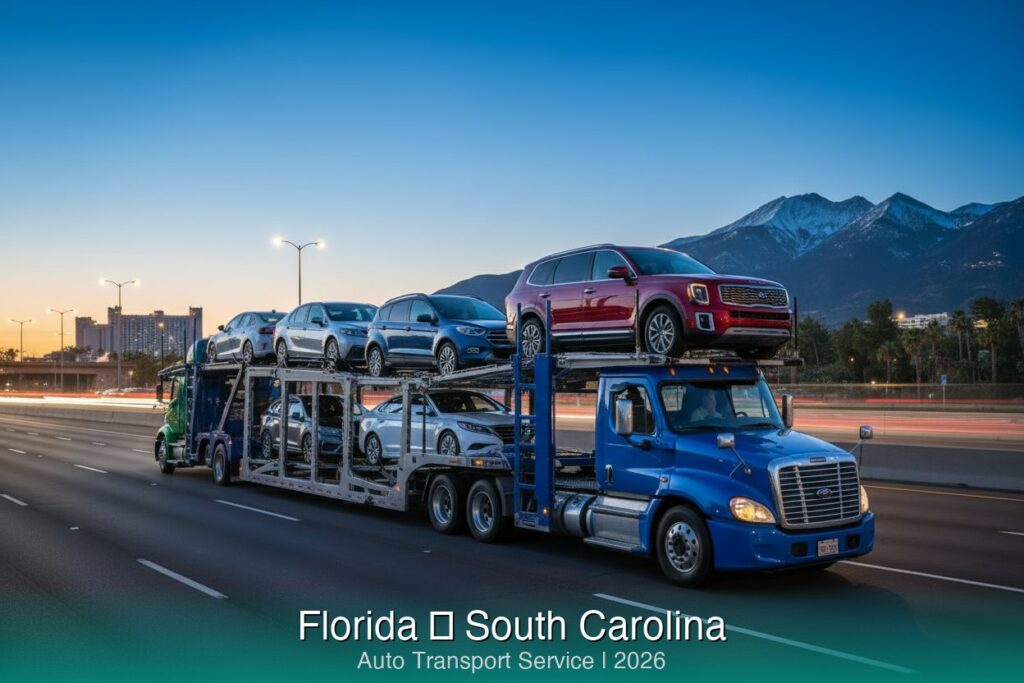
Florida to South Carolina: $400 – $550
Open Transport | ~500 Miles | 2-3 Days Transit
Charleston is further from Miami than Columbia is, and it costs less to ship to. That is not an error in our pricing — it is the most useful thing on this page.
Everybody expects the coastal resort destination to carry a premium and the inland state capital to be the sensible economical choice. On this corridor it runs the other way round, and the reason is simple once you see it: Charleston sits on I-95, which is the road every northbound truck leaving Florida is already using. Columbia is inland, up I-26, and reaching it means leaving that road.
At 500 miles there is not enough distance for the mileage difference to overcome that. Forty fewer miles does not compensate for coming off the corridor.
This is a short, cheap, straightforward booking, and the whole page is really about two decisions: which South Carolina you are going to, and whether you should be shipping at all.
- What It Actually Costs
- City-to-City Price Breakdown
- How Long the Journey Takes
- Seasonal Pricing: When to Book
- Open vs. Enclosed Transport
- Who Ships Florida to South Carolina
- The Complete Shipping Process
- Vehicle Preparation Checklist
- 7 Mistakes That Cost You Money
- Insurance and Liability Explained
- Frequently Asked Questions
What It Actually Costs
$400-$550 open and $650-$850 enclosed, over roughly 500 miles. That is $0.80-$1.10 a mile.
The Highest Per-Mile Rate on This Site, and It Does Not Matter
Well above the $0.50-$0.70 industry band, and worth understanding rather than worrying about.
A shipment carries costs that have nothing to do with distance. A driver has to reach an address at an agreed time. The car is inspected, documented and loaded. A Bill of Lading is completed. All of it happens again at the far end. Two appointments and a couple of hours of skilled labour, identical whether the truck then drives 500 miles or 2,800.
Divide that into 500 miles and it dominates the rate. The 500 miles of actual driving are close to the cheapest part of what you are buying. So the per-mile figure is arithmetic rather than a markup, and comparing it against a coast-to-coast quote tells you nothing you can act on. The number that matters is $400-$550 in total.
Pricing by Vehicle
Deck space is the product, so physical size drives this more than value:
| Vehicle Type | Open Transport | Enclosed Transport |
|---|---|---|
| Sedan/Compact | $400 – $475 | $650 – $750 |
| Mid-size SUV | $450 – $525 | $725 – $825 |
| Full-size SUV/Truck | $500 – $550 | $775 – $800 |
| Luxury ($75K+) | $525 – $600 | $800 – $850 |
| Oversized (dually, extended) | $550 – $700 | $850 – $1050 |
The Levers, in Order of What They Are Worth
- Lead time: $100-$150 for booking inside five days — on a $400 job that is over a third of the price
- Which South Carolina destination: up to $150 across the grid
- Trailer type: $250-$300 to put walls round it, which here is more than half again
- How big the car is: around $150 from smallest to largest
- Month: $50-$100, the smallest lever on this route rather than the largest
- Date flexibility: $50-$100 for a window over a fixed day
That ordering is the inverse of a long haul, where the calendar dominates and geography is noise. On a 500-mile run, lead time and destination are worth several times what the month is.
A car that will not start adds $150-$250 — on this base, up to sixty per cent. See inoperable vehicle shipping.
City-to-City Price Breakdown
About $150 across this grid, which on a $400 base is nearly forty per cent. Short routes concentrate their variation in geography, and this one is a good example.
| Origin City | Destination | Open Price | Enclosed | Transit |
|---|---|---|---|---|
| Miami | Charleston | $400-$500 | $650-$800 | 2-3 days |
| Miami | Columbia | $425-$525 | $675-$825 | 2-3 days |
| Tampa | Charleston | $425-$525 | $675-$825 | 2-3 days |
| Tampa | Columbia | $450-$550 | $700-$850 | 2-3 days |
| Orlando | Charleston | $450-$550 | $700-$850 | 3-4 days |
| Orlando | Columbia | $475-$575 | $725-$875 | 3-4 days |
| Jacksonville | Charleston | $475-$575 | $725-$875 | 3-4 days |
| Jacksonville | Columbia | $500-$600 | $750-$900 | 3-4 days |
Coastal Beats Inland, Against Expectation
Charleston prices below Columbia from every Florida origin, despite Columbia being the shorter journey on paper. Charleston sits on the I-95 spine that northbound Florida freight already runs; Columbia is inland and requires leaving it.
The same logic extends outward. Myrtle Beach, Hilton Head and Savannah-adjacent destinations behave like Charleston — they are on or near the corridor. Greenville and Spartanburg, up on I-85 in the northwest corner, are the furthest and the dearest, because reaching them means crossing the state after leaving the interstate that got you there.
The Florida End
Miami is cheapest despite being furthest south, for the reason that shows up on every Florida page we run: South Florida generates enormous outbound volume, so a northbound truck is nearly always loading there. Tampa and Orlando each add $25-$50, and Jacksonville — which is closest to South Carolina — is not the bargain people expect.
What to Actually Do
If the destination is genuinely flexible — a coastal town versus an inland one — the coast is cheaper and quicker. If it is not flexible, this is worth knowing so the quote makes sense to you rather than looking arbitrary.
Route-specific planning
Planning to Ship a Vehicle?
Get a vehicle shipping quote based on your route, vehicle, and workable dates.
Get My Quote
How Long the Journey Takes
2-3 days on the road from Miami, 3-4 from Tampa or Orlando. Then the part that dominates everything: one to five days for a carrier to accept the load first. Three to nine days from booking to delivery.
You Will Spend Longer Waiting Than the Truck Spends Driving
On a 500-mile route this is not an occasional annoyance, it is the normal state of affairs. Five hundred miles is a single day for a driver. Finding a carrier whose route already accommodates both your addresses takes however long it takes.
Which means the transit figure barely matters for planning purposes. What determines when your car arrives is how much notice you gave and whether the destination sits on the corridor.
Why Two Days Rather Than One
Because the truck is not making your journey. It is collecting eight or nine cars across Florida and dropping them across the Carolinas, and every one of those stops needs somebody standing there. Federal rules also cap the driver at eleven hours of driving inside a fourteen-hour window.
The Road Contributes Nothing
I-95 north through Georgia into South Carolina. Flat, maintained, open all year, no passes and no altitude. The only genuine weather variable is hurricane season between June and November, and it affects the collection rather than the journey — a storm can push a Florida pickup back by a day or two. Once the truck is north of Jacksonville it is clear.
What Shortens It
- Two to three weeks’ notice: by a wide margin the biggest factor, and free
- A coastal destination: Charleston is on the corridor and gets picked up faster than Columbia
- Starting the car in South Florida: more northbound loads are assembled there
- Accepting a window rather than a named day: quicker, and $50-$100 cheaper
Even over 500 miles, nobody credible guarantees a delivery date on a nine-car trailer. Transit times by distance gives the comparison.
Seasonal Pricing: When to Book
Season moves this route by $50-$100 across the year, which is genuinely small — less than lead time, less than the destination, less than the size of your car. Included for completeness rather than because you should plan around it.
The Calendar
- January-February: standard rates, good availability
- March-April: five to ten per cent below standard — the cheapest window, and easy to book
- May: back to standard, with a Memorial Day bump
- June-August: ten to twenty per cent above as national relocation season peaks, with hurricane season overlapping
- September-October: standard rates return, though the storm risk continues
- November-December: steady until mid-December, then thin as drivers stop for the holidays
Hurricane Season Is a Scheduling Matter, Not a Pricing One
June through November, a storm can delay a Florida collection. It does not usually move the price and it does not affect the journey once the truck is north of the state line — but it is a reason to build two or three days of slack into a summer or autumn booking rather than assuming the estimate.
That is genuinely all it means. Carriers on this corridor deal with it every year and it is unremarkable to them.
The Honest Summary
Ship when it suits you. Avoid the second half of December if you can, leave a little slack in storm season, and spend the effort you would have spent on timing making sure you booked a fortnight ahead instead. On this route that single decision is worth more than every month on the calendar put together.
Open vs. Enclosed Transport
Roughly nine cars in ten go open here, and 500 miles of I-95 gives you nothing whatsoever to argue with. No salt, no passes, no altitude, no seasonal closures. Two days of exposure produces road dust.
The Proportion Is the Problem
$650-$850 against $400-$550 is $250-$300 — one of the smallest cash premiums we quote, and simultaneously one of the largest as a percentage. On a base this modest it is more than half again.
Which of those two facts you notice tends to decide how it feels. If you have been pricing coast-to-coast enclosed transport, $300 looks like nothing. Measured against what the journey actually is, it is a lot.
And It Doubles the Wait
Covered trailers are about a tenth of the fleet, so assignment moves from one-to-five days to three-to-ten. On a route where the wait is already the slow part and the drive is a single day, that can more than double your total time from booking to arrival.
Still Right When
- You would want the carrier’s payout limit confirmed in writing before letting them near it
- The car gets shown, judged or auctioned
- There is fabric over your head rather than metal
- Repainting a panel would mean approximating the colour instead of matching it
- Ground clearance is tight enough at the front that ramps become a gamble
One point specific to this corridor: dealer and auction movement between Florida and the Carolinas is common, and in that context arrival condition is part of a transaction rather than a preference. That is a legitimate reason where the general case is not.
Both services: open transport, enclosed transport, and the comparison.
Who Ships Florida to South Carolina
Four situations account for most of this corridor. At 500 miles, three of them exist because driving is not actually an option rather than because shipping is cheaper.
Two cars, one driver
The commonest reason at this distance by some way. Somebody has to be in each vehicle, and $400-$550 beats a second driver’s day, a second tank of fuel and getting them home again. If this is you, the drive-or-ship arithmetic further down does not apply.
The coastal retirement move
Florida to Charleston, Myrtle Beach or Hilton Head — a well-worn path, and conveniently the cheap side of the grid. Usually flexible on timing, which on this route matters less than usual, and usually with two vehicles, which matters more.
The upstate job move
Greenville and Spartanburg draw people for manufacturing and logistics work, generally on fixed start dates. This is the expensive corner of the grid and the one where lead time earns the most, because the destination is furthest from the corridor.
The car nobody is travelling with
Sold, inherited, bought at auction, or heading to a specialist. Nobody is driving it anywhere, so the comparison with driving is beside the point. Documentation is what matters: dated photographs before collection, a Bill of Lading describing the car as the driver finds it, and someone at the far end entitled to sign.
The Complete Shipping Process
One trailer, one driver, Florida to South Carolina. No transfers, no depot in between.
1. Price the actual destination town
Not “South Carolina”. Charleston and Greenville are $150 and a different journey apart on a $400 booking. Price it here with the real address.
2. Book two to three weeks out
The single most valuable step, and it comes second only because you need the quote first. Booking inside five days costs $100-$150, which on this base is over a third of the price — the steepest proportional penalty on this site.
3. Compare three, on deposit as much as price
A $200 deposit is a routine figure industry-wide and half the total here. Not dishonest, but worth asking whether they will hold it at nothing until a carrier is actually assigned. Many will.
4. Assignment
One to five days, ending with a DOT number, an insurance certificate and the driver’s phone number. On a short route a load sitting unassigned for a week usually means it was posted below what carriers will take.
5. Collection in Florida
A four-hour window, about an hour on site. The driver records the car’s condition and you check that record is right, keeping your own dated photographs. Barrier islands and gated communities are the usual access problem here — nominate a retail car park nearby if that describes you.
6. North on I-95
Two to three days, arranged around the other cars on the trailer. Ring the driver rather than the office for an update.
7. Delivery
Walk the car against the Bill of Lading and your Florida photographs, in daylight, before signing anything. The signature ends the discussion. Then settle the balance with the driver.
The parts common to every route: how car shipping works.
Vehicle Preparation Checklist
Two days on flat interstate asks almost nothing of a car. This list is entirely about making the handover documentable.
The Short-Route Temptation
Worth naming directly, because it is the main risk here. People skip the inspection on a 500-mile trip in a way they never would before a coast-to-coast move. That instinct is exactly backwards.
Damage happens at the ramps, and your car goes up a ramp and comes down one precisely as many times on this route as on a 2,800-mile one. A shorter journey reduces your exposure not at all — it simply makes people casual about recording it. The twenty minutes are worth the same either way.
So Do It Properly
Wash it first; a film of grime conceals precisely the shallow mark that becomes contested. Then work round the car with a camera and the date on — panels, roof, sills, each wheel, the cabin. Read the Bill of Lading rather than glancing at it, and resolve any difference while the truck is still in front of you.
The Rest
- ✓ Fuel down to a quarter. Trailers hit their weight ceiling before they run out of room
- ✓ Nothing loose inside, cabin or boot. None of it is covered by anybody
- ✓ SunPass off the glass, unless you fancy funding the carrier’s tolls
- ✓ Mirrors in, aerial down, roof cleared of racks and boxes
- ✓ The alarm needs dealing with: switched off, or explained in writing
- ✓ Snap the odometer before loading
- ✓ Title and keys travel on your person
Fuller version: preparing a vehicle for transport.
7 Mistakes That Cost You Money
1. Booking inside five days
$100-$150 on a $400 job. The steepest proportional lead-time penalty on this site, and the wait it causes is already the slowest part of the process.
Instead: two to three weeks, always. It is free and it is the whole game at this distance.
2. Assuming inland is cheaper than the coast
Columbia is closer to Miami than Charleston and costs more. Charleston is on I-95; Columbia is not. At 500 miles, being on the corridor beats being nearer.
Instead: price both if the destination has any flexibility, and do not be surprised by the answer.
3. Accepting a $200 deposit without asking
Standard across the industry and half the total on this route. It is not dishonest, but plenty of brokers will now hold it at nothing until a carrier is actually assigned.
Instead: ask. The worst outcome is that they say no.
4. Skipping the inspection because it is only 500 miles
Loading and unloading happen exactly as often on a short route as a long one, and that is where damage occurs. The distance changes nothing about your exposure.
Instead: wash it, photograph it, read the Bill of Lading before signing.
5. Paying more than half again for enclosed
$250-$300 sounds trivial until you notice it against a $400 base — for two days on flat interstate with no salt, no passes and no weather. It also roughly doubles the wait.
Instead: choose it for the vehicle if it warrants it. This road never asks for it.
6. A Florida address a truck cannot reach
Barrier islands, gated communities and older narrow streets all defeat a seventy-five-foot rig, and a driver who cannot collect has to rework the day.
Instead: nominate a large retail car park at booking rather than discovering the problem on the morning.
7. Booking a tight delivery in storm season
June to November, a Florida collection can be pushed back a day or two. It does not affect the journey once the truck is north of the state line, but it does affect your date.
Instead: a couple of days of slack in summer and autumn. That is the extent of it.
Insurance and Liability Explained
A cargo policy attaches to the shipment rather than the mileage. That is worth stating plainly on a short route, because people reasonably assume the protection scales down with the distance. It does not, and neither does the risk.
Five Hundred Miles Is Not Safer
Most transport damage happens on the ramps, and your car is loaded once and unloaded once regardless of how far it travels in between. A 500-mile job and a 2,800-mile job carry identical exposure at exactly the moments that matter.
Which means every shortcut people take on short routes — not washing it, not photographing it, signing the Bill of Lading without reading it — costs precisely as much here as anywhere.
What It Answers For
Physical harm while the carrier holds the vehicle: damage inflicted loading or unloading, debris off the highway, equipment that fails, a mistake by the driver, or theft from their custody. Holding that cover is a condition of operating legally.
Ask for the certificate and find the per-vehicle number. Nobody chose that figure with your car in mind — it is the level regulation demanded — and operators sit at different points above it. How a claim proceeds covers the mechanics.
Ninety Seconds Worth Spending
Once a carrier is assigned you are entitled to their DOT number. Put it into safer.fmcsa.dot.gov to confirm the authority is live, an insurance filing is on record, and somebody has inspected them recently.
Where It Stops
Not the contents of the car, since moving household goods needs an authority car haulers do not hold. Not damage that predates the paperwork. Not a component that was already failing. And not delay — a storm-postponed collection in September is an inconvenience rather than a claim.
Changing States
A permanent move means South Carolina registration and insurance replacing Florida’s. The carrier covers the car in transit and you cover it either side, so set the changeover such that the arrival cannot fall in the gap between the two.
Frequently Asked Questions
How much does it cost to ship a car from Florida to South Carolina?
$400-$550 on open transport and $650-$850 enclosed, over roughly 500 miles. One of the cheapest interstate moves we handle, because it is one of the shortest.
Why does Columbia cost more than Charleston when it is closer?
Because Charleston is on I-95 and Columbia is not. Every northbound truck leaving Florida is already using that road, so a Charleston delivery is a stop along the way. Columbia means coming inland off the corridor, and at 500 miles the forty-mile difference is nowhere near enough to compensate.
Where does that leave Greenville and Spartanburg?
The dearest corner of the grid. They sit up on I-85 in the north-west of the state, which means crossing South Carolina after leaving the interstate that brought the truck north. Worth budgeting toward the top of the range.
Why is the per-mile rate so high?
Because the route is short. Two appointments, two inspections, the loading and the paperwork cost the same at any distance, so on 500 miles they dominate the rate. The driving itself is nearly the cheapest part. Judge it on the $400-$550 total.
How long does it take?
2-3 days on the road from Miami, 3-4 from Tampa or Orlando, plus one to five days for a carrier to accept the load. Three to nine days from booking to delivery — and you will usually wait longer for the truck than the truck spends driving.
How far ahead should I book?
Two to three weeks. Booking inside five days costs $100-$150, which here is over a third of the total — the steepest proportional penalty on any route we publish.
Should I just drive it?
Five hundred miles is a single long day. On fuel and wear alone driving is cheaper, so if you have one running car and you are going the same way, drive it. Shipping earns its place when there are two vehicles and one driver, when the car does not run, when nobody is travelling with it, or when you cannot make the trip.
Does the month matter?
Less than almost anything else here — $50-$100 across the whole year. March and April are cheapest and the second half of December is worth avoiding, but do not delay a move to capture it.
Will hurricane season delay my shipment?
It can hold the Florida collection between June and November, by a day or two. The journey itself is unaffected once the truck is north of the state line. Leave a couple of days of slack in a summer or autumn booking and that is the whole of it.
Is enclosed transport worth it?
Rarely. $250-$300 is more than half again on this base, for two days on flat interstate with nothing to protect against, and it roughly doubles the wait. The exception is a car moving between dealers or to an auction, where arrival condition is part of the transaction.
How much deposit should I pay?
$0-$200 is the industry norm, but $200 on a $400 booking is half the price. Ask whether they will hold it at nothing until a carrier is assigned — many will. Never more than a quarter of the total.
Can I leave belongings in the car?
No. The licence a car hauler holds covers vehicles and stops there, so a loaded boot travels uninsured, and the weight counts against what the trailer may legally carry.
Ready to ship your car from Florida to South Carolina?
Get your free instant quote and see exactly what your route costs in 2026.
Related Guides
- the basics of shipping a vehicle
- average car shipping costs explained
- choosing between open and enclosed transport
- how booking and pickup work
Related reading
Shorter still is Florida to Georgia at 350 miles, where we generally tell people to drive it instead. Longer is Florida to Tennessee at 700, where the balance has clearly tipped the other way. Between them the three pages map out where the crossover actually sits.
Other northbound runs out of Florida: Florida to Indiana covers the return-leg seasonality, and Florida to California is the opposite extreme at 2,800 miles.
On the mechanics: why short routes read expensive per mile, transit times, why quotes differ and what the carrier’s cover includes.