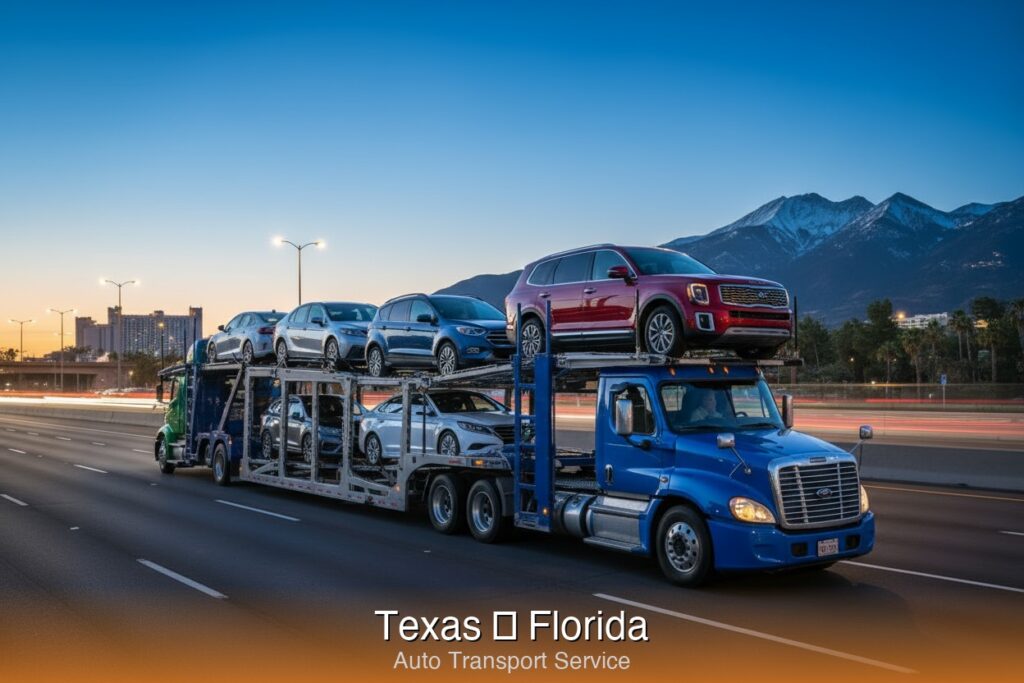
Texas to Florida car shipping can vary significantly depending on where the vehicle starts. Houston, Dallas, Austin, San Antonio, El Paso, and other Texas cities create very different route distances, so a single statewide price is not useful for every shipment.
The best way to plan the move is to use the actual ZIP codes, vehicle details, transport type, and available dates rather than relying on a fixed Texas-to-Florida rate.
How Texas to Florida Car Shipping Works
The vehicle is picked up in Texas, loaded onto an auto transporter, and moved east toward Florida. Most standard vehicles ship on open transport, while enclosed transport is available when the vehicle needs additional protection.
The carrier may have several vehicles on the same load, so pickup order, delivery sequence, traffic, and other scheduled stops affect the final transit.
What Affects Texas to Florida Car Shipping Cost?
- Exact Texas pickup city and ZIP code
- Exact Florida delivery location
- Total route distance
- Vehicle size and weight
- Running versus inoperable condition
- Open versus enclosed transport
- Seasonal demand
- How flexible the pickup schedule is
- Whether a large carrier can reach both addresses
Planning range
For routes in the 500-1,500 mile band, a general planning framework may be around $0.65-$0.90 per mile for open transport and $0.90-$1.40 per mile for enclosed transport.
These are planning ranges only. They are not a guaranteed Texas-to-Florida price. Your actual quote depends on the addresses, vehicle, dates, and available carrier capacity.
For a deeper explanation, see our car shipping cost guide.
Why the Texas Pickup City Matters
Texas is geographically large. A vehicle leaving Houston is not the same shipment as one leaving El Paso or a rural West Texas location. The carrier may need substantially more mileage before the vehicle even reaches the main eastbound corridor.
This is why quotes should always use exact ZIP codes instead of a generic state-to-state estimate.
Florida Delivery Considerations
Miami, Tampa, Orlando, Jacksonville, and Florida’s smaller coastal or inland communities all create different delivery conditions. Dense streets, gated communities, low trees, restricted access, or rural mileage can affect where the transporter can safely unload.
Door-to-door transport aims to get as close to the requested address as practical, but a nearby meeting point may be necessary. Read our door-to-door shipping guide for more detail.
How Long Does Texas to Florida Car Shipping Take?
For routes in roughly the 500-1,500 mile band, a useful planning range after pickup is around 2-4 days. Some shipments take longer because the exact Texas origin, Florida destination, weather, traffic, carrier stops, and loading sequence vary.
Do not confuse carrier assignment time with transit time. The shipment first needs an assigned carrier before the vehicle begins moving. See our transit-time guide.
Weather and Scheduling
Weather along the Gulf Coast and Southeast can affect transportation schedules. A professional driver may pause or reroute when conditions make travel unsafe.
That is one reason delivery should be planned as a window rather than as an exact guaranteed appointment. If your schedule is tied to a flight, move, or other deadline, leave reasonable buffer time.
Open vs. Enclosed Transport
Open transport is the standard option for most everyday vehicles. Enclosed transport may be appropriate for collector cars, rare vehicles, low-clearance vehicles, or situations where additional environmental protection is important.
Compare the two options in our open vs. enclosed transport guide.
What if the Vehicle Does Not Run?
An inoperable vehicle can still be shipped, but it may require winch equipment and additional loading time. Tell the transporter about the vehicle’s condition before booking.
See our non-running vehicle shipping guide.
Preparing the Vehicle
Photograph the vehicle before pickup, remove loose belongings, check tires and battery, and make sure the carrier knows about any mechanical issues.
The Bill of Lading should document the vehicle’s condition when it is loaded. Inspect the vehicle again at delivery before signing the final condition report.
Use our complete vehicle preparation checklist.
Insurance Questions to Ask
Once the carrier is assigned, verify its cargo insurance certificate and ask about the per-vehicle coverage limits, deductible, exclusions, and claim procedure.
Do not assume every carrier has identical terms. See our car shipping insurance guide.
Personal Items
Carrier policies on personal belongings vary. Do not assume a universal allowance or that items inside the car are covered. Ask the assigned carrier what is accepted before pickup.
Read can you ship personal items in your car?
Common Planning Mistakes
- Using a Houston estimate for a West Texas pickup
- Booking before confirming vehicle size or modifications
- Assuming an estimated delivery date is guaranteed
- Not allowing schedule flexibility during severe weather
- Leaving transport type undecided until the last minute
- Skipping the pickup and delivery inspection
How to Get a Texas to Florida Quote
Provide both ZIP codes, the vehicle year/make/model, whether it runs, open or enclosed preference, and the pickup-date range.
See how to get an accurate car shipping quote.
Frequently Asked Questions
How much does it cost to ship a car from Texas to Florida?
The exact cost depends on the pickup and delivery cities, vehicle, transport type, dates, access, and carrier availability. For planning, routes in the 500-1,500 mile range may fall around $0.65-$0.90 per mile open and $0.90-$1.40 enclosed.
Does the Texas city make a big difference?
It can. Texas is large, and the distance from different origins to Florida varies materially. Always quote using exact ZIP codes.
How long does the shipment take?
A broad planning range after pickup is around 2-4 days for this distance band, although the actual route can take longer.
Can weather delay the shipment?
Yes. Severe weather, road closures, or unsafe conditions can change the schedule. Delivery planning should use a window rather than a guaranteed appointment.
Should I choose open or enclosed transport?
Most standard vehicles use open transport. Enclosed transport is generally chosen when the vehicle needs additional protection or specialized handling.