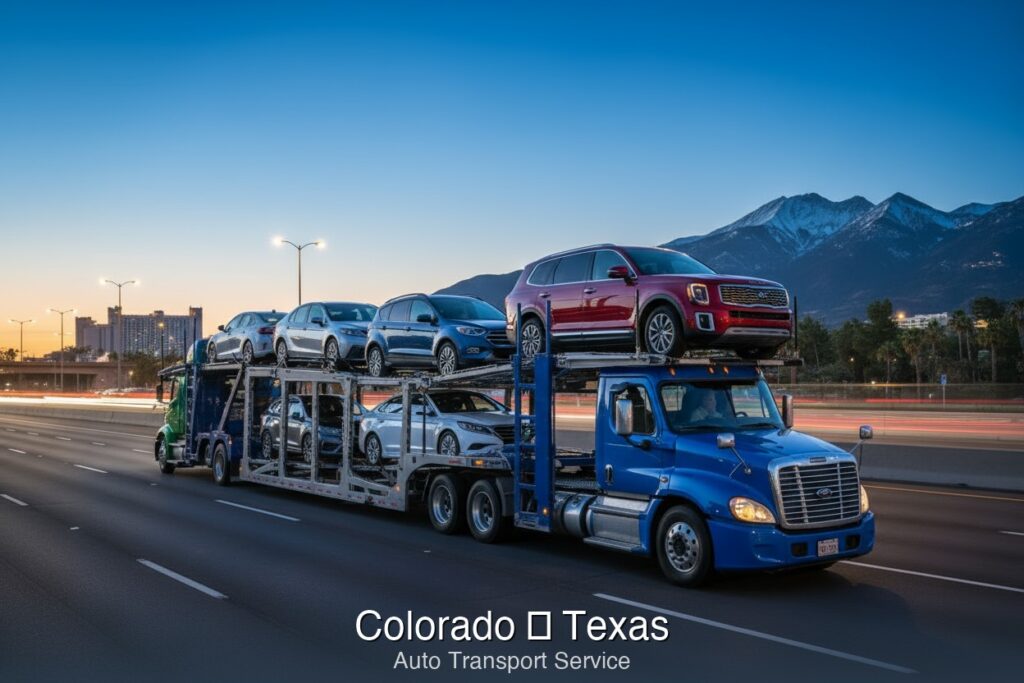
Colorado to Texas Car Transport: What 850 Miles Really Costs
Your car is about to descend a mile.
Denver sits at 5,280 feet. Houston is at sea level. Air pressure changes roughly one pound per square inch for every thousand feet of elevation, which means tyres inflated correctly on a Colorado driveway arrive in Texas reading about five psi over — and the first thing that happens on arrival is that somebody drives the car off a ramp.
It is a small thing and it is the kind of small thing nobody mentions. Check the pressures at the other end before you drive any distance, and if the car has been sitting on marginal tyres, deal with that before it leaves rather than after.
The rest of this route is unusually straightforward. Colorado’s population sits almost entirely on one road, that road goes to Texas, and there is very little else to go wrong.
Table of Contents
- What It Actually Costs: Colorado to Texas Pricing
- City-to-City Price Breakdown
- How Long the Journey Takes
- Seasonal Pricing: When to Book
- Open vs. Enclosed Transport
- What a Colorado to Texas Booking Looks Like
- The Complete Shipping Process
- 7 Mistakes That Cost You Money
- Vehicle Preparation Checklist
- Frequently Asked Questions
What It Actually Costs
Colorado to Texas: $600 – $775
Open Transport | 800-1,000 Miles | 3-5 Days Transit
Enclosed is $950-$1,050. Open transport works out at roughly $0.71-$0.78 per mile, which is ordinary for the distance.
The Front Range Effect
Fort Collins, Denver, Aurora, Colorado Springs and Pueblo sit in a line about 170 miles long, and that line is I-25 — the road a driver takes to Texas. Roughly four-fifths of the state’s population lives along it.
A carrier can therefore fill most of a trailer without leaving the interstate, which keeps the spread across the state to about $75 and makes assignment quick. Anywhere off that corridor — Grand Junction, Durango, the mountain towns — is a different conversation and should be raised when you book rather than assumed.
By Vehicle
A saloon or hatchback is $600-$700 open, $950-$1,050 enclosed. A crossover adds about $50 and a pickup or seven-seater $50 more. Nine slots are sold on a deck and a tall vehicle intrudes on the one above.
Cars over $75,000 are $725-$850 open, reflecting the carrier’s exposure. Oversized vehicles run $800-$950 open and up to $1,400 enclosed — and Colorado ships more lifted trucks and roof-tent-equipped vehicles than most states, so measure the overall height and tell us the figure rather than describing it.
What Moves the Number
- Vehicle size and height: around $200, the largest single factor
- Trailer type: about $350
- Whether you are on the Front Range or off it: $75 on the corridor, considerably more beyond it
- Lead time: $75-$125 inside five days
- The month: $75-$125, with a winter caveat at the Colorado end
- Which Texas metro: about $50
City-to-City Price Breakdown
One road at the Colorado end, and the pricing follows position along it almost exactly.
Down the Corridor
Denver to Houston is the floor at $600-$700 open, three to four days. Colorado Springs adds about $25 and Aurora $50, which on a state this size is a narrow band and reflects position in the collection sequence more than distance.
Fort Collins is furthest north and prices highest of the corridor cities — a driver working south reaches it first and then has 170 miles of Colorado still to cover before the journey proper begins.
Off the Corridor
Not in the table above, and worth stating plainly: Grand Junction, Durango, Steamboat and the mountain towns are not Front Range bookings. A carrier reaching them crosses a pass, and in winter that pass may be closed or chain-controlled.
These are perfectly shippable, but they need more notice, cost more, and should be quoted specifically rather than assumed from a Denver number.
The Texas End
Houston is the baseline and Dallas adds about $25, which is the opposite of what the map suggests — Dallas is nearer. The explanation is that Houston is where southbound loads terminate and Dallas is a stop on the way, so a Dallas delivery is made mid-route while the trailer is still full.
Both are easy cities to unload in. Texas metros are built around wide roads and generous frontage, and access is essentially never a problem.
The realistic combined band is $600-$775 open and $950-$1,175 enclosed, at three to five days.
How Long the Journey Takes
Three to four days from Denver or Colorado Springs, four to five from the northern end of the corridor. Assignment normally takes one to two days.
The Road
South on I-25 through Colorado Springs and Pueblo, over Raton Pass into New Mexico, down past Las Vegas and Santa Fe to Albuquerque, then east on I-40 and south through Lubbock or Amarillo into the Texas triangle. Some loads take I-70 east and drop south through Kansas and Oklahoma instead, depending on where the other cars are going.
The One Piece of Terrain
Raton Pass, at just under 7,900 feet on the Colorado-New Mexico line. It is the highest point on I-25 and it closes occasionally in winter, though far less often than the mountain passes west of Denver. When it does, the alternative is a long way round through Kansas — so a driver will usually wait a few hours rather than divert.
This is a January and February consideration and it costs a day at most.
Where the Rest of the Time Goes
Into the other eight cars. A driver could cover 850 miles in a day and a half; what they cannot do is collect nine vehicles across the Front Range, drive, and deliver nine across Texas in that time. Federal rules also cap them at eleven hours at the wheel inside a fourteen-hour window.
Four to seven days from booking to delivery is the honest span. Ask for a window rather than a date.
Seasonal Pricing: When to Book
A quiet calendar with one genuine complication, and the complication is at the Colorado end rather than on the road.
Price
June through August adds $75-$125 as part of the national relocation season. February through April is cheapest, September and October close behind. There is no migration on this corridor, so the annual spread is modest — less than the difference between shipping a saloon and shipping a lifted pickup.
The Collection Problem
Between November and March a Front Range snowstorm can leave a residential street impassable to a seventy-five-foot rig, and Denver gets those with very little notice. It is the likeliest cause of a delayed collection on this route, considerably more likely than anything happening at Raton Pass.
A cleared car park nominated at booking removes it entirely, and costs nothing.
If You Are Off the Corridor
Winter changes the arithmetic considerably. A collection in a mountain town between December and March depends on a pass being open, and a driver will not commit to one on a forecast. Give those bookings three weeks rather than one, or bring the car down to I-25 yourself — which is faster, cheaper and entirely within your control.
The Best Months
April, May, September and October. Inexpensive, no snow at either end, and the passes reliably open. If your dates are flexible, those are the obvious four.
Route-specific planning
Planning to Ship a Vehicle?
Get a vehicle shipping quote based on your route, vehicle, and workable dates.
Get My Quote
Open vs. Enclosed Transport
About $350 between them. Nine cars on an open deck against two or three inside a box.
Worth remembering that the open deck is not some budget compromise — it is the standard method by which manufacturers deliver stock to dealers. The damage rate sits below one in a hundred shipments, and where it happens it is at the point of loading rather than anywhere out on the highway.
The Argument That Applies Here
Colorado uses a great deal of magnesium chloride on the Front Range in winter, and a January departure begins on treated road. The exposure lasts a few hours — by New Mexico the road is dry — but it is the reason many Colorado cars have visible underbody corrosion by their fifth winter.
For a car that already lives through those winters, this journey adds nothing. For a vehicle kept in a garage with original underbody finish, it is a fair consideration and a stronger one than the mileage would suggest.
A Note About Height
Colorado ships a lot of vehicles with roof tents, cargo boxes and raised suspension. Enclosed trailers have a fixed internal height that open decks do not, so for a tall vehicle the question is often not whether enclosed is worth it but whether it is physically possible. Measure first.
When Enclosed Is Right Regardless
- Clearance at the nose that turns a routine ramp into a scraping exercise
- Value beyond what the open policy would actually pay out on one car
- Original finish, where any repair would announce itself
- A policy written on the understanding that it travels indoors
Full comparison: open versus enclosed auto transport.
What a Colorado to Texas Booking Looks Like
Five illustrations drawn from what this lane carries rather than from named customers, priced from the ranges above. Each isolates one variable.
A relocation in May
Saloon, Denver to Houston, booked nine days out. Around $650, assigned the next day, delivered on the fourth. The Front Range corridor working as intended, which is most of the year.
A lifted truck with a roof tent
Modified pickup, Colorado Springs to Dallas, booked twelve days ahead. Around $900, and a narrower field of carriers because overall height ruled out several trailers. The owner measured it beforehand, which is why this was a quote rather than a problem at the kerb.
A February collection that moved
Crossover, a residential street in Aurora after an overnight fall. The trailer could not turn at the end of the road and the handover shifted to a supermarket car park, costing a morning. Around $700, and nothing at all in time had the car park been named at booking.
A mountain-town booking
Saloon, a town west of the divide, in March. Quoted well above the Denver rate and it took nine days to place, because the collection depended on a pass. The owner eventually drove it to Denver and shipped from there, which cost an afternoon and saved most of a week.
A car that arrived on hard tyres
Nothing went wrong here, but it is worth including. A saloon inflated correctly in Denver read five psi over on arrival in Houston, which is exactly what a mile of descent does. Checked and corrected at the delivery, and a non-event — but only because somebody thought to look.
The Complete Shipping Process
One trailer, one driver, Colorado to Texas. Nothing is transferred in Albuquerque and nothing waits in a compound.
Booking
Both addresses, the vehicle, and the dates you can work with. If it is a tall vehicle, the height. That goes to operators building southbound Front Range runs and is normally claimed within a day or two.
Once claimed you will know the operator, have a number for the cab, and be offered a stretch of hours rather than a fixed time.
Collection
Nothing is loaded until the two of you have been round the bodywork and the existing damage has been written onto the Bill of Lading. Do your own photography beforehand, out in the open. Between the pictures and the completed sheet you have the agreed account of how the car looked leaving Colorado — and your signature is the thing that makes it agreed.
In winter, confirm the spot is cleared the day before rather than on the morning. Denver snow arrives quickly.
In transit
Three to five days. Federal rules cap a driver at eleven hours at the wheel inside a fourteen-hour window, and much of that window goes on the other eight cars. Ring the cab rather than watching a map.
Delivery
The car is looked over again in Texas, and this inspection is the one with any legal force behind it. Give it daylight, open your Colorado photographs alongside, and pay attention to the sills and the area behind each bumper. Anything that has changed goes on the sheet before your name does — because a signature with no exceptions is the end of the road for any claim.
Then check the tyre pressures before driving anywhere. The car has come down a mile and they will read high. Step by step: how car shipping works, start to finish.
Vehicle Preparation Checklist
Half an hour, and one item on this list is specific to leaving altitude.
- Get the camera out before the truck turns up, and do it outside. Work along each flank, then the front, the rear, every wheel, the roof, the windows, and one taken from kneeling height down the side.
- Wash it first. A Colorado winter leaves enough magnesium chloride film on the paint to hide the marks you are trying to record.
- Set the tyres correctly for here, and check them there. Pressure reads about one psi higher per thousand feet of descent, so a car leaving Denver arrives in Houston roughly five over. Not dangerous; worth thirty seconds on arrival.
- Bring the fuel down to about a quarter. That covers both ramps and the drive to a filling station, and stops you paying to haul petrol 850 miles.
- Nothing stays inside. The authority to haul cars and the authority to haul possessions are two different documents, and only one of them is in the cab.
- Remove roof tents, cargo boxes, bike racks and ski carriers. On this route that is not a formality — they change the vehicle’s height class and therefore its price.
- Take the ExpressToll transponder off the screen.
- Mention the quirks — slow to start, a drip, an awkward handbrake — before the driver meets them on a ramp.
Full checklist: preparing your vehicle for transport.
What Actually Costs You Money on This Lane
Quoting a mountain-town collection from a Denver price
Off the Front Range you are asking a driver to cross a pass, and in winter to cross one that may be closed. It costs considerably more and takes considerably longer. Often the cheapest answer is to drive the car down to I-25 yourself.
Not declaring a roof tent or a lift
Colorado ships more of these than almost anywhere, and overall height decides which trailers can take the load at all. Booked as a standard SUV and presented with a rooftop tent, it gets declined at the kerb.
Leaving the winter collection point to chance
Front Range snow arrives fast and a seventy-five-foot trailer cannot get down an unplowed street. Naming a cleared car park at booking costs nothing; discovering the problem on the day costs a morning.
Taking the lowest quote
A quote is a guess at what will tempt a driver and binds nobody until one accepts. Priced under the going rate it goes unclaimed while suitable trailers fill elsewhere. Carrier margins are five to ten per cent.
Assuming Dallas will be cheaper than Houston
It is nearer and it costs about $25 more, because Houston is where the run terminates and Dallas is a delivery made mid-route with the trailer still full. Distance is one input and not always the dominant one.
Driving off the trailer without checking the tyres
A mile of descent puts roughly five psi on every corner. Nobody is going to be hurt by it, but it is the sort of thing worth thirty seconds when the car has just arrived somewhere you intend to drive it a long way.
Signing the delivery paperwork without looking
Sixty seconds that can cost more than everything else on this list combined. Put your name down with nothing noted and the claim is over before it started.
The general list is in why car shipping prices vary.
Frequently Asked Questions
What does it cost to ship a car from Colorado to Texas?
$600-$775 open and $950-$1,050 enclosed for an ordinary car over 800 to 1,000 miles — roughly $0.71-$0.78 a mile.
Why is the price so similar from Denver, Colorado Springs and Fort Collins?
Because they all sit on I-25, the road a driver takes to Texas anyway. Around four-fifths of Colorado’s population lives along that corridor, so a trailer can be filled without leaving the interstate. About $75 covers the whole state.
I am in a mountain town. Does this page apply to me?
Not really. Grand Junction, Durango, Steamboat and the resort towns are off the corridor and require a driver to cross a pass, which in winter may be closed. Expect a higher quote, a longer wait, and get it priced specifically. Driving the car down to I-25 yourself is often the cheapest option available.
How long does it take?
Three to four days from Denver or Colorado Springs, four to five from further north, plus a day or two to get assigned. Four to seven days from booking to delivery.
Does Raton Pass cause problems?
Occasionally, in January and February. At just under 7,900 feet it is the highest point on I-25 and it closes from time to time. The alternative is a long detour through Kansas, so a driver will usually wait a few hours rather than divert. It costs a day at most.
What is the likeliest cause of a delay?
Snow on your own street, not the pass. Front Range storms arrive quickly and a seventy-five-foot rig cannot get down an unplowed road or turn at the end of one. Name a cleared car park at booking and the problem disappears.
My car has a roof tent. Does that matter?
A great deal. Overall height decides which trailers can accept the vehicle at all, so a roof tent or a suspension lift changes both the price and the field of available carriers. Measure it and give us the figure.
Why does Dallas cost more than Houston when it is closer?
About $25, and it is where a driver is in their run rather than how far they have come. Houston is where southbound loads terminate; Dallas is a delivery made mid-route with the trailer still full.
Does the month matter?
$75-$125 across the year, with summer at the top. There is no migration on this corridor, so the calendar matters less than the vehicle does.
When is the best time to ship?
April, May, September and October — inexpensive, no snow at either end and the passes reliably open.
Do I need to do anything about the altitude change?
Check the tyre pressures on arrival. Pressure reads roughly one psi higher for every thousand feet of descent, so a car correctly inflated in Denver arrives in Houston about five over. It is not dangerous, but it is worth thirty seconds before you drive any distance.
Should I just drive it?
About thirteen hours from Denver to Houston, so one very long day or two comfortable ones. Fuel, a night away, meals and 850 miles of wear come to roughly $400-$450, against $600-$700 to ship plus a fare home. Driving is cheaper; shipping buys the days.
Is my car insured in transit?
It is. The hauling company must carry cargo insurance by law, and it applies from the moment the car goes up the ramp to the moment it comes off. Ask what the certificate pays out on a single vehicle — and press on that if yours is tall or modified, since those move on a narrower set of trailers. Turning up late is not something anyone in this business insures.
Can I leave things in the car?
Better not to. Hauling cars and hauling belongings sit under different authorisations, and the driver only has the first — so a loaded boot is nobody’s liability but yours, and it pushes the trailer toward a weight the driver gets stopped and measured against.
Ready to ship your car from Colorado to Texas?
Get your free quote and see exactly what your route costs in 2026.
Useful Background Reading
- open or enclosed, and how to choose
- the step-by-step shipping process
- how car shipping actually works
- average car shipping costs explained
Related reading
Other departures from the Front Range: Denver to San Antonio is the city-level version of this route, and Colorado to California heads west over considerably harder ground.
Arriving in the same place from elsewhere: California to Texas and Minnesota to Texas, both into the same easy Texas delivery market.
On the mechanics: preparing your vehicle, getting an accurate quote and what the carrier’s cover includes.