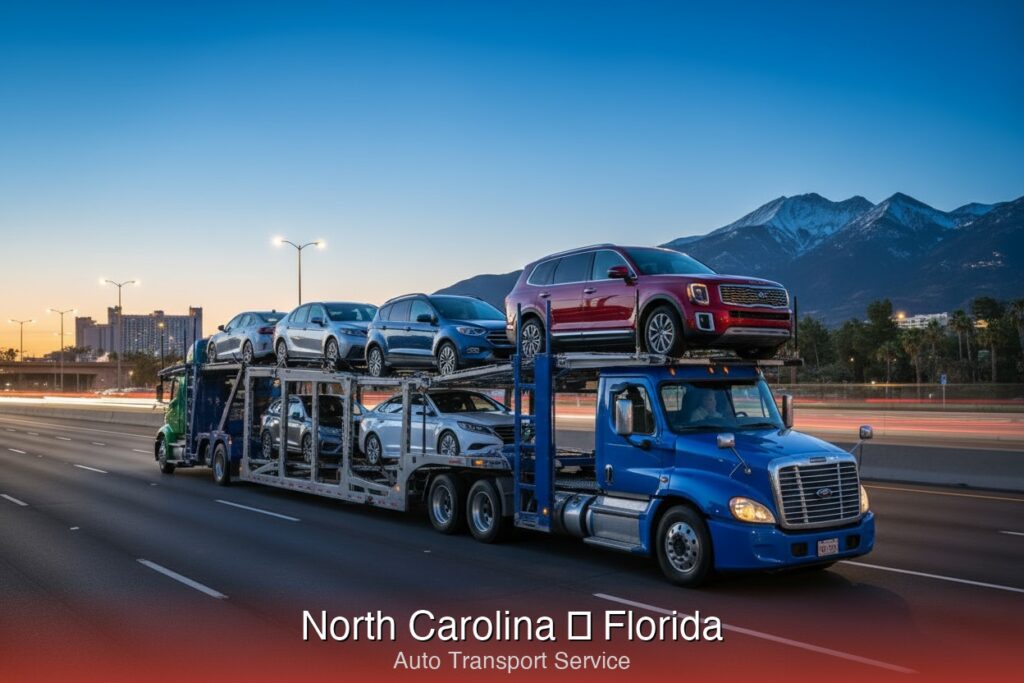
North Carolina to Florida Car Transport: What 550 Miles Really Costs
This is the page where we tell you that you should probably drive.
Charlotte to Jacksonville is about eight hours. Raleigh to Tampa is nine. Petrol for that distance comes to around $80, and there is no night in a hotel because there is no second day. Shipping the same car costs $450 to $600 and takes two to three days on the road plus a day or two to find a driver.
There are perfectly good reasons to ship a car 550 miles — you are moving two vehicles and can only drive one, you are flying in, the car is not something you want to add mileage to, somebody else is buying it. But “it will be cheaper than driving” is not one of them, and any company that lets you assume otherwise is not being straight with you.
If one of those reasons applies, the rest of this page is about doing it properly and about why a short route costs what it does.
Table of Contents
- What It Actually Costs: North Carolina to Florida Pricing
- City-to-City Price Breakdown
- How Long the Journey Takes
- Seasonal Pricing: When to Book
- Open vs. Enclosed Transport
- What a North Carolina to Florida Booking Looks Like
- The Complete Shipping Process
- 7 Mistakes That Cost You Money
- Vehicle Preparation Checklist
- Frequently Asked Questions
What It Actually Costs
North Carolina to Florida: $450 – $600
Open Transport | 500-650 Miles | 2-4 Days Transit
Enclosed is $750-$850. That works out at roughly $0.82-$0.92 per mile on open transport, which is among the highest per-mile figures on this site — and among the lowest total costs.
Why Both Things Are True
Arranging any shipment costs the same regardless of how far the car goes. Two appointments, two inspections, the loading and strapping, the paperwork, a dispatcher’s time. Across 2,500 miles those costs vanish into the rate. Across 550 they are most of what you are paying for.
This is also why the price does not fall much if your journey is shorter. Greensboro to Jacksonville and Charlotte to Tampa differ by 150 miles and about $25.
By Vehicle
A saloon or hatchback is $450-$550 open and $750-$850 enclosed. A crossover adds around $50, a pickup or seven-seater $50 more. Height drives it: nine slots are sold on a deck and a tall car intrudes on the one above.
Above $75,000 in value the range is $575-$650 open, reflecting the carrier’s exposure. Oversized vehicles run $600-$750 open and up to $1,150 enclosed, and on a short route those figures represent a much larger proportional jump than they would on a long one.
What Moves the Number
- Vehicle size: around $150, which is a third of the base and the biggest lever here
- Trailer type: about $300
- Lead time: $50-$75 inside a few days, less punishing than on long routes
- Which North Carolina city: about $75
- The month: $50-$75, which is remarkably little for an eastern lane
City-to-City Price Breakdown
Two parts of the state, two different roads south, and about $75 between them.
Charlotte and the West
Charlotte to Jacksonville is the floor at $450-$550 open, two to three days. Cars from here travel south on I-77 and I-26 toward Savannah, or on I-85 to Atlanta and then down I-75 — a different corridor entirely from the coastal one, with its own carrier population.
The Triangle and the East
Raleigh adds about $25 and sits close enough to I-95 to join the main north-south flow, which means Raleigh cars can be picked up by trailers already running from Virginia and further north. In October that is worth something: a Raleigh booking has more passing traffic to join than a Charlotte one.
Greensboro adds $50 and is the awkward one, sitting between the two corridors on I-40 rather than on either.
The Florida End
Jacksonville is the baseline and about as cheap as any Florida delivery gets — it is the first city a southbound truck reaches, so dropping a car there costs the driver almost nothing. Tampa adds $25 and needs a further four hours.
The realistic combined band is $450-$600 open and $750-$950 enclosed, at two to four days.
How Long the Journey Takes
Two to three days from Charlotte or Raleigh, three to four from Greensboro. Add a day or two for a driver to accept the load. Three to six days from booking to delivery.
Eight Hours of Driving, Three Days of Transit
This is the ratio that surprises people most on short routes, and it is not padding. Your car shares a trailer with eight others. Each has a collection address, a delivery address and a window, and those addresses are spread across several hundred miles at both ends.
A driver can cover 550 miles in a day easily. What they cannot do is collect nine cars, drive, and deliver nine cars in a day.
The Road
From the Triangle, south on I-95 through South Carolina, past Savannah and across the state line at Jacksonville. From Charlotte, either I-77 and I-26 to the coast or I-85 to Atlanta and down I-75.
Both are flat, low and open year-round. There is no weather on this corridor worth planning around, and no elevation at all.
What Does Cause Delay
Almost nothing on the road. The realistic variable is at the front end, in the wait for a carrier — and even that is modest here, because both the coastal and inland corridors carry steady traffic.
This is one of the more predictable routes we run. Ask for a window rather than a date all the same; nobody in the industry can commit to a single day, whatever the distance.
Seasonal Pricing: When to Book
North Carolina sits on the snowbird road but barely experiences the snowbird season, and the reason is distance.
The Peak Is Small Here
October and November add $50-$75. Compare that with $150-$250 out of New England and $200-$300 out of Minnesota. The mechanism everywhere is the empty return leg, and from North Carolina that leg is 550 miles rather than 1,500. There is simply much less of it to recover.
The Availability Question Is Different Too
A trailer arriving from the north in October is usually full, so a North Carolina car cannot always join the long-distance flow. But this route does not depend on that flow — there is enough regional traffic between the Carolinas and Florida that a shorter load is normally available.
You may find yourself on a trailer that started in Richmond rather than Boston. It makes no difference to you.
The Practical Advice
Book a week ahead in season, three or four days at any other time, and stop thinking about the month. On this route it is worth $50-$75, which is less than the difference between shipping a saloon and shipping a pickup.
Where the Season Does Show
In April, on the way back. A car heading north out of Florida in the spring is competing with the whole eastern seaboard returning at once, and that is the one window on this corridor where a booking can genuinely sit. If you are bringing a car home in April, give it a fortnight.
Route-specific planning
Planning to Ship a Vehicle?
Get a vehicle shipping quote based on your route, vehicle, and workable dates.
Get My Quote
Open vs. Enclosed Transport
About $300 divides them, which is the smallest gap on any eastern route we publish — and, against a $450 base, one of the largest proportionally.
Open decks are how every new car in the country reaches its showroom. Fewer than one shipment in a hundred picks up any damage at all, and the damage that does occur happens while the car is being manoeuvred rather than while it is travelling.
There Is No Environmental Case Here
Worth stating plainly, because on our northern routes there usually is one. This corridor is flat, low, salt-free and warm. A car on an open deck between Charlotte and Jacksonville in January is exposed to less than it would be sitting on a driveway at either end.
Whatever reason you have for choosing enclosed transport here is about the vehicle, and it should be argued on those terms.
Where It Is Genuinely the Right Call
- A front end low enough that getting up an open ramp is itself the problem
- A car the standard per-vehicle limit could not replace
- Factory paint no refinisher would match convincingly
- An insurer that has made covered transport a condition of cover
One observation on the arithmetic: because the premium is only $300 here, this is among the cheapest opportunities on the site to move a genuinely valuable car properly. Full comparison: open versus enclosed auto transport.
What a North Carolina to Florida Booking Looks Like
Five illustrations built from what this lane actually carries rather than from named customers. Prices come from the bands above; each makes one point.
A household moving two cars
Saloon shipped, SUV driven, Raleigh to Tampa in June. Around $500 for the shipped car. This is the commonest sensible reason to use this route: you cannot drive two vehicles at once, and the second one has to get there somehow.
A car sold at distance
Crossover sold privately, collected in Charlotte and delivered near Orlando. Open, around $550. The buyer never saw it before it arrived, which makes the delivery inspection the entire event — done slowly, with the seller’s photographs open on a phone.
A student car in August
Older compact, Greensboro to Gainesville, booked with a five-day collection window. Around $525. The wide window is what got it onto a trailer quickly; the month made almost no difference at all.
A car heading back north in April
Saloon, Tampa to Charlotte, in the middle of the spring return. Around $600, and it waited five days for a driver. This is the one window on this corridor where the season genuinely bites, and a fortnight’s notice would have removed it.
Somebody who should have driven
Saloon, Charlotte to Jacksonville, booked by a customer with a free day and no second vehicle. $500 to ship, against about $80 of fuel and eight hours behind the wheel. We said so at the time. Some people would still rather not spend the day, and that is a legitimate reason — but it should be the reason, not an accident.
The Complete Shipping Process
One carrier, kerb to kerb. Nothing is transferred and nothing waits in a yard.
Booking
We need both addresses, what the car is, and roughly when you want it moved. That goes to operators building southbound loads on whichever corridor serves you — the coastal one from the Triangle, the inland one from Charlotte. A driver normally takes it inside a day or two.
You will then have the company name, a number that reaches the cab, and a span of hours rather than a fixed time.
Collection
Before anything is loaded the driver walks the car with you and writes down the damage already on it. Photograph it yourself first, outdoors. Those frames and that form are together the record both sides are held to, and putting your name on it is what makes it agreed.
In transit
Two to four days, of which about eight hours is driving. Federal rules cap a driver at eleven hours behind the wheel inside a fourteen-hour window, and on a route this short almost all of the elapsed time is the other eight cars rather than the road. Phone the driver if you want to know where yours is.
Delivery
A second walk round, and legally this is the only one that decides anything. Do it in daylight against your own photographs, look along the bottoms of the doors and behind the bumpers, and get every difference written down before you sign. Sign it clean and there is nothing left to claim.
Step by step: how car shipping works, start to finish.
Vehicle Preparation Checklist
Twenty minutes on a route this short, and the bonnet stays shut.
- Photograph it outdoors before the driver arrives. Both sides, front and back, all four wheels, the roofline, the glass, then crouch for the sills.
- Wash it first. Road film swallows exactly the sort of light mark you are trying to put on record.
- A quarter of a tank. Enough to get up the ramp, back down and to a pump.
- Empty the cabin. Moving cars and moving belongings are separate permissions and this trailer holds only the first.
- Take any toll transponder off the screen. It reads perfectly well from a moving trailer.
- Fold the mirrors, drop the aerial, remove roof bars and bike racks. Anything protruding can catch on the car beside it.
- Mention the quirks — slow to start, a drip, a handbrake with a knack — before the driver finds them on a ramp.
- Check the tyres. It drives itself onto the trailer and off again.
Nothing on this route needs a seasonal variation, which is not something we can say about most corridors. Full checklist: preparing your vehicle for transport.
What Actually Costs You Money on This Lane
Shipping when driving would obviously do
Eight hours and about $80 of fuel, against $500 and a wait of several days. If you have the day free and no second car to move, drive it. Ship for a reason, not out of habit.
Judging the quote by the per-mile figure
It looks terrible and it means nothing. The cost of arranging a shipment does not shrink with distance, so short routes always price badly by the mile and well in absolute terms. Comparing $0.85 here with $0.60 on a transcontinental run is comparing two unrelated things.
Assuming a shorter journey will be much cheaper
Greensboro to Jacksonville and Charlotte to Tampa differ by 150 miles and about $25. Below a certain distance the overhead dominates and the mileage stops mattering.
Booking an April return at short notice
The one genuine seasonal squeeze on this corridor. A car heading north out of Florida in spring is competing with the whole eastern seaboard going home at once. Give it a fortnight.
Taking the lowest quote
A quote is a guess at what will tempt a driver and binds nobody until one accepts. Pitched under the going rate it simply sits, and on a short route where the margin is thin there is nothing for a driver to absorb.
Paying $300 for enclosed on a warm, flat, salt-free road
Justified for a low-clearance or genuinely valuable car. Not justified by the journey, which exposes the vehicle to nothing at all.
Signing the delivery paperwork without looking
Short route, same rule. An unqualified signature ends any claim permanently.
The general list is in why car shipping prices vary.
Frequently Asked Questions
What does it cost to ship a car from North Carolina to Florida?
$450-$600 open and $750-$850 enclosed for an ordinary car over 500 to 650 miles. That is roughly $0.82-$0.92 a mile.
Should I just drive it?
Probably, and we would rather say so. Charlotte to Jacksonville is about eight hours and around $80 of fuel, with no overnight stop. Ship if you are moving two cars, flying in, protecting the mileage, or selling the vehicle — not because you expect it to be cheaper.
Why is the per-mile rate so high?
Because arranging a shipment costs the same whatever the distance. Two appointments, two inspections, the loading, the paperwork and the dispatch are identical on any journey — on a long haul they disappear into the rate, on 550 miles they are most of it.
Would a shorter journey cost much less?
No. Greensboro to Jacksonville and Charlotte to Tampa are 150 miles apart and about $25 apart. Below a certain distance the overhead dominates.
How long does it take?
Two to three days from Charlotte or Raleigh, three to four from Greensboro, plus a day or two for a driver to accept the load.
Why does an eight-hour drive take three days?
Your car shares a trailer with eight others, each with its own collection and delivery address spread across several hundred miles at both ends. A driver can cover 550 miles easily; what they cannot do is collect nine cars, drive, and deliver nine cars inside a day.
Is October expensive here?
Barely — $50-$75, against $150-$250 out of New England. The premium everywhere comes from the empty return leg, and from North Carolina that leg is 550 miles rather than 1,500.
Is there any month I should avoid?
April, if you are shipping northbound. That is when the whole eastern seaboard brings its cars home at once, and it is the one window on this corridor where a booking can genuinely sit for days. Give it a fortnight.
Does it matter whether I am in Charlotte or Raleigh?
About $25, and they travel on different roads. Raleigh sits near I-95 and can join trailers already running down from Virginia; Charlotte cars go south on I-77 and I-26 or across to Atlanta. Greensboro is the awkward one, between the two corridors.
Does weather ever delay this route?
Effectively never. It is flat, low, warm and open all year, with no elevation on either corridor. This is one of the more predictable routes we run.
Is enclosed transport worth it?
Only if the car warrants it in its own right — the journey certainly does not. The premium is about $300, the smallest on any eastern route, which does make this a cheap opportunity to move something genuinely valuable properly.
Is my car insured in transit?
Yes, under the cargo cover every carrier is federally obliged to hold, from loading until it comes off. Ask what the certificate states per vehicle. Nothing in the trade insures a late arrival.
Is a short journey lower risk?
Less than people assume. The car is loaded and unloaded exactly as many times as on a 2,500-mile run, and loading is where damage actually happens. Give both inspections the same attention you would on a long haul.
Can I leave things in the car?
No. Moving vehicles and moving household goods are separate permissions, and this trailer holds only the first — so anything inside is uninsured and counts against a weight limit the driver answers for.
Ready to ship your car from North Carolina to Florida?
Get your free quote and see exactly what your route costs in 2026.
Related Guides
- everything that happens when you ship a car
- the pricing breakdown for car shipping
- the open and enclosed comparison
- what happens between booking and delivery
Related reading
One state further from Florida: Virginia to Florida shows where the seasonal squeeze starts to bite, and one state closer: Georgia to Florida takes the same logic further still.
Longer runs from the same state: North Carolina to Texas and California to North Carolina are where per-mile pricing starts to look sensible again.
On the mechanics: why per-mile pricing misleads on short routes, transit times by distance and what the carrier’s cover includes.