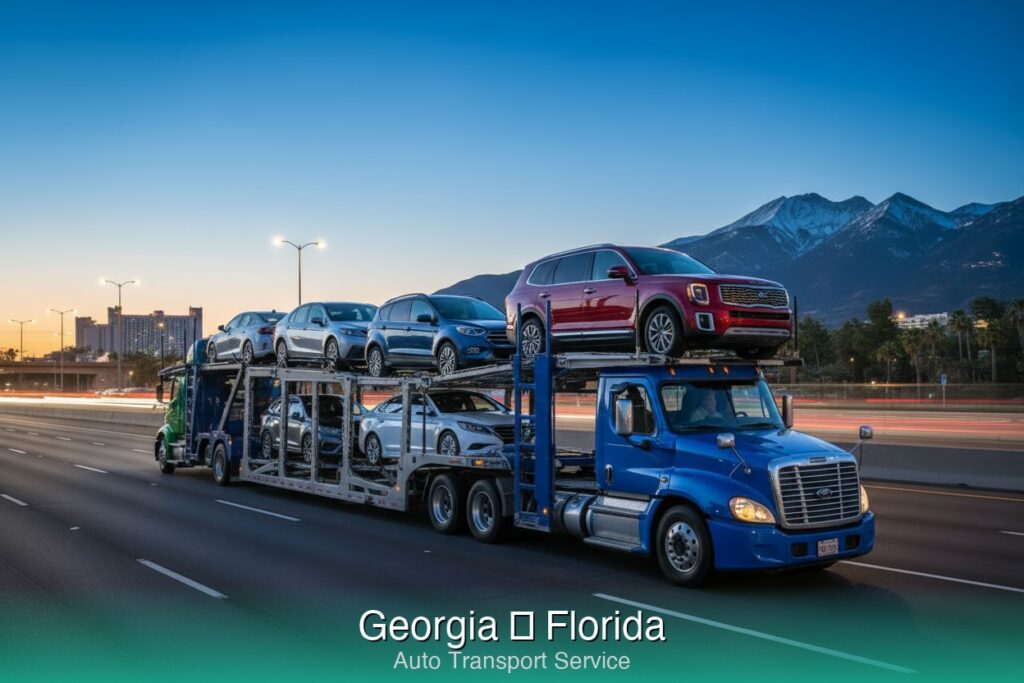
Georgia to Florida Car Transport: What 350 Miles Really Costs
Nearly every car being shipped from the Midwest to Florida passes through Atlanta. Ohio, Michigan, Indiana, Illinois, Tennessee, Kentucky — whichever road they start on, they converge on I-75 and travel down through the city.
If you live in Georgia, that is the traffic you are trying to join, and you are joining it at the point where it is thickest and moving slowest. In October a trailer coming through Atlanta has been loading since Cleveland and has nothing left to sell you.
There is a second complication and it compounds the first. At 350 miles this is barely a long-haul job at all. A driver who has come 900 miles from Detroit is not especially interested in a car that only needs to go another 350, because it occupies a slot that could have carried a vehicle paying twice as much for the same remaining distance.
The result is a route that is very cheap and occasionally quite difficult, and the difficulty is never about the money.
Table of Contents
- What It Actually Costs: Georgia to Florida Pricing
- City-to-City Price Breakdown
- How Long the Journey Takes
- Seasonal Pricing: When to Book
- Open vs. Enclosed Transport
- What a Georgia to Florida Booking Looks Like
- The Complete Shipping Process
- 7 Mistakes That Cost You Money
- Vehicle Preparation Checklist
- Frequently Asked Questions
What It Actually Costs
Georgia to Florida: $350 – $525
Open Transport | 300-450 Miles | 2-4 Days Transit
Enclosed is $600-$700. At roughly $1.00-$1.17 per mile this is the second-dearest route on the site by that measure, and one of the two or three cheapest in absolute terms.
The Floor, and Why It Exists
Around $350 is about as low as any vehicle shipment goes, whatever the distance. Two appointments, two inspections, loading, paperwork and dispatch cost the same on a 300-mile job as on a 3,000-mile one, and below a certain price nobody covers those costs at all.
Atlanta to Tampa is 300 miles and Augusta to Jacksonville is 450. The gap between them is $50. On this route mileage is close to irrelevant.
By Vehicle
A saloon or hatchback runs $350-$450 open and $600-$700 enclosed. A crossover adds around $50 and a pickup or seven-seater $50 more — proportionally a much bigger step here than on a long route, because the base is so small.
Above $75,000 in value the range is $475-$550 open. Oversized vehicles are $500-$650 open and up to $1,000 enclosed, and on a short lane an oversized booking narrows the field of interested drivers considerably.
What Moves the Number
- Vehicle size: around $150, which is nearly half the base price
- Trailer type: about $250
- Whether you can offer a wide collection window: nothing in money, and the most valuable thing you have
- Lead time: $50 or so, though in October it buys availability rather than price
- Which Georgia city: about $75
- The month: $50, which is almost nothing
City-to-City Price Breakdown
Georgia’s pricing has less to do with distance than almost any state we cover.
Atlanta
Atlanta to Jacksonville is $350-$450 open, two to three days; to Tampa, $375-$475. It is the floor for the state, and the reason is volume rather than proximity — Atlanta is where the trucks are, so it is where the loads are easiest to fill.
The city is also, for a driver, one of the more time-expensive places in the country to work. Offer a morning collection and you will find carriers noticeably more willing.
Savannah and the Coast
Savannah adds about $25 and sits directly on I-95, which is a genuine advantage: coastal cars can join trailers running down from the Carolinas and Virginia rather than competing for space on the I-75 flow through Atlanta.
In October that matters. A Savannah booking has a second stream of traffic available to it; an Atlanta booking has one, and it is the busiest one in the country.
Augusta and Inland
Augusta adds $50 and a day. It sits between the two corridors on I-20, near neither, so a carrier collecting there is leaving a route to do it.
The Florida End
Jacksonville is as cheap as Florida deliveries get — it is the first city over the line and costs a driver almost nothing. Tampa adds $25 and four more hours.
The realistic combined band is $350-$525 open and $600-$800 enclosed, at two to four days.
How Long the Journey Takes
Two to three days from Atlanta or Savannah, three to four from Augusta. The wait for a driver is the variable part, and it is longer here than the distance would ever suggest.
Why Assignment Can Be Slow on a Short Route
A trailer has nine slots and a driver is trying to earn as much as possible from each of them. A car going 350 miles pays less than a car going 1,300 miles occupying the same slot for the same remaining stretch of road, so on a busy corridor your load is competing against better-paying alternatives rather than against nothing.
In quiet months this is invisible — there are slots to spare and yours gets taken. In October, when every trailer through Atlanta is already full of Midwestern cars, it is the whole problem.
What Helps
A wide collection window, more than anything else. A driver who can fit you in on whichever day suits their route will do so; a driver who has to be at your address next Tuesday will decline. On this route flexibility is worth considerably more than money, because there is not enough money involved for money to be persuasive.
The Road Itself
South on I-75 through Macon and Valdosta into Florida near Lake City, or down I-95 from Savannah. Both flat, low and open all year. The drive is five hours and it is never the problem.
Three to six days from booking to delivery, wider in the autumn. Ask for a range of dates rather than one.
Seasonal Pricing: When to Book
The season barely touches the price on this route and can dominate everything else about it.
What October Costs You
About $50. From Georgia the empty return leg is 350 miles, so there is almost nothing for a carrier to recover, and the rate stays where it was.
If you have read our pages on the northern states you will have seen premiums of $150 to $300. None of that applies here. You are not paying for the season.
What October Does Cost You
Space, and sometimes a week of it. Every trailer coming down I-75 through Atlanta in the autumn has been loading since Ohio or Michigan and arrives with nothing to sell. Your booking is not too cheap and nobody is ignoring it — there is simply no room on the vehicles going past.
This is the same problem Virginia has on the eastern corridor, and it is sharper here because the distance is shorter and the competing loads are worth more.
What To Do
Book two to three weeks ahead for an October or November move, and offer the widest collection window you can live with. Both are free. Raising the price is not an effective substitute for either, because the constraint is physical rather than financial.
The Rest of the Year
Straightforward. February through September a few days’ notice is usually enough, and the route is among the least troublesome we run. April northbound is the one other week to plan around, when the whole flow reverses at once.
Route-specific planning
Planning to Ship a Vehicle?
Get a vehicle shipping quote based on your route, vehicle, and workable dates.
Get My Quote
Open vs. Enclosed Transport
Roughly $250 between them — the smallest absolute gap of any route we publish, and against a $350 base, easily the largest proportionally. Choosing enclosed here is close to doubling the bill.
Open decks are how every new car in the country reaches its showroom. Under one shipment in a hundred picks up damage of any kind, and what damage occurs happens during manoeuvring rather than on the road.
Nothing About This Journey Argues For It
Five hours, flat, warm, no salt, no altitude, no coastal exposure worth mentioning. A car on an open deck from Atlanta to Jacksonville encounters less than it would parked outside at either end.
If a company recommends enclosed transport on this corridor for reasons of weather or road conditions, they are describing a route that does not exist.
The Availability Point
Enclosed trailers are scarcer than open ones everywhere, and on a short lane where your load already competes poorly for slots, an enclosed booking is a small pool inside a small pool. In October it can wait a fortnight. If the car needs it, book well ahead.
When It Is Genuinely Right
- A front end low enough that the open ramp is itself the obstacle
- A car the standard per-vehicle limit could not replace
- Factory paint that no refinisher would match
- An insurer who has made covered carriage a condition
Full comparison: open versus enclosed auto transport.
What a Georgia to Florida Booking Looks Like
Five illustrations built from what this lane carries rather than from named customers, priced from the ranges above. Each makes one point.
A March booking with a wide window
Saloon, Atlanta to Jacksonville, offered as a five-day collection window. Around $400, claimed the next day, delivered on the third. This is the route behaving normally, which it does for most of the year.
The same booking in late October, pinned to a date
Same car, same addresses, but the customer needed collection on a specific Thursday. Around $425 — barely more — and it sat six days before a driver could fit it in. The price was never the problem. The Thursday was.
A Savannah collection in the same week
Crossover, Savannah to Tampa, booked eight days ahead in October. Around $475, assigned in two days. Being on I-95 rather than I-75 meant a second stream of traffic was available — and in the autumn that is worth more than the $25 premium the coast usually carries.
A dealer transfer
Saloon moved between dealerships, Augusta to Orlando. Open, around $500. Trade moves like this are a large share of what this corridor actually carries, and they are easy precisely because the dealer never insists on a particular day.
Somebody who drove instead
Atlanta to Jacksonville is five hours and about $55 of fuel. A customer with a free afternoon and no second vehicle to move worked that out and cancelled, which was the right call. We mention it because on a route this short it frequently is.
The Complete Shipping Process
The car stays on one trailer throughout. Nothing is transferred and nothing sits in a compound.
Getting it booked
Give us the two addresses, the vehicle, and the dates you can work with — and on this route, be as generous with the dates as you possibly can. The load then circulates among drivers running south, and the width of your window is what decides how quickly one of them can accommodate it.
Once claimed you will know the operator, have a number for the cab, and be offered a stretch of hours rather than an appointment.
Loading
The driver goes round the car with you and notes whatever damage is already there onto the Bill of Lading. Take your own photographs before that begins, outdoors. The form and your frames together are the record both parties are held to, and your signature is what makes it agreed.
In Atlanta, expect drivers to prefer early morning. Their day is measured in hours they cannot get back and the city takes a lot of them.
On the road
Two to four days for five hours of driving. Regulations cap a driver at eleven hours at the wheel inside a fourteen-hour window, and on a route this short essentially all the elapsed time is the other eight cars rather than the journey. Ring the driver rather than watching a map.
Arrival
A second walk round, and legally the only one that decides anything. Do it in daylight against your own photographs, check the lower door edges and behind the bumpers, and write down every difference before you sign. Sign it clean and there is nothing further to claim.
Step by step: how car shipping works, start to finish.
Vehicle Preparation Checklist
Twenty minutes, and no tools.
- Photograph it outside before the driver arrives. Each side, front and rear, all four wheels, the roofline, the glass, and a low shot along the sills.
- Wash it first. A film of road dirt hides exactly the sort of small mark you are photographing to record.
- A quarter of a tank. Enough to get up the ramp, back down and as far as a pump.
- Empty the interior completely. Carrying cars and carrying belongings are separate permissions, and this trailer only holds the first.
- Take the Peach Pass off the screen. It reads perfectly well from a moving trailer, right down the interstate.
- Fold the mirrors, drop the aerial, remove roof bars and bike racks. Cars sit close together and anything protruding can catch.
- Say what is temperamental — slow to catch, a drip, an awkward handbrake — before the driver meets it on a ramp.
- Check the tyres. It has to drive itself onto the trailer and off again.
If you are handing over at a car park rather than at home, get the photographs done there in daylight rather than in a garage the night before. Full checklist: preparing your vehicle for transport.
What Actually Costs You Money on This Lane
Insisting on a specific collection day in October
The defining mistake here. Trailers coming through Atlanta in the autumn arrive full, and the only way onto one is to be available whenever a slot appears. A three or five-day window costs you nothing and is worth more than any amount of money on this route.
Raising the price to fix a waiting problem
It does not work, because the constraint is space rather than money. A full trailer cannot take your car at any rate, and $50 more will not create a slot that does not exist.
Judging the quote per mile
At $1.00-$1.17 a mile this looks like the most expensive route on the site. In absolute terms it is one of the cheapest. The fixed cost of arranging any shipment does not shrink with distance, and comparing this against a transcontinental rate is comparing unlike things.
Expecting a shorter journey to cost much less
Atlanta to Tampa is 300 miles, Augusta to Jacksonville is 450, and $50 separates them. Below a certain distance the overhead is the price.
Offering an afternoon collection in Atlanta
The city consumes hours a driver cannot recover from a legally capped day. A morning slot makes your load noticeably more attractive, and it is free.
Booking enclosed at short notice
Scarce trailers on a lane where your load already competes poorly for slots. If the car genuinely needs it, book a fortnight ahead rather than a few days.
Signing the delivery paperwork without looking
The journey may be short but the car was loaded and unloaded exactly as many times as on a long one, and loading is where damage happens. An unqualified signature ends any claim.
The general list is in why car shipping prices vary.
Frequently Asked Questions
What does it cost to ship a car from Georgia to Florida?
$350-$525 open and $600-$700 enclosed for an ordinary car over 300 to 450 miles. In absolute terms it is one of the cheapest shipments we handle.
Why is the per-mile figure so high?
Because arranging any shipment costs the same regardless of distance. Two appointments, two inspections, loading, paperwork and dispatch are identical on a 300-mile job and a 3,000-mile one. On this route they are essentially the whole price.
Is there a minimum?
Effectively, around $350. Below that nobody covers the cost of arranging the work, which is why Atlanta to Tampa at 300 miles and Augusta to Jacksonville at 450 are only $50 apart.
Why did my booking sit for a week in October?
Because every trailer coming down I-75 through Atlanta in the autumn has been loading since Ohio or Michigan and arrives full. It is not a pricing problem and nobody is ignoring you — there is no space on the vehicles going past.
Would paying more have helped?
Not much. A full trailer cannot take your car at any rate. What helps is a wider collection window and more notice, and both are free.
Why is a short load less attractive to a driver?
A trailer has nine slots and each one earns whatever is put in it. A car going 350 miles pays less than a car going 1,300 miles occupying the same slot on the same stretch of road. In quiet months there are slots to spare; in October there are not.
Does Savannah behave differently from Atlanta?
Yes, and usefully so. Savannah is on I-95 and can join trailers running down from the Carolinas and Virginia, so it has a second stream of traffic available. In the autumn that is worth more than the $25 the coast normally costs.
How long does it take?
Two to three days from Atlanta or Savannah, three to four from Augusta, plus the wait for a driver. Three to six days from booking to delivery, wider in autumn.
What does the season cost?
About $50, which is almost nothing. The empty return leg from Georgia is 350 miles, so there is very little for a carrier to recover. You are not paying for the season here — you are waiting for it.
When should I book?
Two to three weeks ahead for October or November, and a few days at any other time. April northbound is the other window worth planning around, when the whole flow reverses at once.
Should I just drive it?
Atlanta to Jacksonville is five hours and around $55 of fuel, against $400 to ship and several days of waiting. If you have the afternoon and only one car to move, drive it. Ship because you are moving two vehicles, flying in, or selling the car.
Is enclosed transport worth it here?
The journey gives you no reason at all — five hours of flat, warm, salt-free road. Choose it only for the vehicle, and if you do, book well ahead: enclosed trailers are scarce and this lane already competes poorly for slots.
Is a short trip lower risk?
Less than people assume. The car is loaded and unloaded exactly as many times as on a transcontinental run, and loading is where damage actually happens. Both inspections deserve full attention.
Can I leave things in the car?
No. Moving vehicles and moving household goods are different permissions and this trailer holds only the first, so anything inside is uninsured and adds weight the driver answers for.
Ready to ship your car from Georgia to Florida?
Get your free quote and see exactly what your route costs in 2026.
Before You Book
- how auto transport is priced
- open versus enclosed carriers
- how your car gets collected and delivered
- our overview of the whole process
Related reading
The traffic you are trying to join comes from here: Ohio to Florida and Michigan to Florida are the loads already aboard when a trailer reaches Atlanta.
The same problem on the other corridor: Virginia to Florida is a mid-route pickup on I-95, and North Carolina to Florida sits one state further along.
On the mechanics: why per-mile pricing misleads on short routes, how snowbird season sets auto transport prices and what the carrier’s cover includes.