A large share of the cars moving from Oregon to California were bought in Oregon on purpose.
Oregon has no general sales tax. California does, and it also levies use tax on a vehicle brought into the state for use there — with the Department of Tax and Fee Administration treating a car brought in within twelve months of purchase as presumptively subject to it. People buy in Portland believing they have saved several thousand dollars, ship the car south, and find out at registration that the saving was a deferral.
We are a transport company and not your accountant, so take the detail up with the CDTFA or the DMV before you buy rather than after. But it is the single most consequential thing about this particular route and almost nobody mentions it, so it belongs at the top of the page rather than buried in a footnote.
The shipping itself is straightforward: 640 miles, two to three days, one interstate and one mountain pass. What follows is what it costs and what to watch.
- What It Actually Costs
- City-to-City Price Breakdown
- How Long the Journey Takes
- Seasonal Pricing: When to Book
- Open vs. Enclosed Transport
- What an Oregon to California Booking Looks Like
- The Complete Shipping Process
- Vehicle Preparation Checklist
- 7 Mistakes That Cost You Money
- Insurance and Liability Explained
- Frequently Asked Questions
What It Actually Costs
Oregon to California: $450 – $600
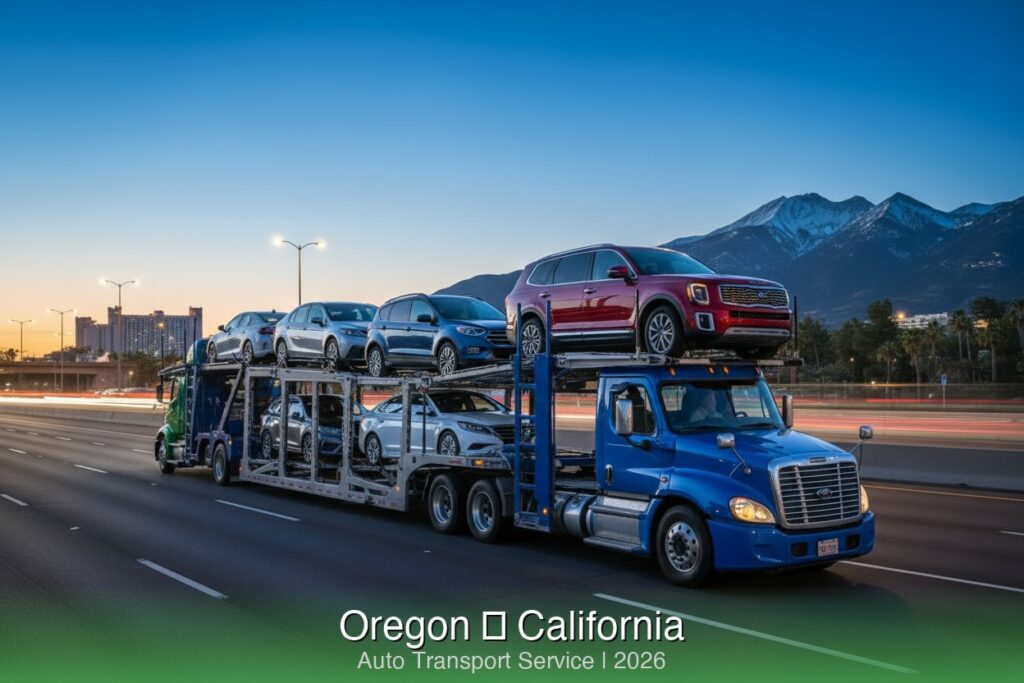
Open Transport | 640-760 Miles | 2-4 Days Transit
Enclosed runs $750-$850. On open transport that is roughly $0.70-$0.79 a mile, which is what short routes cost — the fixed overhead of a shipment never shrinks with distance, so it stays visible in the rate.
Set It Against What You Are Moving
On a route defined by out-of-state purchases, the transport cost is worth putting in proportion. Five hundred dollars against the price of a car is small; it is also small against whatever use tax turns out to be due. Choosing a carrier on price alone, on a run this cheap, is optimising the least significant number in the transaction.
By Vehicle
The floor is $450-$525 open and $750-$850 enclosed, for a saloon or hatchback. Add about $50 for a crossover and $50 to $125 again for a pickup or seven-seater. Height is what drives it: a trailer sells nine positions, and a tall vehicle encroaches on the one above.
Above $75,000 in value the band moves to $575-$700 open, which is the hauler’s exposure rather than anything about the car on a deck. Oversized vehicles run $650-$800 open and up to $1,200 enclosed, since the top deck is often the only place they fit.
What Moves the Number
- Whether you are on I-5 or east of the Cascades: $50-$75 and a day
- Lead time: $75-$100 inside five days
- Vehicle size: about $200 across the standard range
- Trailer type: roughly $300 for enclosed, the smallest premium on the site
- Summer: $75-$125 during the national relocation peak
- Which California city: about $25, running opposite to distance
City-to-City Price Breakdown
Oregon’s cities line up along one road, and the pricing follows that line almost exactly.
Down the Willamette Valley
Portland to Los Angeles is the floor at $450-$550 open, two to three days. Salem and Eugene add about $25-$50 apiece and are, if anything, slightly easier collections — both sit directly on I-5 with straightforward access, and a driver heading south picks them up without leaving the road.
Around three quarters of what leaves this state southbound comes out of that valley, and the concentration is why assignment here rarely takes more than a day or two.
East of the Range
Bend adds $50 and a day. It is on the far side of the Cascades, and a car collected there either comes back over a pass to reach I-5 or goes south on US-97 through a much thinner freight corridor. Either way it is a dedicated trip rather than a stop, and it needs more notice than a valley collection.
The California End
San Francisco is forty miles nearer than Los Angeles and costs about $25 more, which is access rather than mileage — city streets and bridges against the wide industrial approaches of the LA basin. Sacramento, if that is your destination, is cheaper than both and often a day quicker.
The realistic combined band is $450-$600 open and $750-$975 enclosed, at two to four days.
How Long the Journey Takes
Two to three days from the valley, three to four from Bend. Add one to two days for a carrier to accept the load. Three to six days from booking to delivery is the honest span.
Ten Hours of Driving, Three Days of Logistics
The drive from Portland to Los Angeles is about ten hours. That the shipment takes two to three days is not slack in the schedule — it is the eight other cars on the trailer, each with its own collection address, its own delivery address and its own window, spread across two states at either end.
On a short route that ratio is stark, and it is the thing most people are surprised by. Nothing about it indicates a problem.
The Pass
I-5 crosses the Siskiyou Summit at roughly 4,310 feet just before the California line, and every car on this route goes over it. In winter it draws chain restrictions and occasionally closes, and because there is no truck-viable alternative on the West Coast, a closure means waiting rather than diverting.
Practically, that is a day at most and it never affects the price. Carriers plan around weather rather than surcharging for it.
What to Ask For
A window, not a date. Nobody in this industry can guarantee a delivery day, and on a route with a mountain crossing and a two-to-three-day baseline, an operator offering one is telling you something about how they handle expectations.
Seasonal Pricing: When to Book
There is no snowbird cycle on the West Coast, so this is one of the flattest calendars we publish. The variation that does exist comes from two unrelated sources.
Summer Relocation
June through August adds $75-$125. It is the national moving season rather than anything regional, and it affects availability about as much as price — a booking made four days out in July is competing with the whole country.
February through April is cheapest, with September and October close behind.
The Pass, Again
November to March is when the Siskiyou can hold a truck up. It rarely costs money and it rarely costs more than a day, but with no alternative road available it is a wait rather than a re-route, and a winter booking wants two days of slack at the delivery end.
Where the Two Line Up
April is cheap and reliably clear, which makes it the best month on this route by both measures. September and October are nearly as good. February is inexpensive but occasionally slow; if your dates are fixed rather than flexible, that is the month to avoid.
One Timing Note Specific to Buyers
If the car was bought in Oregon and you are thinking about the twelve-month presumption on the California side, the date the vehicle enters the state is a date you may care about for reasons unrelated to price. Work out what you need before you book a collection window, not afterwards, and confirm the position with the tax authority rather than with us.
Route-specific planning
Planning to Ship a Vehicle?
Get a vehicle shipping quote based on your route, vehicle, and workable dates.
Get My Quote
Open vs. Enclosed Transport
About $300 apart, which is the narrowest enclosed premium on any route we publish — purely a function of how short the journey is.
Open carriers are the trucks that deliver new stock to dealerships. Under one per cent of shipped vehicles sustain any damage, and where it happens it is almost always at a ramp rather than on the road.
Why This Route Is Worth Thinking About Differently
On most corridors the enclosed premium is $400 to $600 and the decision is genuinely finely balanced. Here it is $300 on a car you may have just bought sight-unseen from a private seller several hundred miles away.
If the vehicle is worth protecting at all, this is among the cheapest opportunities on the site to do it properly. That is not an upsell so much as an observation about the arithmetic.
Reasons That Justify It
- Ride height low enough that the approach angle onto an open deck becomes a problem
- A replacement cost the open carrier’s per-unit limit would not meet
- Bodywork carrying its original finish, where a repaint would be visible
- Cover written on the condition that the car travels enclosed
For an everyday car outside winter, open transport is the right answer and the $300 buys nothing you need. Full comparison: open versus enclosed auto transport.
What an Oregon to California Booking Looks Like
Five illustrations, assembled from what this lane actually carries rather than from any individual booking. The figures come from the ranges above; each isolates one thing that moved the price.
A car bought in Portland
Saloon purchased from a Portland dealer, delivered to a residential address in Sacramento. Open, around $475. The buyer had never seen the car, so the delivery inspection was the only one they attended — which makes it the whole event, and worth doing at length with the seller’s photographs on a phone.
A relocation in July
Crossover, Eugene to Los Angeles, booked six days out at the height of the moving season. Around $600. Most of the premium over a February booking is the month; a fortnight of notice would have taken $75 off it.
A February crossing
Saloon, Salem to San Francisco, booked with a four-day delivery window. Around $525. Chain controls on the Siskiyou held the driver overnight and delivery landed on the fourth day — inside the window, and the reason the window was drawn that way.
A collection in Bend
Pickup, Bend to San Diego, booked twelve days ahead. Around $675. The vehicle size and the trip across the Cascades account for most of that; the notice is what stopped it becoming a scheduling problem.
A valuable car moved enclosed
Low-mileage sports car, Portland to a Los Angeles collection, booked ten days out. Enclosed, around $800. On a transcontinental route the same decision would have cost several hundred more; the short distance is what makes proper transport affordable here.
The Complete Shipping Process
One carrier handles the car end to end. Nothing is transferred and nothing sits in a yard.
Booking and assignment
You give both addresses, the vehicle and a date window, and the load goes out to carriers building southbound trailers. From the Willamette Valley that is normally one to two days. From Bend it takes longer, because the collection is a dedicated trip rather than a stop on the way.
Once a driver takes it you are told which company, given a direct number, and offered a span of hours rather than an appointment.
Collection
The driver walks the car with you and every existing chip and scuff is logged on the Bill of Lading. Do your own photography first, in good light. Those frames and that sheet are jointly the evidence of how the car looked when it left, and signing means you have accepted the sheet as accurate.
On a purchased car this step is often handled by the seller or the dealership, which is fine — but ask them to send you their photographs on the day, because otherwise your side of the record starts at delivery.
In transit
Two to four days, of which around ten hours is driving. Federal rules cap a driver at eleven hours behind the wheel inside a fourteen-hour window, and much of the fourteen goes on loading, unloading and reaching the next address.
Delivery
There is a second inspection and it is the one that counts. Work through the car in daylight with your departure photographs open, crouch far enough to check the lower edges and the front apron, and record every discrepancy on the sheet before your name goes anywhere near it. An unqualified signature ends your recourse.
Step by step: how car shipping works, start to finish.
Vehicle Preparation Checklist
Thirty minutes, and tools barely come into it.
- Shoot the car outside on the morning it goes. Panel by panel, then the wheels, both ends, the roofline, the glass, and the sills from low down.
- Clean it first. Grime flattens a photograph, and a dent obvious on clean paint vanishes on dirty paint.
- Fuel down to about a quarter. Enough for loading, unloading and the run to a pump; beyond that you are paying to haul petrol.
- Strip the interior. Vehicle haulage and household goods fall under different licences, and nothing left inside is covered by the one this truck holds.
- Fold the mirrors, drop the aerial, take off roof bars, bike racks and ski boxes. Anything that projects is something that can catch.
- Flag anything temperamental in advance — a drip, a tired battery, a knack to the ignition.
- Check the tyres. The car has to drive on and off under its own power at both ends.
If you are shipping a car you have just bought and cannot get to it yourself, ask the seller to do the photographs and send them the same day. It costs them five minutes and it is the only version of this list that matters. Full checklist: preparing your vehicle for transport.
What Actually Costs You Money on This Lane
Budgeting the sales-tax saving before checking the use tax
By a very wide margin the most expensive mistake associated with this route, and it has nothing to do with shipping. California levies use tax on vehicles brought in for use there, with a twelve-month presumption applied to recent purchases. Confirm your position with the CDTFA or the DMV before you buy. A few hundred dollars of transport is not the number that will surprise you.
Not getting collection photographs on a bought car
If a seller or dealer hands the car over on your behalf and nobody photographs it, your record of its condition begins at delivery — which means any damage claim starts from a position you cannot support. Ask for pictures on the day. It is free.
Booking a hard delivery date in winter
One road, one 4,310-foot pass, and no alternative to divert onto. Two days of slack costs nothing; a rebooked flight does not.
Treating Bend as a valley collection
It is across the Cascades on a thinner corridor, and picking up there is a dedicated trip. Give it a fortnight rather than a few days.
Choosing a carrier on a $50 difference
On a $500 shipment attached to a car worth many times that, the transport quote is the least significant figure in the transaction. An underpriced load also goes unclaimed, which is how a $50 saving turns into a week of waiting.
Signing the delivery sheet without looking
The most expensive minute of the process. An unqualified signature ends the matter for good.
Leaving belongings in the car
Insured by nobody, and the weight counts against an allowance the driver is inspected against.
The general list is in why car shipping prices vary.
Insurance and Liability Explained
Cover comes from the hauling company. Federal law obliges every carrier we dispatch to hold cargo insurance, and it runs for as long as your car is on the deck. Nothing is sold to you separately.
What it covers
Physical damage on the road and at the ramps. What varies between operators is the ceiling per vehicle, so ask to see the figure rather than assume it — and if the car is worth more than the limit, that is a concrete reason to look at enclosed transport, where the ceilings are generally higher and, on this route, only $300 away.
What it does not
A slow delivery, including one caused by a closed pass. No policy in this industry insures time. Belongings left in the vehicle are outside it too, since the carrier’s authority does not extend to freight.
The point that matters most on a purchased car
A claim is settled on two documents: the Bill of Lading signed at collection and the one signed at delivery. The carrier answers for the difference between them.
If you were not present at collection, that first document was signed by somebody with no stake in the outcome, and it is the only baseline you have. Get a copy of it, and get the seller’s photographs, before the truck leaves. Full detail: car shipping insurance and liability.
Frequently Asked Questions
How much does it cost to ship a car from Oregon to California?
$450-$600 open and $750-$850 enclosed for a standard vehicle over 640 to 760 miles — about $0.70-$0.79 a mile.
I bought the car in Oregon to avoid sales tax. Does that work?
Not straightforwardly. California charges use tax on vehicles brought into the state for use there, and its tax authority applies a twelve-month presumption to recent purchases. We are a transport company rather than a tax adviser, so check the position with the CDTFA or the DMV before buying — but treat the saving as uncertain until you have.
How long does it take?
Two to three days from the Willamette Valley, three to four from Bend, plus one to two days for a carrier to accept the load.
Why does a ten-hour drive take two to three days?
Because the trailer is carrying eight other cars, each with a collection address, a delivery address and a window, spread across two states. On a route this short the driving is the small part of the elapsed time.
Does the Siskiyou Pass cause problems?
Occasionally, between November and March. I-5 crosses it at about 4,310 feet and every car on this route goes over it. Because there is no truck-viable alternative, a closure means a wait rather than a detour — usually a day, and never a surcharge.
When is the best month to ship?
April. Cheap, and the pass is reliably clear by then. September and October are close behind. February is inexpensive but occasionally slow.
Why does Bend cost more?
It is east of the Cascades on a thinner corridor, so collecting there is a dedicated trip rather than a stop on a southbound run. Expect $50 more, a day longer, and give it a fortnight’s notice.
Why is San Francisco dearer than Los Angeles when it is closer?
Access rather than distance — city streets and bridges a full-size rig would rather not meet, against the wide industrial approaches of the LA basin. About $25 between them. Sacramento is cheaper than either and often a day quicker.
I am buying a car I have not seen. What should I insist on?
Photographs from the seller on the day of collection, and a copy of the signed collection Bill of Lading. Without them your record of the car’s condition begins at delivery, which is a position no damage claim can be argued from.
Is enclosed transport worth it here?
The premium is about $300, the narrowest on any route we publish, because the journey is short. For an everyday car outside winter it buys nothing. For anything genuinely valuable it is the cheapest chance on this site to move it properly.
Should I just drive it?
About ten hours, so one long day. Fuel, a meal and 640 miles of wear come to roughly $250-$300, against $450-$550 to ship plus a flight home. Driving wins on cost. It stops winning if you are buying the car remotely and would have to fly up first.
Is my car insured in transit?
It is, through the cargo cover federal law obliges the hauling company to carry, running for as long as the car is on the deck. Ask for the per-vehicle ceiling on the certificate. A slow delivery falls outside every such policy.
Can I pack things in the car?
You should not. Vehicle haulage and household goods are separately licensed, so a packed boot is insured by nobody and its weight eats into an allowance the driver is inspected against.
Ready to ship your car from Oregon to California?
Get your free instant quote and see exactly what your route costs in 2026.
Useful Background Reading
- how car shipping actually works
- the pricing breakdown for car shipping
- comparing the two carrier types
- the shipping process, step by step
Related reading
The same road, longer: Washington to California starts one state north and crosses the same pass, and Oregon to Arizona leaves I-5 partway down.
Other short western runs: Nevada to California is shorter still and priced by a different part of the industry, and Arizona to California approaches the state from the east.
On the mechanics: getting an accurate quote, what the carrier’s cover includes and open versus enclosed.