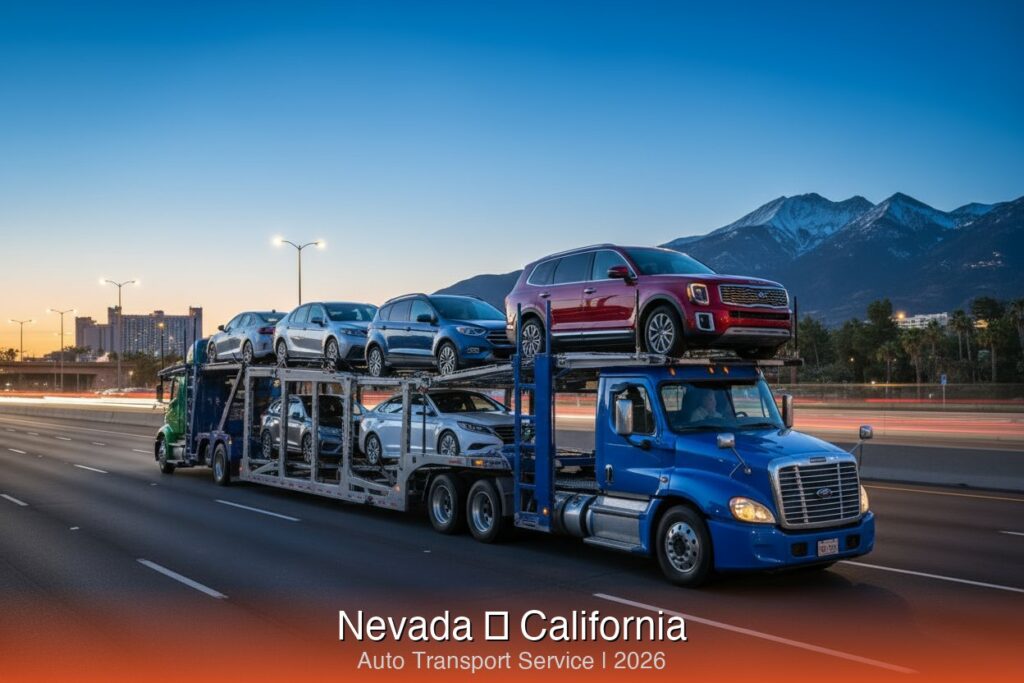
At 270 miles, Las Vegas to Los Angeles is the shortest route on this site and the most expensive per mile on it. Around $1.10 to $1.50 a mile, against roughly $0.60 on a transcontinental run.
That is not a markup. It is what happens when a journey is too short for the fixed costs of a shipment to be spread across anything. Two appointments, two inspections, the loading and strapping, the paperwork and the dispatcher’s time are identical whether the car goes 270 miles or 2,700. On the long run they vanish into the rate. On this one they are most of it.
The more useful consequence is that this route is not really served by the same industry as the rest of the site. A nine-car interstate trailer is built for long hauls; at 270 miles you are often looking at smaller operators, single-car carriers and drivers repositioning between the two cities. It is a different market with different economics, and it explains almost everything about how this booking behaves.
- What It Actually Costs
- City-to-City Price Breakdown
- How Long the Journey Takes
- Seasonal Pricing: When to Book
- Open vs. Enclosed Transport
- What a Nevada to California Booking Looks Like
- The Complete Shipping Process
- Vehicle Preparation Checklist
- 7 Mistakes That Cost You Money
- Insurance and Liability Explained
- Frequently Asked Questions
What It Actually Costs
Nevada to California: $300 – $450
Open Transport | 230-430 Miles | 1-3 Days Transit
Enclosed runs $500-$600. In absolute terms this is the cheapest shipment we handle; in per-mile terms it is the dearest. Both statements describe the same fixed-cost arithmetic from opposite ends.
Why the Floor Exists
There is a price below which nobody will move a car at all, regardless of distance, because the overhead does not go away. That floor sits around $300, and it is why shortening the journey further would barely reduce the quote. A 100-mile move and a 270-mile move cost roughly the same to arrange.
Which is worth knowing if you are comparing this against driving it yourself. On this route the honest answer is often that you should drive.
By Vehicle
The floor is $300-$375 open and $500-$600 enclosed for a saloon or hatchback. A crossover adds about $50 and a pickup or seven-seater $50 to $75 again. The proportions are larger here than on a long route, because a fixed increment against a small base is a bigger share of it.
Above $75,000 in value the band moves to $425-$500 open. Oversized vehicles run $450-$600 open and up to $900 enclosed, and on a route served partly by smaller operators an oversized booking narrows the field considerably.
What Moves the Number
- Whether you are in Las Vegas or Reno: $50-$100, and they are genuinely different routes
- Vehicle size: about $150 across the standard range, which is a third of the base
- Trailer type: roughly $200 for enclosed
- Lead time: $50-$75 inside a few days, less punishing than on long routes
- Which California city: about $25
- The month: very little — this corridor barely has a season
City-to-City Price Breakdown
“Nevada to California” covers two corridors that share almost nothing except a state line.
The Southern Corridor
Las Vegas to Los Angeles is $300-$400 open, one to two days, down I-15 through the Mojave. San Diego is $325-$425. Henderson adds about $50, largely because it is on the wrong side of the valley for a driver already pointed south-west.
This is one of the densest vehicle-movement lanes in the country. Rental fleets reposition along it constantly, auction cars move both directions, and there is a steady flow of drivers running the gap. Assignment is usually same-day or next-day, which is faster than anything else on this site.
The Northern Corridor
Reno and Carson City are a different proposition entirely. Reno to Los Angeles is quoted at $325-$425 for 310 miles, but the natural destination from northern Nevada is the Bay Area or Sacramento, over Donner Pass on I-80.
Donner is the significant fact about the northern half of this state. At just under 7,000 feet it is among the most closure-prone stretches of interstate in the western United States, and between November and April a Reno booking has a genuine weather variable that a Las Vegas booking simply does not have.
The Practical Difference
A Las Vegas collection is quick, cheap, predictable and available at short notice all year. A Reno collection in January needs a window and some patience. The price gap between them understates how differently they behave.
The realistic combined band is $300-$450 open and $500-$725 enclosed, at one to three days.
How Long the Journey Takes
One to two days from Las Vegas, two to three from Reno or Carson City. Assignment is often same-day on the southern corridor, which is unusual enough to be worth stating.
The Route That Barely Needs Describing
I-15 south-west out of Las Vegas, across the Mojave through Baker and Barstow, then I-15 or I-210 into the basin. Four and a half hours of driving, no elevation of consequence, and a road that is open essentially every day of the year.
The recurring hold-up is not weather but traffic: I-15 through the Mojave on a Sunday afternoon carries the entire weekend returning to Los Angeles, and a driver caught in it loses hours from a legally capped fourteen-hour window.
The Northern Route Is Not This
A car leaving Reno for the Bay Area crosses Donner Pass, which sits just under 7,000 feet and closes or goes under chain control repeatedly through the winter. It is the same distance and a completely different kind of journey, and any transit estimate for northern Nevada in January should be read as a range rather than a plan.
Why Even One Day Is Not Four Hours
Because the driver still has to reach you, load, drive, reach the delivery address and unload — and on a nine-car trailer, do that eight more times. Even on the shortest route in the country the appointments dominate. A same-day delivery is possible on this lane in a way it is nowhere else, but it is not the default.
Seasonal Pricing: When to Book
Southern Nevada barely has a shipping season. Northern Nevada has a serious one. They are on the same page only because of the state line.
Las Vegas: A Flat Year
Summer adds perhaps $50 as part of the national relocation peak, and that is close to the whole of it. The corridor carries so much constant vehicle movement — fleet repositioning, auction traffic, drivers running the gap — that seasonal swings get absorbed rather than passed on.
In practice this means you can book a Las Vegas collection in any month with a few days’ notice and expect the same number. Very little else on this site behaves that way.
Reno: Four Months That Matter
November through April, Donner Pass governs everything. Chain controls are routine, full closures happen most winters, and a truck facing one waits rather than diverts — the alternatives across the Sierra are not options for a car carrier.
The price barely moves. The certainty does. A Reno booking in February wants a window and two or three days of slack; the same booking in June is unremarkable.
The Heat Question
People ask about summer temperatures across the Mojave, and the honest answer is that it is not a problem for the vehicle. Cars sit outside in that heat in Las Vegas car parks every day of July. It is a consideration for a driver’s schedule, not for your paintwork, and it does not justify paying for an enclosed trailer.
If You Want the Easiest Month
From Las Vegas, any of them. From Reno, May through October.
Route-specific planning
Planning to Ship a Vehicle?
Get a vehicle shipping quote based on your route, vehicle, and workable dates.
Get My Quote
Open vs. Enclosed Transport
About $200 apart, the smallest gap of any route on this site — and, as a proportion of the base price, one of the largest. It is roughly a two-thirds increase on a $300 shipment.
Open carriers are the trucks manufacturers use to deliver new stock to dealerships. Under one per cent of shipped vehicles pick up any damage, and where it happens it is nearly always at a ramp.
There Is No Environmental Case Here At All
Worth being blunt about. The southern corridor is 270 miles of dry desert interstate at low elevation, crossed in four and a half hours. There is no salt, no sustained rain, no altitude and no winter. A car on an open deck between Las Vegas and Los Angeles is exposed to less than it would be parked outside at either end.
Anyone selling you enclosed transport on this route for reasons of weather is selling you something you do not need.
Reasons That Do Apply
- A front end that would ground out going up an open ramp
- A car the standard per-unit cover could not actually replace
- Paint that has never been touched and could not be matched if it were
- An insurer who has made enclosed carriage a term of the policy
Las Vegas moves a lot of genuinely valuable cars, and for those the $200 is trivial and the answer is obvious. For everything else on this corridor, open. Full comparison: open versus enclosed auto transport.
What a Nevada to California Booking Looks Like
Five illustrations drawn from what this lane carries rather than from any individual booking, priced from the ranges above. Each isolates one thing that moved the number.
A same-week Las Vegas booking
Saloon, Las Vegas to Los Angeles, arranged four days out. Around $350, assigned the following morning, delivered two days later. This is the corridor working as it normally does, and the short notice cost almost nothing — which is not true anywhere else on this site.
A car bought at auction
Crossover collected from a Las Vegas auction lot, delivered to a dealer in San Diego. Open, around $425. Auction collections are routine here and generally straightforward, though the lot signs the collection paperwork rather than you — so ask for a copy and for photographs the same day.
A Reno shipment in February
Saloon, Reno to Sacramento, booked with a four-day window. Around $375. Donner Pass went under chain control and the driver waited half a day rather than attempting it — the correct decision, and the reason the window existed.
A high-value car
Sports car, Las Vegas to a Los Angeles collection, enclosed, around $600. The decision was about the ramp angle and the per-vehicle insurance ceiling, not about the desert. On any longer route the same choice would have cost several hundred more.
Someone who should have driven
Saloon, Las Vegas to Los Angeles, booked by a customer with a free afternoon. $350 to ship against about $60 of fuel and four and a half hours behind the wheel. On this route, unless you cannot make the drive or are moving more than one car, driving is usually the right answer and we would rather say so.
The Complete Shipping Process
One carrier, kerb to kerb. On this corridor that carrier may be a nine-car interstate trailer or a much smaller operator running the gap, and either is normal.
Booking and assignment
You give both addresses, the vehicle and a date window. Out of Las Vegas the load is frequently taken the same day, because the volume of traffic between these two cities is enormous and somebody is always heading that way. Out of Reno it takes a day or two, and longer in winter.
When the load is accepted you will have the operator’s name and a phone number that reaches the person actually driving. What you will not have is a time — you get a range of hours, because the cars ahead of yours decide the rest.
Collection
Before anything is loaded, the two of you go over the bodywork and every mark already on it is noted down. Get your own photographs done ahead of that, somewhere with decent light. Between the pictures and the completed form you have a fixed account of how the car looked at the start — and once you sign, that account is the agreed one.
A note for the Strip and the resort corridor: most properties will not permit a full-size car carrier on site. Arrange a car park off the corridor when you book.
In transit
One to three days. The driving portion is four and a half hours; everything else is the other cars and their addresses. Federal rules cap the driving day at eleven hours inside a fourteen-hour window, which matters less here than anywhere but still sets the shape of the day.
Delivery
The car is checked over again on arrival, and this is the check with legal weight behind it. Compare what is in front of you against the frames you took at the other end, in proper light, and take a moment on the underside of the bumpers where transit damage tends to land. Whatever does not match goes on the sheet first; your signature goes on it second. Sign it clean and there is nothing left to argue.
Step by step: how car shipping works, start to finish.
Vehicle Preparation Checklist
Twenty minutes on a route this short, and tools barely come into it.
- Get photographs done in the open air first. Cover each side, the front and back, all four wheels, the roof, the windows, and kneel down for the lower edges.
- Run it through a wash beforehand. A film of desert dust will swallow a small scuff entirely, and you cannot photograph what you cannot see.
- Fuel down to about a quarter. Enough for loading, unloading and the trip to a pump.
- Empty it completely. Moving vehicles and moving possessions are two separate permissions, and this truck only has the first — so nothing you leave behind is anybody’s responsibility.
- Fold the mirrors, drop the aerial, take off roof bars and bike racks. Anything that projects can catch.
- Flag anything temperamental — a drip, a tired battery, a knack to the ignition — before the driver finds it on a ramp.
- Check the tyres. Summer heat in this part of the country moves pressures more than people expect, and the car has to drive on and off twice.
Nothing here needs a seasonal variation, which we cannot say about most routes. Full checklist: preparing your vehicle for transport.
What Actually Costs You Money on This Lane
Shipping when driving would obviously do
Four and a half hours and about $60 of fuel, against $350 and a day or two of waiting. If you can make the drive, make the drive. Ship because you are moving more than one car, or cannot be there, or genuinely value the afternoon — not out of habit.
Judging the quote by the per-mile figure
It looks alarming and it means nothing. The overhead of arranging a shipment does not shrink with distance, so short routes always price badly by the mile and well in absolute terms. Comparing $1.30 a mile here against $0.60 on a cross-country run is comparing two different things.
Treating a Reno booking like a Las Vegas one
Different corridor, different destination, and a 7,000-foot pass in the middle of it. From November to April a northern Nevada collection needs a window and some tolerance. The southern one needs neither.
Arranging collection at a resort property
Most will not allow a full-size carrier on site, and a driver circling the Strip is a driver burning the only hours they have. Nominate a car park away from the corridor at the time of booking.
Paying for enclosed because of the desert
$200 for nothing. The car spends four and a half hours in conditions no worse than the car park it came from. Choose enclosed for the vehicle, never for this journey.
Not getting paperwork on an auction car
If a lot releases the vehicle on your behalf, they sign the collection record and you never see it. Ask for a copy and for photographs on the day, or your account of the car’s condition begins at delivery.
Signing the delivery sheet without looking
Short route, same rule. An unqualified signature closes the matter for good.
The general list is in why car shipping prices vary.
Insurance and Liability Explained
Whoever is physically moving the car is the party carrying the insurance. That is a federal requirement rather than a courtesy, and the policy is in force for the whole time your vehicle is aboard. No separate product is offered to you, because none is needed.
Ask for the Certificate on This Route in Particular
Because the southern corridor is partly served by smaller operators rather than large interstate fleets, the per-vehicle ceiling varies more here than on a long-haul lane. That is not a reason to avoid them — they are often faster and cheaper — but it is a reason to ask for the figure rather than assume it.
If the car is worth more than the limit, enclosed transport generally carries higher ceilings and on this route costs only about $200 more.
What Is Not Covered
A slow delivery, under any policy in this industry — including a driver waiting out chain controls on Donner. Belongings left in the vehicle are outside it as well, since the carrier’s authority does not extend to freight.
How a Claim Is Settled
On two documents. The Bill of Lading signed at collection fixes the car’s condition going on; the delivery copy fixes it coming off. The carrier answers for the difference and for nothing you accepted without noting.
On a car released by an auction lot or a dealer, that first document was signed by somebody with no stake in the outcome — get a copy of it before the truck leaves. Full detail: car shipping insurance and liability.
Frequently Asked Questions
How much does it cost to ship a car from Nevada to California?
$300-$450 open and $500-$600 enclosed, over 230 to 430 miles depending on the city pair. In absolute terms it is the cheapest shipment we handle.
Why is the per-mile rate so high?
Because the fixed costs of a shipment do not shrink with distance. Two appointments, two inspections, the loading, the paperwork and the dispatch are the same whether the car goes 270 miles or 2,700 — on a long haul they disappear into the rate, on this one they are most of it.
Is there a minimum price?
Effectively, yes — around $300. Below that the overhead of arranging the job is not covered, which is why a 100-mile move costs much the same as a 270-mile one.
Should I just drive it?
Usually, and we would rather say so. Las Vegas to Los Angeles is four and a half hours and about $60 of fuel, against $350 to ship. Shipping makes sense if you are moving more than one car, cannot be there, or genuinely cannot spare the afternoon.
How long does it take?
One to two days from Las Vegas, two to three from Reno. Assignment out of Las Vegas is often same-day, which is faster than anywhere else on this site.
Why is a four-hour drive still one to two days?
Because the driver has to reach you, load, drive, reach the delivery address and unload — then do it eight more times for the rest of the trailer. Same-day delivery is genuinely possible on this lane, but it is not the default.
Is Reno the same booking as Las Vegas?
No. Northern Nevada usually ships to the Bay Area or Sacramento over Donner Pass, which sits just under 7,000 feet and closes or goes under chain control repeatedly between November and April. The price is similar; the predictability is not.
Does desert heat damage the car?
No. It sits in that heat in a Las Vegas car park every day of July. Four and a half hours on an open deck is not a risk to the vehicle, and it is not a reason to pay for enclosed transport.
Does the month matter?
Hardly at all from Las Vegas — perhaps $50 in summer. The corridor carries so much constant vehicle movement that seasonal swings get absorbed. From Reno, November to April is the window that matters, and it affects certainty rather than price.
Can the truck collect from my hotel?
Almost certainly not. Resort properties generally will not permit a full-size car carrier on site. Nominate a large car park away from the resort corridor when you book.
Can you collect from an auction lot?
Routinely — it is a large share of what moves on this corridor. Ask the lot for a copy of the signed collection paperwork and for photographs on the day, since they will be releasing the car on your behalf rather than you.
Is my car insured in transit?
Yes, under the carrier’s federally required cargo cover, live from loading to unloading. On this corridor ask specifically for the per-vehicle ceiling, because smaller operators serve it and the figure varies more than on long-haul lanes. Nothing insures a slow delivery.
Can I pack things in the car?
Better not to. Moving vehicles and moving possessions require different permissions and this truck holds only the first, so anything in the boot rides at your own risk — and adds weight to a total the driver can be pulled over and measured against.
Ready to ship your car from Nevada to California?
Get your free instant quote and see exactly what your route costs in 2026.
Worth Reading Next
- typical rates for auto transport
- picking the right trailer for your car
- what to expect at each stage
- car shipping explained end to end
Related reading
Other short western runs: Arizona to California approaches the state from the east on a similarly flat desert road, and Oregon to California comes down I-5 from the north.
Longer journeys out of the same region: Minneapolis to Las Vegas arrives on this corridor from the opposite end of the country.
On the mechanics: why per-mile pricing misleads on short routes, getting an accurate quote and what the carrier’s cover includes.