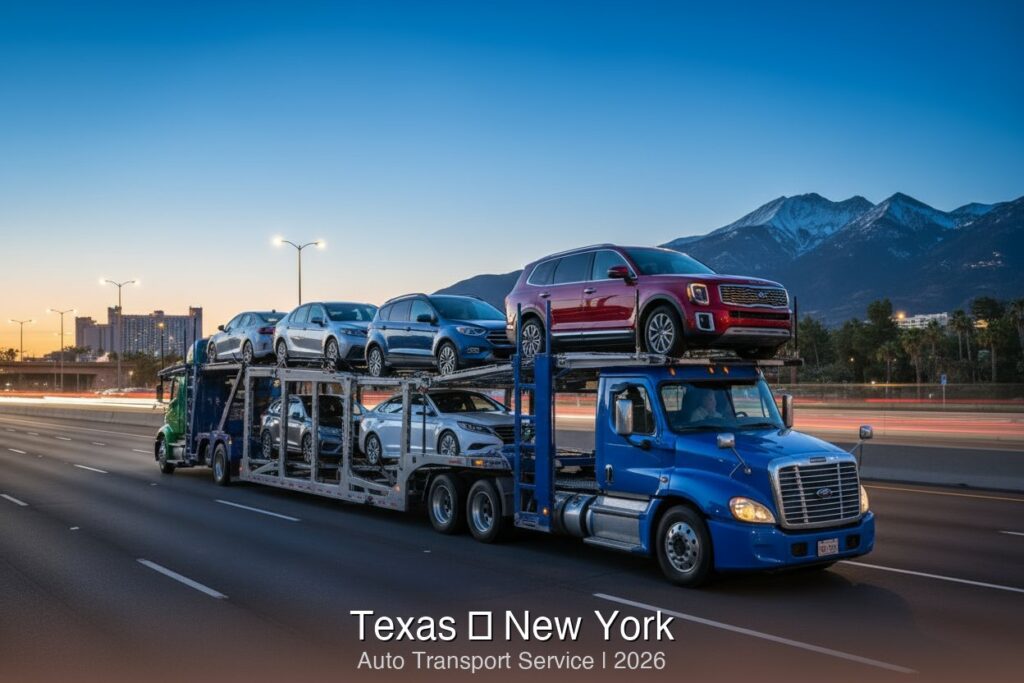
This route joins the two most different logistics environments in the country, and the difference is entirely one-sided.
Collecting a car in Texas is about as easy as the job gets. The metros were laid out around wide roads and generous frontage, there is somewhere for a seventy-five-foot rig to stop on nearly every street, and a driver rarely has to ask where they are supposed to load. Delivering into the New York metropolitan area is the opposite: parkways closed to commercial traffic, bridges that exclude it, and street after street with no legal place to unload.
So the attention this booking needs is not evenly distributed. Almost nothing will go wrong at the Texas end. What determines whether the last afternoon is straightforward or spent on the phone is a decision you make when you book, about where the truck is actually going to stop.
The pricing below is straightforward and the road is long but unremarkable. The delivery is the part worth reading twice.
- What It Actually Costs
- City-to-City Price Breakdown
- How Long the Journey Takes
- Seasonal Pricing: When to Book
- Open vs. Enclosed Transport
- What a Texas to New York Booking Looks Like
- The Complete Shipping Process
- Vehicle Preparation Checklist
- 7 Mistakes That Cost You Money
- Insurance and Liability Explained
- Frequently Asked Questions
What It Actually Costs
Texas to New York: $1,100 – $1,275
Open Transport | 1,770-1,880 Miles | 5-7 Days Transit
Enclosed is $1,650-$1,800. Open transport comes to about $0.62-$0.68 per mile, which is where long hauls settle once the fixed costs of the job have been spread thin enough to stop mattering.
The Same Northbound Advantage, Over a Longer Road
The dominant flow between these regions runs toward Texas rather than away from it, so a carrier heading north-east is largely solving its own problem of getting a trailer home. That keeps this rate below what the distance alone would suggest, and it keeps the calendar unusually quiet.
None of that advantage reaches the last fifty miles, which is where the actual difficulty of this route lives.
By Vehicle
Saloons and hatchbacks begin at $1,100-$1,175 open, $1,650-$1,750 enclosed. Reckon on $50 more for a crossover and $50 to $225 beyond that for a pickup or seven-seater. Nine positions are sold on a deck and a tall vehicle intrudes on the one above.
Cars above $75,000 move to $1,225-$1,450 open, reflecting what the hauler carries in risk. Duallies and lifted trucks — a larger share of Texas cargo than of most states’ — run $1,400-$1,550 open and up to $2,300 enclosed, since they generally need the upper deck.
What Moves the Number
- The size of the car: around $350, the biggest single factor
- Open or enclosed: about $550
- How much notice: $100-$150 under five days
- Which Texas metro: roughly $75
- The month: $100 or so, which is modest
- Whether the delivery point is workable: nothing in money, potentially a day in time
City-to-City Price Breakdown
The two ends of this route publish similar-looking numbers and mean entirely different things by them.
The Texas End
Houston is the floor at $1,100-$1,200 open to New York City, five to six days. Dallas adds around $25 and Austin about $50, with San Antonio a little beyond that. The ordering follows the north-eastbound road rather than the map, and $75 covers the entire state.
More usefully: none of those figures contains a hidden access charge, because there is no access problem to charge for. Texas collections are among the most straightforward we handle.
The New York End
New York City is quoted as the baseline and Buffalo at about $25 more, which looks like a rounding error and is not. Buffalo is nearly four hundred miles further from Manhattan than the number implies, and it prices this close because delivering there is trivial by comparison — good approaches, room to unload, no restricted routes.
What the metropolitan quote does not include is the effort of the final handover, and that is a matter of arrangement rather than money.
Where the Truck Will Actually Stop
Settle this at booking. Across much of Manhattan, Brooklyn and Queens there is nowhere a full-size carrier may legally halt, and the parkways and several bridges bar commercial vehicles outright. A retail car park, a wide industrial street or a spot in New Jersey will all work; being told on the day that none of them was arranged will not.
The realistic combined band is $1,100-$1,275 open and $1,650-$1,875 enclosed, at five to seven days.
How Long the Journey Takes
Five to six days from Houston or Dallas, six to seven from Austin or San Antonio. A carrier is usually assigned within one to three days, helped by the fact that the trailer wants to be heading that way anyway.
The Road
North-east out of Texas on I-30 or I-20 through Little Rock and Memphis, up through Nashville and Knoxville, then over the Appalachians into Virginia and north on I-81 or I-95 through Pennsylvania and New Jersey. Which combination a driver takes depends on where the other eight cars are going.
Having genuine alternatives is worth something. A blockage on one road means a different road rather than a wait, which is not true of every corridor.
The Two Places Time Is Lost
The Appalachian crossing in winter, where I-81 through Virginia and Pennsylvania can turn genuinely difficult for a day; and the metropolitan approach at any time of year, where a driver arriving in the wrong hours loses time that a fourteen-hour federal limit will not give back.
Neither is common enough to plan around in detail. Both are reasons to hold a window rather than a date.
The Honest Span
Six to ten days from booking to arrival. If you are flying up separately, book the flight against the far end of that rather than the near one — an early delivery is easy to accommodate and a late one is not.
Seasonal Pricing: When to Book
A quiet calendar, for structural reasons rather than luck.
Why the Year Is Flat
Seasonal premiums arise where demand in one direction outstrips supply. Here the demand doing the work is the carrier’s own need to move a trailer back toward the north-east, and that does not rise or fall with the calendar. Summer adds perhaps $100 as part of the national relocation season, and that is close to the whole of it.
February through April and September through November are marginally the cheapest. Late December thins as drivers stop, affecting availability rather than rate.
The Winter Consideration
Not price, but the Appalachian section. I-81 through Virginia and Pennsylvania is a road that can turn awkward for a day in January or February, and a driver who stops rather than pressing on is exercising judgement rather than letting you down.
Two days of slack at the delivery end covers it entirely, and it costs nothing to build in.
The Timing That Does Matter
Not the month — the hour. A driver reaching the metropolitan area mid-afternoon on a weekday faces a materially worse job than one arriving early on a Sunday, and drivers plan around this whether or not anyone discusses it with them.
If you can be flexible about the delivery hour, say so when you book. It is worth more on this route than choosing a cheaper month.
Route-specific planning
Planning to Ship a Vehicle?
Get a vehicle shipping quote based on your route, vehicle, and workable dates.
Get My Quote
Open vs. Enclosed Transport
About $550 divides them, the widest gap on any route in this batch, because the journey is long.
Open decks are how new cars reach dealer forecourts, which is the benchmark worth holding onto. Damage occurs on well under one shipment in a hundred, and the ramps rather than the highway are nearly always where it happens.
The Consideration Peculiar to This Route
An enclosed trailer is longer and less manoeuvrable than an open one, and you are delivering into the most access-constrained market in the country. The list of places a full-size enclosed rig can unload in the New York metropolitan area is shorter than the already short list for an open one.
This does not argue against enclosed transport. It argues for settling the delivery point and the trailer type in the same conversation rather than in two separate ones a fortnight apart.
Weather Is a Secondary Argument Here
A winter run does cross treated Appalachian road, which reaches the underside of anything on an open deck. It is a few hours of a five-day journey. For a car with original underbody finish it is a fair tipping factor; for anything else a wash on arrival settles it.
Circumstances That Warrant Enclosed
- The car is low enough at the front that the ramp becomes a genuine problem
- The open carrier’s stated limit per vehicle would not buy you another one
- The paint has never been redone and could not convincingly be
- Your policy only holds if the car travels under cover
Full comparison: open versus enclosed auto transport.
What a Texas to New York Booking Looks Like
Nobody named below is a real customer. These are the shapes this corridor throws up week after week, costed against the bands set out earlier, and each one is here to make a single point about where the money goes.
A delivery point agreed at booking
Saloon, Houston to an address in Brooklyn, with a supermarket car park nominated at the outset. Around $1,150, delivered on the sixth day, handed over in twenty minutes. The whole difficulty of this route disappeared into one line in an email.
A delivery point left to the day
Same class of car, similar destination, nothing discussed in advance. The driver could not get within four streets, spent an hour finding somewhere legal, and the handover slipped into the following morning. The rate was the same $1,150 — the whole cost was time and temper.
A delivery to Buffalo
Crossover, Dallas to Buffalo, booked ten days ahead. Around $1,200. Nearly four hundred miles further than Manhattan for $25 more, because upstate New York is simply an easy place to unload a car.
A pickup, which changes the arithmetic
Full-size crew-cab, Austin to New York City, booked a fortnight out. Around $1,375. The vehicle accounted for most of the gap over a saloon — on a route this long, what you ship matters far more than when.
A February crossing
Saloon, San Antonio to New Jersey, booked with a week-wide delivery window. Around $1,225. Weather on I-81 through Pennsylvania held the driver for most of a day, and delivery landed on the seventh — inside the window, which is why it existed.
The Complete Shipping Process
A single carrier takes the car from one end to the other. It is not handed on partway and it does not sit in a compound.
Arranging it
Two addresses, what the car is, and the days you can work with. From there it is circulated among the outfits putting north-eastbound trailers together, and one of them normally picks it up inside a day to three.
This is the moment to settle where the delivery will actually happen. A driver who knows on day one that they are unloading at a car park in Bayonne rather than a street in Brooklyn will plan the last leg around it. One who learns it on arrival will improvise, and the improvisation costs a day.
Handover in Texas
Straightforward, nearly always at your own address. The two of you examine the bodywork and every existing blemish goes onto the Bill of Lading. Take your own pictures beforehand in decent light — those images and the completed form are jointly the agreed record of the car’s condition, and signing means you accept it.
On the road
Five to seven days. A driver may not exceed eleven hours at the wheel inside a fourteen-hour period, and a good part of that period goes on the other eight vehicles. Ringing the driver will tell you more than any tracking screen.
Handover in New York
Everything legally rests on this second look, which on this corridor tends to happen in a car park neither party has seen before. Take it in daylight, hold up the photographs you took in Texas, run your eye along the bottom of the doors and around the back of the bumpers, and get any difference written down while the pen is still yours. Sign with nothing noted and there is no claim left to make.
If the meeting point is badly lit, say so and move the car rather than rushing it. Step by step: how car shipping works, start to finish.
Vehicle Preparation Checklist
Twenty minutes with a phone and five with a hose covers most of this list.
- Wash it, then photograph it. In that order — a fortnight from now you will be holding these images up against a car parked somewhere you have never been, and dirt will have hidden whatever you most wanted to see.
- Cover the whole car with the camera. Sides, both ends, wheels, roof, windscreen, and a shot taken from crouching height along each sill.
- Drop the fuel to a quarter. Enough to get up the ramp, down it again and to a pump. Everything past that is weight travelling 1,770 miles for no reason.
- Nothing stays in the cabin. The permission this operator holds is for vehicles, not for possessions, and the two are not the same document.
- The TxTag comes off the screen. Otherwise it bills its way up the eastern seaboard without you.
- Anything that sticks out comes off: mirrors folded, aerial down, roof racks, cycle carriers and any bed cover that lifts.
- Say what is wrong with it. A reluctant starter, a slow leak, a handbrake with a knack — the driver would rather hear it now than work it out on a ramp.
- Glance at the tyres. It has to drive on and drive off under its own power.
If it is a lifted truck, measure the overall height and give us the figure — it determines which trailers can take the job. Full checklist: preparing your vehicle for transport.
What Actually Costs You Money on This Lane
Leaving the delivery point undecided
The defining mistake of this route. Across much of the metropolitan area there is nowhere a full-size carrier may legally stop, and the parkways and several bridges exclude commercial traffic outright. Settled at booking, it costs nothing. Discovered on arrival, it costs a day and occasionally a redelivery fee.
Assuming the easy Texas end predicts the New York end
The collection will go so smoothly that it is tempting to expect the same in reverse. These are the two least similar delivery markets in the country and the second one needs planning the first never did.
Shopping for a cheaper month
About $100 across the whole year. Being flexible about the delivery hour is worth more than the best month you could pick, because a driver reaching the metro early on a Sunday has a materially easier job than one arriving mid-afternoon on a Thursday.
Not declaring a lifted or oversized vehicle
Modified vehicles leave this state in numbers you would not see elsewhere, and how tall the thing stands is what rules trailers in or out. Book it as an ordinary pickup, present something on a six-inch lift, and the driver will decline it where it stands.
Chasing an outlier quote
A quotation is a guess at what will tempt a driver, and until one bites it is worth nothing to either of you. Pitched under the going rate for eighteen hundred miles, the job simply sits there while the trailers that might have carried it load up with something else. There is five to ten per cent in this for the carrier, which is not enough to discount from.
Booking a flight against the near end of the window
Six to ten days is honest, and there is a winter mountain crossing in the middle of it. Plan against the far end and an early arrival becomes a bonus.
Rushing the arrival inspection because the light is poor
On this route the handover often happens somewhere unfamiliar and frequently in bad light. Move the car, use a torch, take the extra ten minutes. An unqualified signature extinguishes any claim.
The general list is in why car shipping prices vary.
Insurance and Liability Explained
The cover sits with the operator whose trailer the car is on. That is a legal obligation on them rather than a service they advertise, it applies for the whole time the vehicle is aboard, and there is consequently no add-on for us to sell you.
The scope of it
Harm done to the car in motion, and harm done to it going up or coming down the ramp. Where operators differ is in how much they will pay on any one vehicle — a figure printed on the certificate and worth reading rather than guessing at. If your car is worth more than it says, that is the clearest reason there is to look at an enclosed trailer.
Outside the scope
Late arrival, under every policy in this trade — including a driver stopped by weather on I-81 or held up on the approach to the city. Items left in the car are excluded too, since the authorisation the carrier holds does not extend to goods.
Why the Arrival Inspection Carries More Weight Here
A claim turns on the difference between two Bills of Lading. On most routes both are signed at kerbsides in reasonable conditions. On this one the second is often signed in an unfamiliar car park, sometimes after dark, with a driver keen to be out of the metropolitan area before the traffic builds.
That is precisely the circumstance in which people sign without looking properly, and it is worth resisting. Full detail: car shipping insurance and liability.
Frequently Asked Questions
What does it cost to ship a car from Texas to New York?
$1,100-$1,275 on an open trailer and $1,650-$1,800 enclosed, for an ordinary car over 1,770 to 1,880 miles. That is roughly $0.62-$0.68 per mile.
Will the truck come to my address in New York?
Across much of the metropolitan area, no. There is frequently nowhere a seventy-five-foot rig may legally stop or unload, and commercial vehicles are barred from the parkways and several bridges. You agree a workable spot with the driver instead — and you should do it when you book, not when they arrive.
What happens if I do not?
The driver improvises. That typically means an hour trying to reach the address, another hour finding somewhere legal, and a handover that slips to the following day. The rate does not change; the afternoon does.
How long does it take?
Five to six days from Houston or Dallas, six to seven from Austin or San Antonio, plus one to three days to get a carrier assigned. Six to ten days end to end.
Is the Texas end difficult?
Not at all, and that is worth saying because the contrast catches people out. Texas metros are built around wide roads and generous frontage, and a collection here almost always happens at your own address without discussion.
Does the month matter?
About $100 across the year, with summer at the top. The dominant flow between these regions runs toward Texas, so a north-eastbound trailer is largely solving its own problem of getting home — and that need does not have a season.
Then what should I be flexible about?
The delivery hour. A driver reaching the metro early on a Sunday has a materially easier job than one arriving mid-afternoon on a weekday, and saying you can accommodate either is worth more than picking a cheaper month.
Why does Buffalo cost barely more than New York City?
Because unloading there is easy. Upstate New York has good approaches, room to work and no restricted routes. About $25 separates them despite nearly four hundred miles of difference — the price is following the difficulty, not the distance.
Does winter affect this route?
One section of it. I-81 through Virginia and Pennsylvania can turn awkward for a day in January or February. It does not move the price, and two days of slack at the delivery end covers it entirely.
I am shipping a lifted truck. Does that change anything?
Yes. Overall height decides which trailers can take the load, so the field is narrower and the rate higher — $1,400-$1,550 open. Measure it and give us the figure rather than describing it.
Should I choose enclosed?
Only if the car warrants it. The premium is about $550, and an enclosed trailer is longer and less manoeuvrable in exactly the market where manoeuvring is already the problem. If you do choose it, settle the delivery point in the same conversation.
Would driving it be cheaper?
About 27 hours, so three days honestly done. Petrol, two nights, meals and 1,770 miles of wear come to somewhere near $850-$925, against $1,100-$1,200 to ship plus a fare home. Narrower than most people expect, and it usually turns on whether three days are available.
Is the car covered while it is being moved?
Yes — the company doing the hauling must hold cargo cover by law, and it applies throughout the time your car is on the trailer. The one number worth asking for is what that policy pays out on a single vehicle. Arriving late is not something any insurer in this business will write cover for.
May I leave belongings inside?
It is not a good idea. The paperwork that lets a driver carry cars is not the paperwork that lets anyone carry freight, so a filled boot is uninsured by definition — and heavy enough to matter at a weigh station, where the driver rather than you answers for it.
Ready to ship your car from Texas to New York?
Get your free instant quote and see exactly what your route costs in 2026.
More on How Car Shipping Works
- how your car gets collected and delivered
- our overview of the whole process
- how much shipping a vehicle really costs
- when enclosed transport is worth the premium
Related reading
The same northbound economics over a shorter road: Texas to Illinois, where the delivery end is far more forgiving.
The metropolitan delivery problem from the other direction: New York to Florida deals with the same access constraints at the collection end instead.
Other long Texas departures: Texas to California and Texas to Washington. Background: transit times by distance and what the carrier’s cover includes.