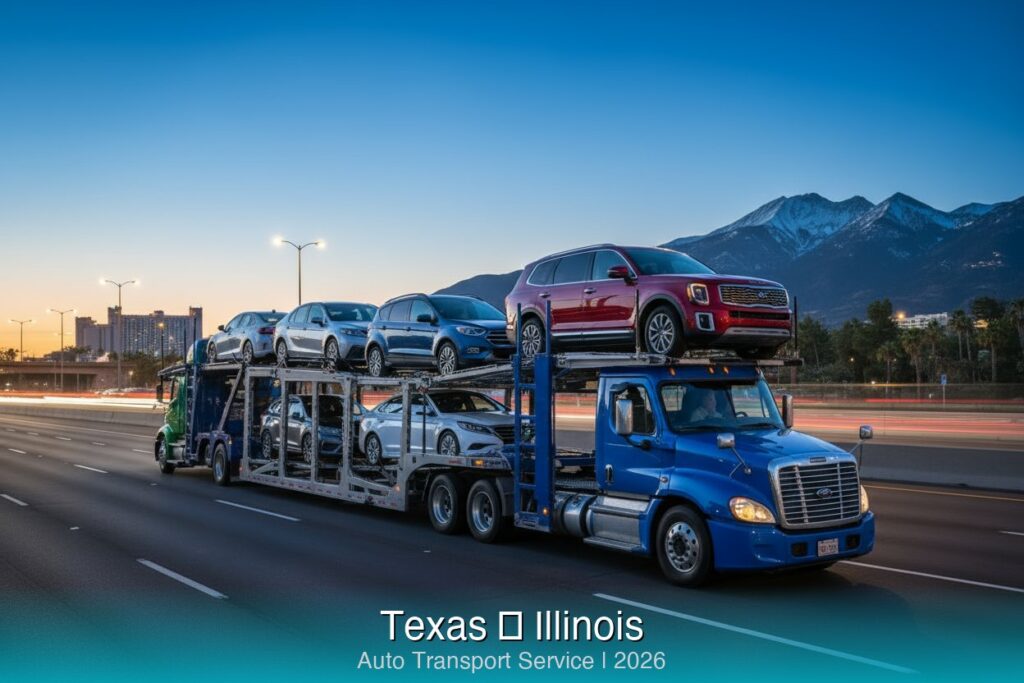
You are shipping in the wrong direction, and that is entirely to your advantage.
For years now the heavy flow between the Midwest and Texas has run one way. People move to Texas; companies relocate to Texas; cars are bought in the Midwest and driven or shipped south. Carriers respond to that by keeping trailers pointed toward Houston and Dallas, and the problem they face at the end of every run is the same one every freight operator faces: filling the truck for the journey home.
Your car going north is that journey home. A dispatcher looking at a Texas-to-Illinois booking is not weighing whether it is worth the trip — the trip is happening regardless. They are deciding whether to make it with an empty deck or a paid one.
The result is a route that is cheaper than its distance suggests, quicker to get assigned than most, and remarkably indifferent to the time of year. Almost nothing else on this site is all three.
- What It Actually Costs
- City-to-City Price Breakdown
- How Long the Journey Takes
- Seasonal Pricing: When to Book
- Open vs. Enclosed Transport
- What a Texas to Illinois Booking Looks Like
- The Complete Shipping Process
- Vehicle Preparation Checklist
- 7 Mistakes That Cost You Money
- Insurance and Liability Explained
- Frequently Asked Questions
What It Actually Costs
Texas to Illinois: $750 – $950
Open Transport | 1,050-1,180 Miles | 3-5 Days Transit
Enclosed is $1,150-$1,300. Open transport comes to roughly $0.71-$0.80 per mile, and the useful comparison is not with other routes but with the same route in reverse — Illinois to Texas typically prices above this, for identical mileage and an identical truck.
The Backhaul Discount, Such As It Is
Nobody labels it a discount and no broker will offer you one. It shows up instead as a rate that simply sits lower than the arithmetic of distance would predict, because the carrier’s alternative is not a better-paying northbound load. It is no load at all.
This is also why the route resists seasonal pressure. The southbound flow rises and falls; the need to get the trailer back does not.
By Vehicle
Saloons and hatchbacks begin at $750-$825 open, $1,150-$1,250 enclosed. Add around $50 for a crossover and $50 to $125 more for a pickup or seven-seater. The driver sells nine positions on a deck and a tall vehicle intrudes on the one stacked above.
Above $75,000 in value the band moves to $875-$1,000 open, which reflects what the hauler carries in risk. Duallies and lifted trucks — not rare cargo out of Texas — run $950-$1,100 open and up to $1,600 enclosed, since they usually need the upper deck.
What Moves the Number
- The size of the car: around $200, and the largest single factor here
- Open or enclosed: about $400
- Which Texas metro: roughly $75
- How much notice: $75-$125 under five days, gentler than most routes
- The month: $75-$100, which is barely anything
- Where in Illinois: about $50
City-to-City Price Breakdown
Texas is enormous and its metros sit hundreds of miles apart, yet the pricing spread across them is narrow. There is a reason for that.
The Texas End
Houston is the floor at $750-$850 open to Chicago, three to four days. Dallas adds about $25 and Austin about $50, with San Antonio a little beyond.
The ordering looks odd until you notice it tracks the northbound road rather than the map. A trailer running home to the Midwest leaves on I-45 or I-35 and works its way up; Houston and Dallas sit on that line, Austin and San Antonio require a slight lean west. Fifty dollars covers the difference between the state’s largest cities, which on a state this size is remarkable.
Access Is Not a Problem Here
Worth saying because it is unusual. Texas metros are built around wide roads, generous parking and industrial frontage, and a seventy-five-foot carrier can get close to almost any residential address. Collections on this route are among the most straightforward we handle, and there is rarely any need to negotiate a meeting point.
The Illinois End
Chicago is the baseline and Springfield adds about $40, which is a short run down I-55 rather than a detour. Chicago itself is a large freight city with good approaches on every side, so the delivery is generally easier than the city’s reputation suggests — though the older North Side streets are a genuine exception worth mentioning at booking.
The realistic combined band is $750-$950 open and $1,150-$1,375 enclosed, at three to five days.
How Long the Journey Takes
Three to four days from Houston or Dallas, four to five from Austin or San Antonio. Getting a carrier assigned usually takes one to two days, and that is the part of this route that quietly outperforms.
Why Assignment Is Quick
Because a dispatcher is not being asked to create a journey. Trailers arrive in Texas loaded and have to leave it somehow, and a northbound booking slots into a movement that was going to happen. On a route where the carrier had to be persuaded to make the trip at all, the same booking would wait days.
The Road
North out of Houston on I-45 to Dallas, or straight up I-35, then across to I-44 through Oklahoma City and Tulsa, into Missouri past Springfield and St. Louis, and up I-55 to Chicago. Some loads take the I-30 and I-40 line instead depending on where the other cars are going.
Having more than one workable road is a genuine advantage. When something blocks one of them, a driver reroutes rather than waits — which is not true of every corridor we run.
What Actually Delays It
Very little, most of the year. The route is flat and low and the only serious weather exposure is a Midwestern winter at the far end, where an ice event in Missouri or Illinois can cost a day. Texas ice storms are rarer but not unknown and tend to affect the collection rather than the drive.
Four to seven days from booking to delivery is the honest span. Ask for a window rather than a date; no operator in this industry can promise a single day.
Seasonal Pricing: When to Book
This is among the flattest calendars we publish, and the flatness is structural rather than lucky.
Why the Season Barely Registers
Seasonal pricing exists because demand in one direction outruns supply. On this lane the demand that matters is the carrier’s own need to get the trailer home, and that need does not vary with the calendar. Summer adds perhaps $75-$100 as part of the national relocation peak, and that is close to the whole story.
Compare that with a snowbird corridor, where the same car can cost $250 more in one month than another, and the difference in planning burden is obvious.
The Months That Are Slightly Better
February through April and September through November are marginally cheaper and marginally quicker. June to August is the busiest. Late December thins out as drivers stop, which affects availability more than price.
The One Weather Window
January and February at the Illinois end. An ice event across Missouri or northern Illinois can hold a truck for a day, and it is the only weather on this route worth building slack for. It does not move the price — carriers plan around winter rather than surcharging for it.
The Practical Upshot
Book when it suits you. On most routes we would tell you which month to aim for; here the honest advice is that the month is not where your money is. Vehicle size and trailer type will move your quote three times as far as the calendar will.
Route-specific planning
Planning to Ship a Vehicle?
Get a vehicle shipping quote based on your route, vehicle, and workable dates.
Get My Quote
Open vs. Enclosed Transport
Roughly $400 between them, and on this route the choice is unusually clear-cut in favour of open.
Open decks are how new cars reach dealer forecourts, which is the most useful benchmark available. Damage occurs on well under one shipment in a hundred, and the ramps rather than the highway are almost always where it happens.
The Environmental Case Is Thin Here
There is no altitude on this route, no sustained mountain road and no salted crossing except at the very end of a winter run. A car travelling from Houston to Chicago in April is exposed to nothing of consequence.
A January delivery into Illinois does put the vehicle on treated road for the final stretch, and for a car with original underbody finish that is a fair consideration. For everything else, a wash on arrival is the entire answer.
The Texas Exception Worth Knowing
Lifted trucks, duallies and long-wheelbase vans are a much larger share of what moves out of Texas than out of most states, and those vehicles are not really an open-versus-enclosed decision at all — they are a question of which trailers can physically take them. Expect fewer options and give the booking more notice.
Circumstances That Warrant Enclosed
- A front end that would ground out on the approach to an open deck
- A vehicle the standard per-unit cover could not actually replace
- Untouched original paintwork that no refinish would match
- An insurer that has written enclosed carriage into the terms
Full comparison: open versus enclosed auto transport.
What a Texas to Illinois Booking Looks Like
Five illustrations drawn from the pattern of what this lane carries rather than from named customers, priced from the ranges above. Each isolates a single variable.
A job move arranged at a week’s notice
Saloon, Houston to Chicago, booked seven days ahead in May. Around $800, assigned the next day, delivered on the fourth. Short notice cost almost nothing, which on a route running against the dominant flow is the normal experience rather than a fluke.
A pickup, which changes the arithmetic
Full-size crew-cab, Dallas to Chicago, same month, same notice. Around $900. The vehicle accounted for the entire difference — on this lane the truck you are shipping matters roughly three times as much as the month you ship it in.
A lifted truck that needed the top deck
Modified pickup, San Antonio to Springfield, booked twelve days out. Around $1,050 and a narrower field of carriers, because only some trailers could take it at all. The notice is what kept this straightforward.
A February delivery into Illinois
Crossover, Austin to Chicago, booked with a five-day delivery window. Around $875. Ice across northern Missouri held the driver for most of a day and delivery landed on the fifth — inside the window, which is why the window was drawn that way.
The same route in reverse
Worth including for contrast. An identical saloon going Chicago to Houston in the same week would have run closer to $900 — the same distance, the same truck, and a hundred dollars more, because that is the direction everybody wants to travel.
The Complete Shipping Process
One carrier takes the car the whole way. Nothing is handed on partway and nothing sits in a compound.
Arranging it
You supply two addresses, the vehicle details and a span of dates. The job goes to operators assembling northbound loads, and on this lane it is usually taken within a day or two because those operators need it more than you need them.
When a driver accepts you get the company name, a direct number and a range of hours rather than an appointment.
Handover
Before the car goes up the ramp the two of you go over the bodywork and every existing blemish is entered on the Bill of Lading. Take your own pictures beforehand in decent light. Those images and the completed form together are the agreed record of the car’s condition, and signing means you accept that record.
Texas collections are generally easy — there is almost always somewhere for the truck to stop — so this step tends to happen at your address rather than at a negotiated meeting point.
On the road
Three to five days. A driver may not exceed eleven hours at the wheel inside a fourteen-hour period, and much of that period is spent on the other eight vehicles. Ringing the driver will tell you more than any tracking screen.
Delivery
The car is examined a second time and this examination is the one with legal weight. Go over it in daylight against your own pictures, look along the lower panels and behind the bumpers, and write down anything that differs before signing. An unqualified signature closes the matter permanently.
In a Chicago winter, do this properly even in poor light — ask the driver to wait while you find somewhere better lit if you need to. Step by step: how car shipping works, start to finish.
Vehicle Preparation Checklist
Allow half an hour. Very little of it is mechanical.
- Take pictures outdoors before handover. Each flank, front and rear, all four wheels, the roof, the glazing, and a low shot along the sills.
- Have it washed first. Dirt conceals exactly the sort of small damage you are photographing to record.
- Leave about a quarter of a tank. Enough for the ramps at both ends and a run to a filling station.
- Empty the interior. Carrying vehicles and carrying possessions are separately authorised, and this operator holds only the former.
- Detach the TxTag. Left on the screen it will read across every tolling authority the trailer passes.
- Fold in the mirrors, lower the aerial, strip roof racks, bed covers that lift and cycle carriers. Projections are what catch.
- Warn the driver of anything awkward — a slow starter, a weeping seal, a trick to the handbrake.
- Look at the tyres. The car has to move under its own power onto the deck and off again.
If it is a lifted truck, measure the overall height and tell us the figure. It determines which trailers can take the job at all and it is better established now than at the kerb. Full checklist: preparing your vehicle for transport.
What Actually Costs You Money on This Lane
Shopping for the cheapest month
There barely is one. The calendar moves your quote $75-$100 across the whole year, because the carrier’s need to get the trailer home does not have a season. Time spent optimising the date here is time better spent on the two levers that do matter.
Not declaring a lifted or oversized vehicle
A far larger share of what leaves Texas is modified than in most states, and overall height determines which trailers can accept the load at all. A booking quoted as a standard pickup and presented as a lifted one is a booking that gets refused at the kerb.
Chasing an outlier quote
The figure you are given is one a broker hopes a driver will take, and it binds nobody until one does. Set beneath what the run pays, it goes unclaimed while the trailers that would have carried it head home empty. Margins sit at five to ten per cent.
Assuming the reverse trip prices the same
It does not. Illinois to Texas is the direction everyone wants, and the same car on the same truck costs more going that way. If you are planning a return leg, price it separately rather than doubling this one.
Booking a hard delivery date into a Midwestern January
The only weather worth planning for on this route is at the Illinois end. An ice event across Missouri or northern Illinois costs a day, and a window absorbs it where a fixed date does not.
Signing the arrival paperwork too quickly
The costliest minute of the exercise, and worse in winter when the light is poor and everybody wants to be indoors. An unqualified signature extinguishes any claim.
Loading the boot before it goes
Nobody insures it, the weight counts towards a limit the driver can be stopped and measured against, and a driver who notices may decline the vehicle on the spot.
The general list is in why car shipping prices vary.
Insurance and Liability Explained
Whoever physically moves the car carries the insurance. Federal law requires it of them, the policy is in force for as long as the vehicle is aboard, and nothing separate is offered to you because nothing separate is needed.
The scope of it
Damage sustained on the road and at the ramps. What differs between operators is the ceiling per vehicle, so ask what the certificate states rather than assuming. A car above that ceiling is a straightforward argument for enclosed carriage, where limits tend to be higher.
Outside the scope
Late arrival, under every policy written in this trade — including a driver held up by ice in Missouri. Items left in the car are excluded as well, since the authorisation the carrier holds does not extend to goods.
The point specific to a large vehicle
If you are shipping a lifted truck or a dually, ask about the per-unit ceiling with particular care. These vehicles are frequently worth more than a standard saloon and are handled by a narrower set of carriers whose cover varies more.
A claim is settled on the difference between two Bills of Lading — the one signed at handover and the one signed at delivery. Liability attaches to that gap and to nothing you signed for without comment. Full detail: car shipping insurance and liability.
Frequently Asked Questions
What does it cost to ship a car from Texas to Illinois?
$750-$950 on an open trailer and $1,150-$1,300 enclosed, for an ordinary car over 1,050 to 1,180 miles. That is roughly $0.71-$0.80 per mile.
Why is this cheaper than shipping the same car in the opposite direction?
Because the heavy flow between these regions runs toward Texas, not away from it. Carriers arrive loaded and have to get the trailer home somehow, and your northbound car is that journey. The alternative for the driver is not a better-paying load; it is an empty deck.
How long does it take?
Three to four days from Houston or Dallas, four to five from Austin or San Antonio, plus one to two days to get a carrier assigned. Four to seven days end to end.
Is it easy to get a truck?
Easier than on most routes, and for the same reason it is cheap. A dispatcher is not deciding whether to make the journey — they are deciding whether to make it paid or empty.
Does the month matter?
Hardly. About $75-$100 across the whole year, with summer at the top. Seasonal pricing exists where demand outruns supply in one direction, and on this lane the demand that matters is the carrier’s own need to head home, which does not vary.
Then what should I optimise?
Vehicle and trailer type. Those two move your quote roughly three times as far as the calendar does. If you have a choice about which of two cars to ship, that decision is worth more than any date.
Why is there so little difference between Houston, Dallas and Austin?
About $50 covers them, because the ordering follows the northbound road rather than the map. Houston and Dallas sit on the line a trailer takes going home; Austin and San Antonio need a slight lean west. On a state this size that is a remarkably narrow spread.
Will a truck reach my address?
In Texas, almost certainly — the metros are built around wide roads and generous frontage, and collections here are among the easiest we handle. In Chicago the approaches are good too, though the older North Side streets are worth mentioning at booking.
I am shipping a lifted truck. Does that change anything?
Yes, and it is worth raising early. Overall height decides which trailers can take the load at all, so the field is narrower and the rate higher — $950-$1,100 open. Measure it and give us the figure rather than describing it.
Does weather delay this route?
Only at the Illinois end, and only in January and February, when an ice event across Missouri or northern Illinois can cost a day. It does not affect the price. Texas ice storms are rarer and tend to interrupt the collection rather than the drive.
Would driving it be cheaper?
About seventeen hours, so two days honestly done. Petrol, a night away, meals and 1,050 miles of wear come to somewhere near $475-$525, against $750-$850 to ship plus a fare home. Driving wins on cost; shipping buys the two days.
Is the car covered while it is being moved?
It is, by the cargo insurance the hauling company is legally obliged to hold, from loading until it comes off. Ask what the per-vehicle ceiling is — particularly for a large or modified vehicle, where the figure varies more. No policy anywhere in this trade covers late arrival.
May I leave belongings inside?
Better not to. Moving vehicles and moving goods require different authorisations and this truck holds only one, so anything in the boot travels at your own risk and adds weight the driver can be stopped and measured against.
Ready to ship your car from Texas to Illinois?
Get your free instant quote and see exactly what your route costs in 2026.
Related Car Shipping Guides
- choosing between open and enclosed transport
- what happens between booking and delivery
- how car shipping actually works
- what it costs to ship a car
Related reading
Other departures running against the dominant flow: Texas to New York is the same northbound economics over a longer distance, and Texas to California heads west instead.
The busy direction, for comparison: California to Texas and Illinois to Florida show what a route looks like when everyone wants to travel it.
Background: how per-mile pricing works, getting an accurate quote and what the carrier’s cover includes.