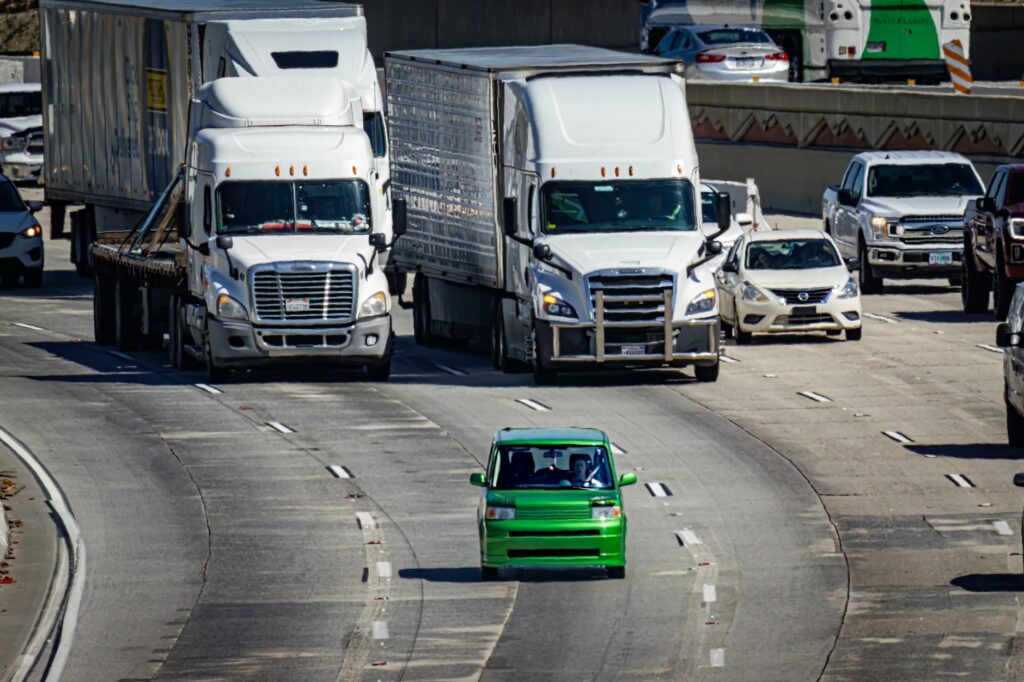
Miami to Houston is 1,190 miles, and almost every one of them is coastline. The route runs I-10 west out of Florida, across the Panhandle and through Alabama, Mississippi and Louisiana before dropping into Texas — which makes it a weather-exposed Gulf Coast corridor between June and November, not because of where it starts or finishes but because of the whole middle.
That is the one genuinely route-specific thing to plan around. Everything else about this lane is comfortable: $750-$1,000 on open transport, 3-5 days in transit, and carriers running it constantly in both directions.
The traffic is business more than lifestyle. Energy companies move staff between Houston and South Florida, Miami’s role as a gateway for Latin American commerce keeps vehicles flowing both ways, and both cities are large enough ports that a fair number of the cars on this route are not staying put once they arrive.
What follows is how the shipping process actually works, what the price is built from, what the federal rules entitle you to, and how to book this particular corridor in storm season without getting caught out.
In This Guide
- How the Auto Transport Industry Actually Works
- The Miami to Houston Corridor
- Pricing: What Drives the Math
- Driving vs. Shipping: The Real Comparison
- Seasonal Demand Patterns
- Open vs. Enclosed: A Technical Comparison
- How Carrier Assignment Works
- Federal Regulations That Protect You
- Preparing Your Vehicle: The Engineering Perspective
- Common Misconceptions About Auto Transport
- Frequently Asked Questions
How the Auto Transport Industry Actually Works
The industry is structured in a way that is not obvious from the outside, and nearly every frustration people have with it traces back to the same misunderstanding.
The Company You Book Is Not the Company That Drives
You book with a broker. A carrier moves the car. The carrier is usually a small operation — one to five trucks, frequently owner-operated — hauling seven to ten vehicles along routes it runs regularly. The broker owns no trucks and instead posts your job to a national load board where carriers already heading your way can claim it.
That structure exists because neither side can do the other’s job. A carrier running Miami to Houston cannot maintain a nationwide sales operation, and you have no way to find the specific truck passing your neighbourhood next Tuesday.
Why Nothing Happens for a Few Days
A carrier will not run 1,190 miles half empty. Your vehicle is one piece of a load being built across South Florida and the Gulf Coast, and that assembly is the whole explanation for the wait between booking and pickup. It is also why a flexible pickup window is worth money — you are simply easier to fit into the puzzle.
Why the Cheap Quote Does Not Move
If the posted rate is below what a driver will accept, no one claims the job. It sits on the board while your date approaches. The broker eventually calls to say the price has gone up — which is not a bait and switch so much as the market correcting a number that was never real. On a short corridor like this one there is less margin to hide in, so the floor is firmer than people expect.
What This Means for You
- You are buying a slot on a truck that already exists. Flexibility is leverage.
- Review the payment schedule before booking and confirm in writing when any deposit or remaining balance becomes due.
- You will deal with two parties: the broker before pickup, the driver during transit. Get the driver’s direct number at assignment.
- Once a carrier is assigned, ask for its identifying information and verify its operating status before pickup.
The Miami to Houston Corridor
Distance: 1,190 miles via I-10. Transit: 3-5 days. Cities served: Miami, Fort Lauderdale, Miami Beach and Hialeah west to Houston, Katy, Sugar Land and The Woodlands.
A Corridor That Is Entirely Coastal
Most routes have a weather problem at one end. This one has it end to end. Leaving South Florida, the road crosses the Panhandle, then the Alabama, Mississippi and Louisiana Gulf coast, then the Texas coastal plain into Houston. There is no inland stretch where a truck is out of reach of a Gulf system.
In practice this matters for about half the year and not at all for the other half. From December through May it is one of the easiest runs in the country — flat, fast, no mountains, no snow, no altitude. From June to November it is a route where the delivery date deserves slack, because a storm anywhere along 1,190 miles of coast can hold a truck up without ever coming near your vehicle.
Who Uses It
Energy sector moves. Houston is the industry’s centre of gravity and South Florida has a steady share of the corporate and financial side. Staff rotate between them on company timelines.
Latin American business. Miami functions as the commercial gateway to the region, and that generates continuous vehicle movement in both directions — including cars that arrive in Miami on their way somewhere else entirely.
Relocations in both directions. Two large, fast-growing metros with no state income tax between them. People move back and forth for work and cost of living, and rarely in only one direction.
Why It Prices Well
Because it genuinely fills both ways, and because it is short enough that a carrier can turn it around quickly. At $0.63-$0.84 per mile the rate looks high next to a coast-to-coast quote — that is normal on a shorter route, where the fixed costs at each end have fewer miles to spread across. The total is what matters, and the total on this lane is among the more reasonable in the country for the distance.
Pricing: What Drives the Math
Open Transport | 3-5 Days | 1,190 Miles | $0.63–$0.84 per mile
Enclosed runs $1,150-$1,500. The per-mile rate sits above the national average, which is what always happens on a shorter route — loading, paperwork and driver time at each end cost the same whether the truck runs 1,190 miles or 3,000, so on a shorter haul they weigh more heavily per mile. Per-mile pricing explains the mechanism; the total is the number that matters.
Where the Money Goes
Roughly 1,190 miles at about six miles per gallon means close to 200 gallons of diesel, and fuel is a quarter to a third of the total. Driver wages take a comparable share for the three to five days the trip occupies under federal hours rules.
The rest divides fairly evenly. Insurance is ten to fifteen per cent, covering cargo liability of $250,000 or more per vehicle alongside general liability. Equipment is another ten to fifteen — depreciation, maintenance, tyres and inspections on a purpose-built trailer. The broker’s fee is ten to fifteen for finding and vetting the carrier and handling claims.
Five to ten per cent is left as carrier profit. On margins that thin, a quote several hundred dollars below the market is not a better deal; it is a load nobody will take.
Fuel and driver wages are over half the quote, and neither compresses. That is why prices on this lane cluster so tightly, and why a quote materially below the rest is not a leaner operator — it is a rate no driver will run 1,190 miles for.
What Moves Your Number
- Where in the Miami metro you start. Miami Beach and the barrier islands are harder for a 75-foot truck than Hialeah or a suburban Broward address, and difficulty shows up as a slower assignment before it shows up as a price.
- Where in the Houston metro you finish. Katy, Sugar Land and The Woodlands are straightforward; the spread across the metro is modest.
- Vehicle size. Deck space rather than weight — a three-row SUV or full-size pickup sits meaningfully above a sedan.
- Season. A couple of hundred dollars across the year, which is less than on most corridors.
- Lead time. Under five days out typically adds $100-$150.
- Delivery date flexibility. Worth more here than the pickup window is, and worth most between August and October.
Driving vs. Shipping: The Real Comparison
At 1,190 miles this is genuinely arguable, unlike a coast-to-coast run. It is roughly eighteen hours of driving — two comfortable days, or one very long one if you are determined. Plenty of people do it. Here is the honest arithmetic, including the parts that favour driving.
| Cost Category | Driving Yourself | Shipping Your Car | Notes |
|---|---|---|---|
| Fuel | $190 | $0 | 1,190 mi at ~25 MPG, $4.00/gal avg |
| Hotels | $240 | $0 | 2 night(s) at $120/night avg |
| Meals | $90 | $0 | 2 day(s) at $45/day road food |
| Vehicle wear | $249 | $0 | IRS rate: $0.21/mi depreciation + maintenance |
| Time off work | $400-$800 | $0 | 2 day(s) of lost productivity |
| Flight (one-way) | N/A | $282 | Average domestic one-way fare |
| Shipping cost | N/A | $750-$1000 | Open transport |
| TOTAL | $769-$1569 | $900-$1350 |
Reading It Properly
On fuel alone the drive wins, and it is closer than the coast-to-coast comparisons. The case for shipping lives in the columns people leave out: two days of your time, a night in a hotel somewhere around Tallahassee or Mobile, and 1,190 miles of wear that surfaces at resale.
Three situations settle it. Two vehicles and one driver — the second car has to ship regardless of the maths. A start date at the Houston end that cannot absorb two days of driving. Or a car valuable enough that the depreciation line outweighs everything above it.
There is a fourth, particular to this route. Driving I-10 along the Gulf in September means committing yourself to a two-day trip through the storm belt on a fixed schedule. A professional running that road weekly is better placed to judge when to wait than someone doing it once with a hotel booked. How costs scale with distance covers where the crossover sits generally.
Route-specific planning
Planning to Ship a Vehicle?
Get a vehicle shipping quote based on your route, vehicle, and workable dates.
Get My Quote
Seasonal Demand Patterns
This corridor has two calendars running at once: a price calendar, which is mild, and a weather calendar, which is not. They do not overlap neatly, and the second one is what actually determines whether your delivery lands when you were told.
The Price Calendar
March and April are the cheapest months, running $690-$950 with excellent availability and three to five days’ notice usually sufficient. Winter relocations are over, summer has not begun.
June through August is the peak, driven by family relocations timed to the school year. Expect the upper half of the range and book two weeks out rather than five days.
September through February sits at standard rates, $750-$1,000, with reliable availability — apart from 15 to 31 December, when drivers take the holidays, capacity collapses nationwide and rates spike. Ship before the 15th or wait for January.
The whole annual swing is a couple of hundred dollars. On this route, timing is worth less than it is on the snowbird corridors.
The Weather Calendar, Which Matters More
Atlantic hurricane season runs from June through November and peaks from mid-August into October. On most corridors that is a consideration for one endpoint. Here it applies to the entire 1,190 miles.
What actually happens is rarely dramatic. Carriers reroute, wait out a system, or delay a departure by a day or two. Your vehicle is not in danger; your schedule is. A storm making landfall in the Panhandle can hold up a truck that left Miami two days earlier and is nowhere near the weather.
How to book around it: add two to three days of slack to any delivery between August and October, and do not schedule a flight, a lease return or a closing against the delivery date. If the move is genuinely flexible, shipping in spring avoids the question entirely and is cheaper as well.
Open vs. Enclosed: A Technical Comparison
About nine vehicles in ten travel open, and on a three-to-five day run down a flat interstate that is comfortably the right default. The question worth asking on this particular corridor is not about impact damage — it is about salt and humidity.
What a Gulf Coast Run Actually Exposes a Car To
Road film, insect residue and the occasional stone chip, same as anywhere. What is different here is the air. This route runs beside salt water for most of its length in a consistently humid climate, and a vehicle on an open trailer travels through all of it.
For a modern daily driver over three to five days, that is a wash on arrival and nothing more. For a car with existing corrosion, older brightwork, or paint that has already been compromised, it is a reasonable thing to weigh — more reasonable than the impact risk people usually worry about.
The Numbers
Open runs $750-$1,000 and carries seven to ten vehicles per truck, with assignment typically inside 1-5 days. Enclosed runs an estimated $1,150-$1,500 and typically carries fewer vehicles per load. Because enclosed capacity is more limited, assignment can take longer than open transport. The premium is $400-$500 — over half again on top of a short-haul base, which is a steep proportion.
Where Enclosed Earns It
- A classic, exotic, collectible, especially valuable vehicle or one that needs additional protection
- Paint or brightwork that is expensive to match, particularly on an older vehicle where salt air is a real consideration
- Ground clearance low enough that open hydraulic ramps are a genuine risk — enclosed trailers often have a lift gate instead
- A car heading onward from Miami or Houston to a buyer, an auction or a port, where arrival condition is the transaction
For everything else, open transport is both cheaper and faster to book on this lane. The full comparison covers the rest of the trade-off.
How Carrier Assignment Works
Assignment is the gap between booking and anything visible happening, and on a short corridor it can be longer than the drive itself. Understanding what is going on removes most of the anxiety.
Your Job Goes to Market
Once booked, the shipment is posted to a national load board that carriers monitor continuously. A driver already running Florida to Texas next week sees it, checks it fits the trailer and the route, and takes it. That is the assignment, and it normally lands within 1-5 days.
On a 1,190-mile route it is entirely possible for the wait to exceed the transit. That is not a fault; it is the arithmetic of filling a trailer.
What Makes It Quick
A pickup window instead of a date. Two or three days of latitude multiplies the number of trucks that can take you, and it is free.
A collectable address. South Florida has a lot of places a 75-foot vehicle cannot go — Miami Beach and the barrier islands especially, along with gated communities and narrow older streets. A nearby retail car park solves it.
A realistic rate. Underpriced jobs are the single commonest reason a shipment does not move. Nothing else about your booking matters if no driver will take it.
An accurate vehicle description. A lift kit, oversized wheels or a roof box found at loading can cost the slot outright.
What You Get at Assignment
The carrier’s company name, its DOT number, the driver’s direct number and a confirmed pickup window. Verify the DOT number — it takes a minute and it is the only real check available to you. After that the driver is your point of contact, not the broker.
Between August and October, ask the driver directly what the weather picture looks like for the week. They are watching it far more closely than you are, and their answer is worth more than any tracking page.
Federal Regulations That Protect You
Interstate vehicle transport is federally regulated, and the rules hand you more leverage than most customers use. Four of them are worth knowing before you book.
Authority and Insurance Are Not Optional
Any company moving your car across state lines must hold federal operating authority and carry cargo insurance. The DOT number is how you confirm it. Request the certificate of insurance as well, and look at the per-vehicle limit rather than assuming the federal minimum is adequate for your car.
The Bill of Lading Decides Everything Later
It is simultaneously the contract and the condition record. What gets written on it in Miami determines what can be claimed in Houston, and damage that was not recorded at pickup cannot be established afterwards. This is why the inspection is the most valuable five minutes of the whole process.
Hours of Service Set the Timetable
Drivers face federal limits on daily driving and mandatory rest periods. That is why 1,190 miles takes three to five days rather than eighteen hours, and why anyone promising overnight delivery is either mistaken or planning to break the rules. The limits exist because a tired driver is carrying ten cars.
Vehicles Only, Not Belongings
Auto carriers are licensed to move vehicles and not household goods. Anything inside is uninsured, and enough of it across a full trailer puts the truck over regulated weight. Some drivers will tolerate a small amount in the trunk; it still travels entirely at your risk.
For what the cover does and does not include, our breakdown of carrier insurance goes into more detail — including the point most relevant here: weather damage on an open carrier is generally handled as an act of nature rather than carrier negligence, which on a Gulf Coast route in September is worth understanding in advance.
Preparing Your Vehicle: The Engineering Perspective
Three to five days is short enough that the usual long-haul worries mostly do not apply. What does apply on this route is documentation, access, and the fact that the car is travelling through salt air the whole way.
Photograph It Properly, Because Humidity Hides Things
Wash the car the day before, then photograph all four sides, the roof, the lower panels and each wheel in daylight with the date on the file. Shoot every existing chip and scratch close enough to be unambiguous.
A car arriving in Houston after a coastal run carries a film that makes small marks genuinely hard to see, and a photograph taken at delivery proves nothing about what was there beforehand. Check each existing mark appears on the Bill of Lading before the driver leaves.
Sort Out Where the Truck Can Stop
A loaded car carrier is roughly 75 feet long. Miami Beach, the barrier islands, the older grid streets and most gated communities are all out of reach for one, and a driver who cannot collect has to rearrange — which on a load being built across South Florida can cost days.
Nominate a large retail car park or a wide commercial street at booking rather than at pickup. This is the single most useful thing you can do on the Miami end.
Salt Air and Standing Water
The route is coastal for most of its length. Over three to five days that is not a corrosion event, but it is a reason to wash the underside once the car arrives rather than leaving a salt film to sit in Houston humidity. If the vehicle already has corrosion starting, that is a genuine argument for enclosed.
If the car has been sitting outdoors in South Florida, check under it for standing water before pickup. An active leak is a refusal at loading, not a problem discovered later.
The Ordinary Checklist
- ✓ Empty the cabin and trunk entirely — contents are uninsured and carriers may not legally haul them
- ✓ Remove toll transponders, garage remotes, the spare key and the title
- ✓ Fuel at a quarter tank or less; weight is federally regulated across a full trailer
- ✓ Battery healthy enough to start after several days standing — the car must drive off the truck
- ✓ If it does not run, book it as an inoperable vehicle so a winch is on board
- ✓ Mirrors folded, antenna retracted, roof boxes and bike racks removed
- ✓ Alarm disabled or written instructions left for the driver
Common Misconceptions About Auto Transport
“Hurricane season means I should not ship”
It means your delivery date needs slack, not that the route closes. Carriers run this corridor all year and reroute or wait out systems as a matter of routine. Between August and October, add two or three days to your expectations and avoid scheduling anything irreversible against the delivery. That is the whole adjustment.
“Three to five days is how long I will be without the car”
That is transit. Carrier assignment adds 1-5 days before it, so realistic booking-to-delivery is 4-10 days. On a corridor this short the wait for a truck routinely exceeds the drive, which surprises people every time.
“$0.63 to $0.84 a mile is expensive”
Per-mile rates always look high on shorter routes and always look low on long ones, because the fixed costs at each end do not change with distance. Compare totals, not per-mile figures, when you are weighing corridors of different lengths.
“They can pick up from my building in Miami Beach”
Usually not. A 75-foot carrier cannot work the barrier islands, most gated communities or the older narrow streets. Collection happens at an agreed nearby point — a retail car park is standard. This is ordinary practice, but it needs arranging when you book rather than discovering on the day.
“Enclosed is safer, so it is the responsible choice”
Most genuine damage happens during loading and unloading, which is identical on both trailer types. On this route the real argument for enclosed is salt air and humidity against vulnerable paint or existing corrosion — a narrower case than “safer”, and a $400-$500 premium on a short haul.
“I can track the truck”
You get the driver’s number and periodic updates. Hours-of-service rules mean the truck is legitimately parked for part of every day, so silence is not a problem. In storm season the driver is the best information source you have — ask them directly.
Frequently Asked Questions
How much does it cost to ship a car from Miami to Houston?
$750-$1,000 on open transport for most vehicles in 2026, or $1,150-$1,500 enclosed. That is $0.63-$0.84 per mile across 1,190 miles. The city pair, vehicle size and how much notice you give move it more than the season does.
How long does Miami to Houston car shipping take?
3-5 days in transit. Add 1-5 days for carrier assignment, so realistic booking-to-delivery is 4-10 days. On a route this short the wait for a carrier is often longer than the drive itself.
Should I avoid shipping during hurricane season?
No, but build slack into the delivery date. This corridor runs the Gulf Coast for its entire length, so from June to November a storm anywhere along it can delay a truck that is nowhere near the weather. Carriers handle it routinely. Add two to three days between August and October and do not book anything irreversible against the delivery.
Is Miami to Houston cheaper than Miami to Houston?
They price in the same band. This corridor fills reliably in both directions — energy sector moves, Latin American business traffic and relocations both ways — so carriers are not covering an empty return leg in either direction.
When is the cheapest time to ship?
March and April, at $690-$950. Summer is the peak but only by a couple of hundred dollars, and 15-31 December is the one window genuinely worth avoiding. Seasonality matters less on this route than on the snowbird corridors.
Can you collect from Miami Beach?
Not from the address itself in most cases — a 75-foot carrier cannot work the barrier islands or most of the older narrow streets. Collection is arranged at a nearby accessible point, usually a large retail car park. Agree it when booking rather than on pickup day.
Which Florida cities do you collect from?
Miami, Fort Lauderdale, Miami Beach, Hialeah, Coral Gables, Hollywood and across South Florida generally. Inland and suburban addresses are easier to assign than the barrier islands.
Which Texas cities do you deliver to?
Houston, Katy, Sugar Land, The Woodlands, Pearland and the surrounding metro, plus destinations across the state. The Houston metro is straightforward for carriers and the spread across it is modest.
Should I ship or drive it?
On fuel alone driving is cheaper — it is roughly eighteen hours over two days. Shipping wins when you are moving a second vehicle, when two days off work is not realistic, or when you would rather not add 1,190 miles to a car you plan to sell. In September there is a fourth argument: a professional running I-10 weekly is better placed to judge a storm than you are on a fixed schedule.
Will salt air damage my car on an open carrier?
Over three to five days, no — it arrives wanting a wash. Wash the underside once it lands rather than leaving the film to sit. If the vehicle already has corrosion or vulnerable brightwork, that is a legitimate reason to consider enclosed on this particular route.
Is my car insured during transport?
Ask for the assigned carrier’s current insurance information before pickup and confirm the applicable coverage, limits and exclusions. Ask for the certificate and check the per-vehicle limit. Personal items are never covered, and pre-existing damage not recorded on the Bill of Lading cannot be claimed. Weather damage on an open carrier is generally treated as an act of nature rather than negligence.
How far ahead should I book?
Five to seven days for most of the year, two weeks in summer. Booking under five days out adds $100-$150. A flexible pickup window matters more than lead time on this corridor.
Ready to ship your car from Miami to Houston?
Request a quote for your vehicle and route. Submit your shipment details through the quote form.
Related Guides
- choosing between open and enclosed transport
- how a shipment actually runs
- the full guide to car shipping
- what it costs to ship a car
Related reading
The eastbound leg is covered on our Houston to Miami page, which prices in the same band. For other routes out of South Florida, Florida to California is the long-haul western run, Florida to Tennessee is the shorter northbound option, and Miami to Kansas City covers the inland route toward Missouri.
Arriving in Texas from elsewhere, Georgia to Texas joins the same I-10 approach further north and Tennessee to Texas is the shorter inland alternative.
On the mechanics behind these numbers: how per-mile pricing works explains why a 1,190-mile route reads as expensive by the mile, cost by distance sets it against longer hauls, transit times covers the timing, and carrier insurance goes further on what weather damage does and does not cover.