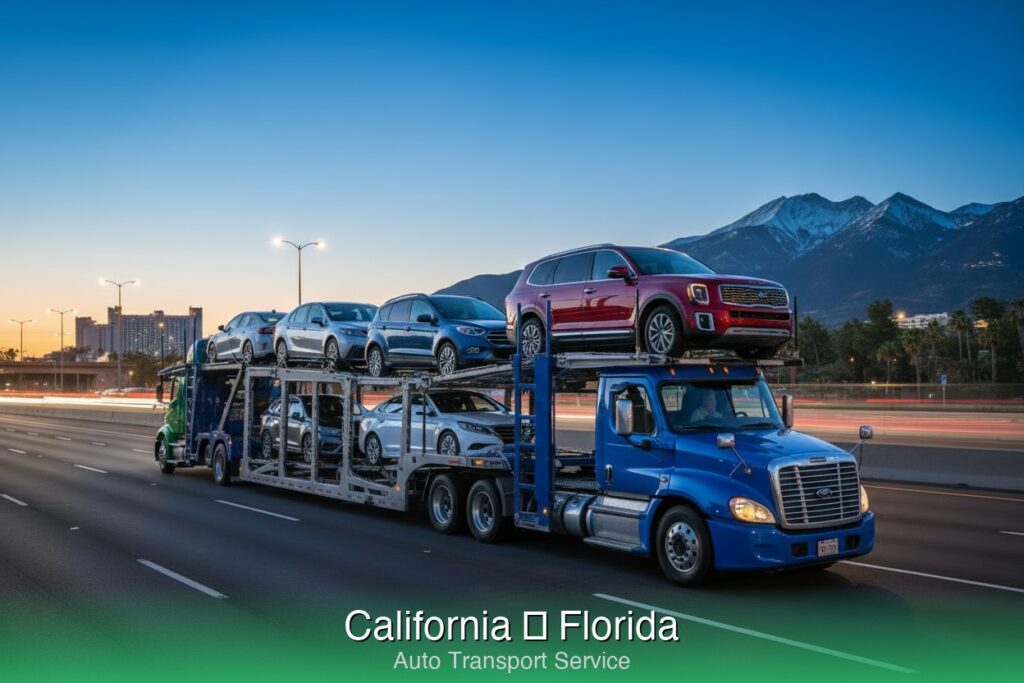
California to Florida car shipping is one of the longest common domestic vehicle-transport moves. Because the route spans the country, the most useful way to estimate it is by combining distance, vehicle size, transport type, access, schedule, and current carrier availability rather than relying on one fixed California-to-Florida price.
Los Angeles to Miami, San Diego to Tampa, and San Francisco to Orlando are all different shipments even though each starts in California and ends in Florida.
How California to Florida Car Shipping Works
The vehicle is picked up in California, loaded onto a multi-car transporter, and moved across the country toward Florida. Most standard vehicles use open auto transport. Vehicles needing additional protection can use enclosed transport.
The carrier may pick up and deliver several vehicles during the cross-country trip, so the shipment is planned as part of a complete route rather than as a nonstop point-to-point drive.
What Affects California to Florida Car Shipping Cost?
- Exact California pickup ZIP code
- Exact Florida delivery ZIP code
- Total route mileage
- Vehicle size and weight
- Whether the vehicle is operable
- Open versus enclosed transport
- Seasonal demand
- Carrier availability
- Residential pickup and delivery access
- Flexibility in the pickup window
Long-distance planning range
For routes over 1,500 miles, a broad planning framework may be around $0.40-$0.65 per mile for open transport and $0.65-$1.15 per mile for enclosed transport.
These are planning ranges only. They are not national averages, live rates, or guaranteed California-to-Florida prices. Your actual quote depends on the real addresses, vehicle, dates, and carrier market at the time of booking.
For more context, see our car shipping cost-per-mile guide and cross-country shipping cost guide.
California Pickup Factors
Southern California, the Bay Area, Sacramento, and inland California do not produce identical routes. The carrier may already be moving through a major metro or may need additional mileage to reach a more remote origin.
Pickup access is also important. Large carriers need adequate room to stop, turn, and load safely. If the address is difficult, the driver may suggest a nearby meeting point.
Florida Delivery Factors
Miami, Fort Lauderdale, Orlando, Tampa, Jacksonville, Naples, and Florida’s smaller communities create different final-mile routing requirements. A delivery location that requires substantial travel away from the carrier’s main route can affect both timing and price.
Gated communities, low trees, narrow residential roads, and restricted loading areas can also require a nearby meeting point.
Route-specific planning
Planning to Ship a Vehicle?
Get a vehicle shipping quote based on your route, vehicle, and workable dates.
Get My Quote
How Long Does California to Florida Car Shipping Take?
For routes over 1,500 miles, a broad transit-planning range after pickup is around 4-7 days. A coast-to-coast shipment can take longer depending on the precise city pair, driver schedule, loading sequence, traffic, weather, and other scheduled vehicles.
This is not a guaranteed delivery window. See our transit-time guide for the difference between pickup timing and transit timing.
Open vs. Enclosed Transport
Open transport is the normal choice for most standard vehicles. Enclosed transport is often considered for collector cars, rare vehicles, low-clearance cars, or vehicles that need additional protection from road exposure.
The route distance alone does not mean enclosed transport is necessary. Choose based on the vehicle and the level of protection you want. See our open vs. enclosed transport guide.
Shipping a Non-Running Car
If the vehicle cannot move under its own power, tell the transporter before booking. The shipment may require winch-equipped equipment and can have fewer compatible carriers.
Read our non-running vehicle shipping guide.
Seasonal and Scheduling Factors
Cross-country auto transport demand changes throughout the year. Summer moves, holidays, severe weather, and regional demand can all affect carrier availability.
No month is automatically cheapest for every shipment. If your schedule is flexible, compare several pickup windows and use current quotes instead of assuming a fixed seasonal discount.
See our best time to ship a car guide.
Vehicle Preparation
Before pickup, wash and photograph the vehicle, remove loose belongings, check the tires and battery, and tell the carrier about any operational issues.
The driver should document the vehicle’s condition on the Bill of Lading. Review the condition report at pickup and again before signing at delivery.
Use our full vehicle preparation checklist.
Insurance Questions to Verify
Once a carrier is assigned, ask for the carrier’s cargo insurance certificate and verify the coverage limits, deductible, exclusions, and claim procedure.
Do not assume that every carrier provides identical protection or that a generic insurance statement applies to your vehicle. Read our car shipping insurance guide.
Personal Items in the Vehicle
Personal-item policies vary by carrier. There is no universal allowance that should be assumed for every shipment. Ask the assigned carrier what is accepted and whether personal property would be covered.
See can you ship personal items in your car?
Relocating to Florida
If the shipment is part of a permanent move, vehicle registration, insurance, licensing, tax, or residency requirements may also apply. Those requirements are separate from the transportation service and can change over time.
Verify current requirements directly with the relevant Florida agencies and your insurer instead of relying on an auto-transport article for legal or regulatory guidance.
Common California to Florida Shipping Mistakes
- Treating a generic state-to-state number as a live quote
- Assuming Los Angeles, San Diego, San Francisco, and inland California have identical routing
- Planning around a guaranteed delivery date that has not actually been guaranteed
- Waiting until pickup day to disclose that the vehicle does not run
- Choosing enclosed transport only because the trip is long
- Skipping pickup and delivery condition inspections
- Relying on outdated relocation or registration information
How to Get an Accurate California to Florida Quote
Provide both ZIP codes, the vehicle year/make/model, whether the vehicle runs, preferred transport type, and a realistic pickup window.
Read how to get an accurate car shipping quote.
Frequently Asked Questions
How much does it cost to ship a car from California to Florida?
The exact rate depends on the vehicle, city pair, transport type, dates, access, and carrier availability. For planning, routes over 1,500 miles may fall around $0.40-$0.65 per mile open and $0.65-$1.15 enclosed, but these are not guaranteed route quotes.
How long does California to Florida car shipping take?
A broad planning range after pickup for a 1,500+ mile shipment is around 4-7 days. Coast-to-coast moves can take longer depending on the full route and operating conditions.
Is open transport safe for a coast-to-coast shipment?
Open transport is the standard method used for most vehicles. Enclosed transport is generally chosen when the vehicle needs additional protection or specialized handling.
Does the California pickup city affect the quote?
Yes. California is large, and carrier access and route mileage vary between different metros and inland locations.
Do I need to complete Florida registration before the car arrives?
Transportation and registration are separate matters. If you are becoming a Florida resident, verify the current registration and insurance requirements directly with the relevant state agency and your insurer.