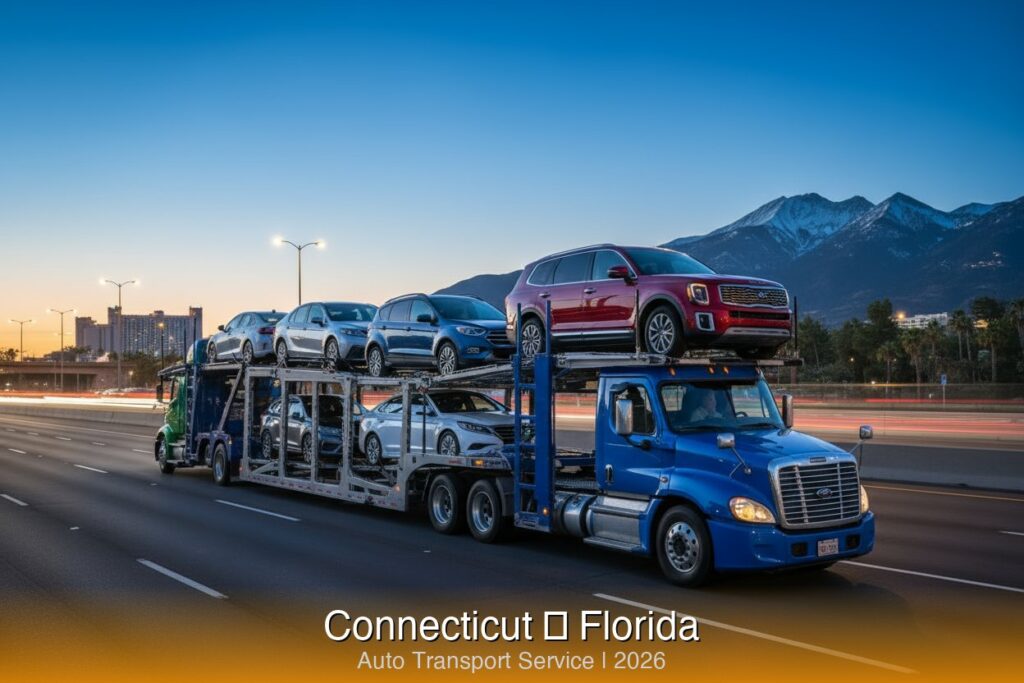
Look at Connecticut’s own price list for this route and something is wrong with it. Stamford is the closest point in the state to New York, the shortest drive to the interstate and the first place a southbound carrier would logically reach. It is also the most expensive place in Connecticut to ship a car from — $50 above Hartford, which is fifty miles further from Florida.
That inversion is not an error. It is the whole character of this route, and the explanation is that your car and the truck carrying it are not allowed on the same roads.
Connecticut’s two most useful north-south routes, the Merritt and the Wilbur Cross Parkways, ban commercial vehicles outright — they were built with stone bridges too low for a truck to pass under. Which leaves I-95 through Fairfield County, one of the most reliably congested stretches of interstate in the United States. A car carrier working the south-west corner of the state has one road available and it is the wrong one.
Everything below follows from that.
- What It Actually Costs
- City-to-City Price Breakdown
- How Long the Journey Takes
- Seasonal Pricing: When to Book
- Open vs. Enclosed Transport
- What a Connecticut to Florida Booking Looks Like
- The Complete Shipping Process
- Vehicle Preparation Checklist
- 7 Mistakes That Cost You Money
- Insurance and Liability Explained
- Frequently Asked Questions
What It Actually Costs
Connecticut to Florida: $800 – $1,050
Open Transport | 1,250-1,330 Miles | 4-6 Days Transit
Enclosed runs $1,250-$1,400. That is roughly $0.64-$0.76 a mile on open transport, which is ordinary for the distance — the interesting part of this route is not the headline number but how it varies across sixty miles of a small state.
The Access Premium
Roughly $75 of the range is a Fairfield County surcharge that nobody calls a surcharge. A driver collecting in Stamford or Greenwich is committing to I-95 at whatever hour they arrive, with no parkway alternative and no realistic way to route around the traffic. That time comes out of an eleven-hour driving day, and it is priced accordingly.
Hartford, inland and on I-91, has none of that problem. It is further from Florida and it is cheaper, which is the opposite of how distance normally works.
By Vehicle
A sedan or compact starts at $800-$875 open and $1,250-$1,350 enclosed. A crossover or mid-size SUV is about $50 higher, and a full-size SUV or pickup $50 to $175 above that — a trailer earns by the slot, and a tall vehicle takes the airspace the slot above it would have used.
Above $75,000 in value the band moves to $925-$1,100 open, reflecting the carrier’s insurance exposure. Oversized vehicles run $1,050-$1,200 open and up to $1,700 enclosed, because they typically need the top deck and that narrows the field of trailers considerably.
What Moves the Number
- Which corner of the state: $75, and it runs the opposite way to distance
- The month: $150-$250, the largest lever on any snowbird lane
- Lead time: $100-$150 inside five days, and much more in October
- Vehicle size: about $250 across the standard range
- Trailer type: roughly $450 for enclosed
- Whether the collection address is reachable by a 75-foot rig: nothing, if you sort it out in advance
City-to-City Price Breakdown
This is the table that makes the point.
Inland, and Cheaper
Hartford to Miami is $800-$900 open, $1,250-$1,400 enclosed, four to five days. It is the floor for the state. Hartford sits on I-91, which meets I-95 south of the worst of the congestion, and a carrier can get in and out of it without losing an afternoon.
New Haven adds about $25. It is on the coast but at the eastern end of the bottleneck rather than inside it.
Coastal, and Dearer
Stamford and Bridgeport are $850-$950 open, and Stamford is quoted at five to six days rather than four to five. Both are nearer to Florida than Hartford by every measure a map offers. Both cost more and take longer.
The reason is the road. South-western Connecticut has no truck-legal alternative to I-95, and I-95 there carries traffic it was designed for in the 1950s. A driver who reaches Stamford at four in the afternoon has effectively lost the rest of the day.
What You Can Do About It
Two things, and both are free. Offer a morning collection window rather than an afternoon one — a driver working Fairfield County before the traffic builds is a driver who will quote you the lower end. And nominate a collection point on the inland side of the town, near an exit, rather than deep in a coastal residential grid.
The realistic combined band is $800-$1,050 open and $1,250-$1,475 enclosed, at four to six days.
How Long the Journey Takes
Four to five days from Hartford, five to six from the south-western corner. Add one to three days for a carrier to accept the load, and more than that in October.
The First Two Hours
Almost all of the variance on this route happens before the truck leaves New England. Getting out of Connecticut and through the New York metropolitan area is the hard part: I-95 through Fairfield County, the crossing itself, and then the run down through New Jersey. After that it is a straightforward interstate journey.
Drivers know this, which is why so many of them prefer to collect in Connecticut early in the morning and be south of the city before the day starts properly. It is worth accommodating.
The Rest of the Road
I-95 the whole way, in practice: through New Jersey, Delaware and Maryland, past Washington and Richmond, into the Carolinas, through Savannah and across the state line at Jacksonville. Then south to Miami or west on I-4 to Tampa. Flat, low, and open year-round.
The one recurring hold-up south of New York is the corridor between Washington and Richmond, which costs hours rather than days.
Why the Estimate Is a Range
Federal rules cap a driver at eleven hours of driving inside a fourteen-hour window. Time spent stationary in traffic is time spent inside that window, so a bad afternoon in Fairfield County does not get made up later — it simply pushes the arrival a day deeper into the range.
No company in this industry can guarantee a delivery date, and one that offers you a date on this particular route has not thought about it very hard.
Seasonal Pricing: When to Book
Connecticut sits in the heart of the north-eastern snowbird belt, and the seasonal swing here is as pronounced as anywhere in the country.
October and November
The peak, and a sharp one. Rates climb $150-$250 and carriers stop needing to compete for your business. The mechanism is simple enough: southbound trailers fill instantly, northbound ones return empty, and the cost of that empty return is folded into what you pay going down.
April reverses it exactly, which is worth remembering if you are the one bringing the car back.
The Compounding Problem
In October the Fairfield County access premium and the seasonal premium stack. A Stamford collection at the height of the season is the least attractive load in the north-east: an awkward pickup, on a congested road, in the one month when a driver has better options everywhere.
This is the single situation on the route where the wait can genuinely stretch, and it is entirely avoidable with notice. Six weeks in August, not six days in October.
The Good Months
February through April southbound is cheapest and easiest. May and September are nearly as good and are often quieter still. Anyone with flexible dates who moves an October departure into September has made the largest saving available on this page.
Against the Flow
A car heading north out of Florida in October, or south in April, is exactly the load carriers are short of. Expect a rate below the ordinary one rather than above it. On a corridor this seasonal, running counter to the crowd is the only genuine discount on offer.
Route-specific planning
Planning to Ship a Vehicle?
Get a vehicle shipping quote based on your route, vehicle, and workable dates.
Get My Quote
Open vs. Enclosed Transport
Around $450 apart on this route. Nine cars on an open deck against two or three inside a box.
Open carriers are the same trucks that deliver new stock to dealerships, which tells you most of what you need to know about the risk. Fewer than one in a hundred shipped vehicles picks up any damage at all, and when it happens it is nearly always during loading rather than on the road.
The Scarcity Problem in South-Western Connecticut
There is an argument for enclosed here that is nothing to do with weather. Enclosed trailers are less common than open ones everywhere, and this corner of the state is already the hardest place in the north-east to persuade a driver into. An enclosed booking out of Stamford in October is a small pool inside a small pool.
If you need enclosed from Fairfield County, give it a fortnight rather than a few days. From Hartford the pressure is much lower.
Reasons That Do Justify It
- The car sits low enough that an open ramp would catch the front splitter
- Its value exceeds whatever the open carrier’s certificate names per vehicle
- The paint is factory-original and difficult to match
- An agreed-value or club policy makes enclosed a condition of cover
A January departure does put the car on salted road for its first hours, which matters for a collector vehicle and not much for anything else. Full comparison: open versus enclosed auto transport.
What a Connecticut to Florida Booking Looks Like
These are composites rather than customers — five bookings of the kind this lane sees regularly, priced from the bands above, to show where a quote comes from.
A Hartford snowbird departure booked in August
Mid-size sedan, Hartford to Naples, collected in the third week of October, arranged ten weeks ahead. Around $900. The same booking made a week before travel would have been near $1,100, and might have gone unclaimed for days.
The same trip from Stamford
Identical car, identical destination, identical dates. Around $975, and quoted at five to six days rather than four to five. Fifty miles closer to Florida, seventy-five dollars dearer and a day slower — the access premium in its purest form.
A Stamford booking that avoided it
Same origin, but with a 7am collection window offered at a retail car park just off the interstate rather than a residential street near the shore. Around $900. The driver was through New York before the traffic, and the saving was simply the cost of an easier morning.
A car going north in November
Compact, Fort Lauderdale to New Haven, in the middle of the southbound rush. Around $725 — under the southbound floor for the same distance, because the truck was returning empty either way.
A low-clearance car in February
Sports car, Hartford to a Miami storage unit, booked a fortnight out. Enclosed, around $1,400. The ramp angle decided it rather than the season; the winter road was a secondary reason and the owner would have made the same choice in June.
The Complete Shipping Process
A single carrier handles the car end to end. There is no transfer and no yard in between.
Booking and assignment
You provide both addresses, the vehicle details and a date window; the load then goes out to carriers building southbound trailers. From Hartford that is typically a day or two. From Fairfield County it takes longer, and in autumn it can take several days — which is the argument for booking well ahead rather than for paying more.
On acceptance you receive the carrier’s name, the driver’s number and a collection window.
Collection
You and the driver walk round the car and whatever is already wrong with it goes onto the Bill of Lading. Take your own daylight photographs first — between those and the form, you hold the only record of the car’s condition before it moved. Your signature is you agreeing that record is right, so read it before you sign.
Be ready at the start of the window if you have offered an early slot. The whole benefit of a morning collection here is lost if the driver waits.
In transit
Four to six days. The driving day is capped at eleven hours by federal rule, so nobody goes faster for a fee, and you will generally find the driver easier to reach than a tracking page is to trust.
Delivery
The inspection happens again, and only this second one carries any consequence. Do it in daylight with your collection photographs to hand, get low enough to see the sills and the valance, and put anything you find on the paperwork before your name goes on it. A signature with no exceptions ends the matter permanently.
Step by step: how car shipping works, start to finish.
Vehicle Preparation Checklist
None of it is difficult and hardly any of it involves a spanner. Half an hour is enough.
- Take pictures in daylight, on the day. Every panel, both bumpers, the alloys, the roof, the glass, and underneath if you can manage it.
- Wash it beforehand, so a light scuff shows up in those pictures rather than hiding under winter road film.
- A quarter of a tank. Enough to drive on, drive off and reach a filling station; more is weight the trailer has to account for.
- Clear the cabin out. The licence a car carrier holds does not cover freight, so anything left inside is outside every policy on the truck.
- Take the E-ZPass out of the windscreen. It will read perfectly well from a moving trailer across half a dozen states.
- Fold the mirrors in, drop the aerial, strip roof bars and bike racks. Anything that sticks out is something that can catch.
- Warn the driver about any leak, soft battery or starting trick instead of letting them find out halfway up a ramp.
- Check the tyres. The car drives on and off under its own power twice.
One item specific to this route: if your street is in a dense coastal grid, work out where the truck will actually stop before the driver rings to ask. Full checklist: preparing your vehicle for transport.
What Actually Costs You Money on This Lane
Offering an afternoon collection in Fairfield County
The one that is specific to Connecticut and the one nobody warns you about. A driver reaching Stamford at four o’clock has lost the evening; a driver reaching it at seven in the morning is south of New York by ten. That difference is worth about $75 to them, and they will quote it either way.
Booking an October departure in October
The snowbird peak is six weeks long and completely predictable. Arranged in August it costs the normal rate; arranged three days out it costs $200 more, if it is taken at all. From the south-west corner in autumn, that “if” is doing real work.
Assuming closer to Florida means cheaper
It does not, in this state. Hartford is further away and less expensive than Stamford, because a truck can get in and out of Hartford. Distance is only one input and here it is not the dominant one.
Taking the lowest quote
The figure you are given is one a broker hopes a driver will accept; it binds nobody until one does. Set too low, the load goes unclaimed, and the call explaining that the price has to move usually arrives too late to start again elsewhere. Margins on a run like this are five to ten per cent.
Not saying where the truck can actually stop
A seventy-five-foot rig cannot enter most of the older shoreline streets. Sorted out at booking, this costs nothing. Discovered on the day, it means a driver circling a neighbourhood on the phone while the rest of the load waits.
Signing the delivery paperwork without looking
The most expensive minute of the entire process. Once your name is on it with no exception noted, there is no way back to a claim.
Filling the boot for the trip south
Tempting when the car is going to a second home, and covered by nothing. It also counts against what the trailer may legally weigh, and a driver who notices can decline the vehicle where it stands.
The general list is in why car shipping prices vary.
Insurance and Liability Explained
Cover comes from the carrier. Every one we dispatch holds the cargo policy federal law requires of it, and your car falls under that policy from the moment it is on the deck until the moment it is off again. You are not asked to buy anything.
What it covers
Physical damage on the road and during loading and unloading. The figure worth asking for is the per-vehicle limit named on the certificate, which is not always as high as owners assume — and if your car is worth more than it, that is a concrete reason to look at enclosed transport, where the limits are generally higher.
What it does not
A late arrival, under any policy anywhere in this industry. On this route the delay that actually happens is traffic between Connecticut and New Jersey, and nothing insures against an afternoon on I-95. Belongings left in the car are outside the policy too, since the carrier’s authority does not extend to freight.
How a claim gets decided
By two pieces of paper. The Bill of Lading signed at collection fixes what the car looked like going on; the one signed at delivery fixes what it looked like coming off. The carrier answers for the difference, and for nothing you accepted without noting it.
Find damage and you write it on the delivery copy before signing, photograph it where the car is standing, and file immediately. Full detail: car shipping insurance and liability.
Frequently Asked Questions
How much does it cost to ship a car from Connecticut to Florida?
$800-$1,050 open and $1,250-$1,400 enclosed for a standard vehicle over 1,250 to 1,330 miles — about $0.64-$0.76 a mile.
Why does Stamford cost more than Hartford when it is closer to Florida?
Because a car carrier in south-western Connecticut has one legal road and it is I-95. The Merritt and Wilbur Cross Parkways ban commercial vehicles — the bridges are too low — so there is no alternative when the interstate is jammed. That lost time is worth roughly $75 to a driver, and Hartford, inland on I-91, does not impose it.
Can I do anything about that premium?
Yes, and it costs nothing. Offer an early-morning collection window and nominate a car park near an interstate exit rather than a shoreline residential street. A driver who clears New York before the traffic will often quote the lower end of the band.
How long does it take?
Four to five days from Hartford, five to six from the south-west corner, plus one to three days for a carrier to accept the load.
Where does the time actually go?
Mostly in the first two hours. Getting out of Connecticut and past New York is the difficult part; everything south of New Jersey is ordinary interstate driving. Since the driving day is capped at eleven hours by federal rule, an afternoon lost to traffic is not recovered later.
When is the cheapest time to ship?
February through April, with May and September close behind. Shifting an October departure into September saves more than every other decision on this page.
Why is October so expensive?
The snowbird migration out of the north-east. Southbound trailers fill instantly, northbound ones come back empty, and the cost of that empty return goes into your rate. Expect $150-$250 more, and from Fairfield County expect the wait to lengthen as well.
Is northbound cheaper?
In autumn, distinctly — a truck heading north in October is running empty otherwise. In spring the advantage flips. Shipping against the seasonal flow is the only real discount this corridor offers.
How far ahead should I book?
A week is fine most of the year. For October, six weeks. For enclosed transport out of Fairfield County at any time of year, a fortnight.
Does it matter where in Florida the car is going?
About $25 between Miami and Fort Lauderdale. The peninsula is so heavily served by southbound carriers that the last stretch is close to free — the opposite of the situation at the Connecticut end.
Will a truck reach my street?
In Hartford, usually. In the older shoreline neighbourhoods, often not — a seventy-five-foot rig needs somewhere to turn. Agree a car park within a few miles when you book and the problem disappears.
Should I just drive it?
About twenty hours, so two days honestly done. Fuel, a night, meals and 1,250 miles of wear come to roughly $550-$600, against $800-$900 to ship plus a flight. Genuinely close, and it usually turns on whether you want to spend two days on I-95.
Is my car insured in transit?
It is, through the cargo cover every carrier is federally obliged to hold, live from the moment the wheels are on the deck until they are off. Ask for the per-vehicle limit on the certificate. Nothing insures a late arrival.
Can I pack things in the car?
No, and it comes up constantly on a route where people are moving to a second home. A car carrier’s licence does not extend to freight, so a loaded boot sits outside every policy on the truck and counts against the trailer’s legal weight.
Ready to ship your car from Connecticut to Florida?
Get your free instant quote and see exactly what your route costs in 2026.
More From Our Shipping Guides
- open or enclosed, and how to choose
- how booking and pickup work
- the basics of shipping a vehicle
- what it costs to ship a car
Related reading
The same snowbird corridor from neighbouring states: Massachusetts to Florida joins this road an hour north, and New York to Florida starts on the far side of the bottleneck this page is about.
Where the same access logic applies: New Jersey to Florida shares the metropolitan crossing, and Pennsylvania to Florida is a state where geography splits the price in a different way.
On the mechanics: how snowbird season sets auto transport prices, transit times by distance and what the carrier’s cover includes.