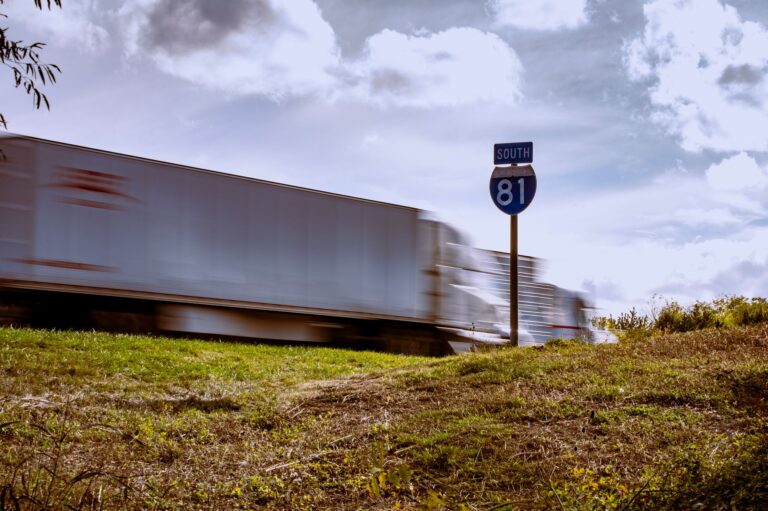
Nashville to Los Angeles is the closest thing in American freight to a straight line. Interstate 40 leaves Nashville heading west and does not stop being the right road until Barstow, California — some 1,900 miles later, at which point there is barely 130 miles left to run. One interstate, eight states, almost no decisions.
That matters more than it sounds. Most transcontinental routes are stitched together from three or four highways, and every junction is somewhere a carrier can be delayed, diverted or tempted by a better-paying load. This one has almost none of that, which is why transit times here hold up better than the distance would suggest.
The complication is not the road. It is the altitude. I-40 looks like a southern route on a map, and for the first half it behaves like one. Then it climbs the Colorado Plateau and spends several hundred miles above 6,000 feet, topping out near Flagstaff at around 7,300. Between December and March that stretch is a genuinely wintry road, and it is the single thing most people booking this route have not accounted for.
- What It Actually Costs
- City-to-City Price Breakdown
- How Long the Journey Takes
- Seasonal Pricing: When to Book
- Open vs. Enclosed Transport
- What a Nashville to Los Angeles Booking Looks Like
- The Complete Shipping Process
- Vehicle Preparation Checklist
- 7 Mistakes That Cost You Money
- Insurance and Liability Explained
- Frequently Asked Questions
What follows is the whole run in order: what it costs, what moves that number, how the road behaves in each season, and what to do at the two inspections that decide whether anything goes wrong.
What It Actually Costs
Nashville to Los Angeles: $1,250 – $1,400
Open Transport | ~2,010 Miles | 5-7 Days Transit
Enclosed runs $1,850-$2,000 for the same vehicle. On open transport the rate works out at roughly $0.62-$0.70 a mile, which is where long hauls settle once the fixed costs of the job have been spread thin enough to disappear.
Why Long Is Cheap Per Mile
Every shipment carries the same overhead regardless of distance: two appointments, two inspections, the loading and strapping, the paperwork, the dispatch. On a 500-mile run those costs are a third of the invoice. Spread across 2,010 miles they round down to nothing, and what you are left with paying for is fuel, hours and deck space.
This is why a route twice as long is never twice the price, and why the cheapest per-mile shipping in the country is on exactly these coast-to-interior hauls.
By Vehicle
A sedan or compact sits at the floor, $1,250-$1,325 open and $1,850-$1,950 enclosed. A mid-size SUV adds about $50. A full-size SUV or pickup adds $100 to $275 on top of that, because a trailer sells height as well as length and a tall vehicle costs its neighbour a slot.
Past $75,000 in value the number moves again, to $1,375-$1,650 open, though that is the carrier’s insurance exposure rather than anything physical. Oversized vehicles — duallies, extended vans, anything lifted — run $1,600-$1,750 open and up to $2,600 enclosed, because they frequently have to travel on the top deck and that restricts which trailers can take them at all.
What Moves the Number
- The month: $150-$250 across the year on this corridor, and in winter the question is availability rather than price
- Lead time: $100-$200 for booking inside five days
- Vehicle size: around $350 from the smallest to the largest standard car
- Trailer type: roughly $600 to put walls round it
- Where in the Nashville area: about $100 across the metro
- Where in the LA basin: another $100, and more if the address is genuinely tight
City-to-City Price Breakdown
Both ends of this route are metros rather than points, and where you sit inside them moves the quote by roughly $100 apiece.
The Nashville End
Nashville proper prices lowest, at $1,250-$1,350 open. Franklin and Brentwood add around $25, Murfreesboro around $50. The gaps are small for a reason that is specific to this route: every one of those suburbs feeds onto the same westbound I-40 within half an hour, so a carrier collecting in Murfreesboro is not detouring so much as starting slightly late. On routes where the suburbs sit off the lane, the spread is wider.
The Los Angeles End
Delivery into Los Angeles itself is the baseline. Santa Monica and the Westside add about $25, and that increment is congestion rather than distance — a truck that comes off I-210 and crosses the basin in afternoon traffic has spent an hour it cannot bill.
Combining both ends, the realistic band runs $1,250-$1,450 open and $1,850-$2,100 enclosed, with transit of five to six days from Nashville and six to seven from the outer suburbs.
One Thing Worth Agreeing in Advance
Large parts of the LA basin are not navigable by a seventy-five-foot rig — the hillside streets, the older Westside grid, anywhere with a low-clearance approach. Nominate a large car park within a few miles when you book. It costs nothing, and it prevents the one failure that reliably turns a delivery day into a delivery week.
How Long the Journey Takes
Five to seven days on the road, plus one to three days for a carrier to accept the load. Six to ten days from booking to delivery is the honest window.
The Road, in Order
West out of Nashville on I-40 through Memphis, across the Mississippi into Arkansas, over Little Rock and into Oklahoma. Oklahoma City, then Amarillo and the Texas Panhandle. New Mexico brings Tucumcari and Albuquerque, and this is where the ground starts rising in earnest. Flagstaff, Arizona, sits at 6,900 feet with the road cresting higher just east of it. Then the long fall through Kingman to Barstow, and I-15 into the basin.
Eight states, one interstate for all but the last 130 miles. A driver on this run makes fewer routing decisions than on almost any comparable distance in the country.
Why That Buys You Reliability
Junctions are where schedules come apart. Each one is a place a carrier can be re-routed by construction, pulled aside by a better-paying load in a different direction, or simply held in metropolitan traffic. A route that is essentially one road has very few of those, and the practical result is that estimated transit on this corridor holds up better than the mileage alone would predict.
The Exception Is Overhead
Roughly 400 miles of this route, from central New Mexico through to western Arizona, sits above 6,000 feet. In summer that is pleasant driving. Between December and March it is a mountain road with a southern reputation, and I-40 around Flagstaff closes to commercial traffic several times most winters.
A closure does not usually cost days. It costs the hours a driver waits it out, and those accumulate into a delivery that lands at the far end of the window rather than the near end. Book winter transport with that in mind and it is a non-event.
Route-specific planning
Planning to Ship a Vehicle?
Get a vehicle shipping quote based on your route, vehicle, and workable dates.
Get My Quote
Seasonal Pricing: When to Book
Two separate things move across the year on this corridor, and they do not move together. One is price. The other is whether the high ground is open.
Price
Cheapest in late winter and early spring, roughly February through April, when national relocation volume is at its annual low and carriers have deck space to fill. Dearest from June to mid-August, the standard summer moving peak, which adds $150-$250. September and October settle back down. The second half of December thins as drivers stop for the holidays, which tightens availability without much affecting the rate.
Passability
This is the calendar that matters more here. December through March, the Flagstaff stretch can close, chain restrictions can go up, and a driver may sit for half a day. It rarely changes the price — carriers absorb weather into their scheduling rather than surcharging for it — but it widens the delivery window.
Where They Disagree
February is among the cheapest months and among the least predictable. April is the resolution: still inexpensive, and the plateau is reliably clear by then. If your dates are genuinely open, April is the best month to move a car west on I-40.
If they are not, winter shipping here is entirely routine — thousands of cars make the crossing every January. Build three days of slack into the delivery end and do not book a tight flight against it.
Open vs. Enclosed Transport
Around $600 separates them on this route. Nine cars in the open air against two or three behind walls, and the difference is almost entirely a question of what the vehicle is.
Open transport is what manufacturers use to deliver new cars to dealerships, which is the most useful thing to know about it. If it is adequate for a vehicle nobody has driven yet, it is adequate for one you have.
The Argument Specific to This Route
Winter shipments here spend several hundred miles on treated mountain road. Magnesium chloride and salt brine get onto the underside of everything on an open deck, and while a wash resolves it for most cars, it is a real consideration for a collector vehicle, anything with exposed chrome underneath, or a car whose paint you are not prepared to have re-detailed on arrival.
Between May and October that argument does not apply, and the honest advice for a standard car in summer is open transport without hesitation.
When Enclosed Is the Right Answer Regardless
- Ground clearance too low for an open trailer’s ramp angle
- A car whose value would make an open-carrier deductible painful
- Anything with unrepeatable paint or period trim
- A vehicle that cannot be exposed to road debris for insurance or warranty reasons
The full comparison is in our guide to open versus enclosed auto transport.
What a Nashville to Los Angeles Booking Looks Like
The shapes below are typical of this corridor rather than accounts of particular customers. Prices are the ranges quoted above; they are meant to show which factors move a quote and by how much.
A relocation booked in April
Mid-size SUV, Nashville to a Westside address, booked eleven days out. Open transport, around $1,375 with the Santa Monica increment. Collected on the second day of the window, delivered on the sixth. The month did most of the work here: the same booking in July would have run $150 higher and been harder to place.
A car bought at distance
A sedan purchased online, collected from a Franklin seller and delivered to a residential street in Los Angeles. Open, $1,275-$1,375. The buyer had never seen the car, which makes the delivery inspection the whole event — and worth doing slowly, with the pickup photographs on a phone alongside.
A January shipment
Full-size pickup, Murfreesboro to the San Fernando Valley, booked with a nine-day delivery window rather than a date. Open, around $1,500. The carrier stopped a night short of Flagstaff waiting for a system to clear and arrived on the eighth day. Inside the window, and the reason the window was drawn that way.
A collector car in February
Low-clearance classic, Brentwood to a Los Angeles storage facility. Enclosed, around $2,050. Two reasons rather than one: the ramp angle on an open trailer was marginal for the car, and the owner had no interest in several hundred miles of treated mountain road under it.
The Complete Shipping Process
One carrier takes the car the whole way. Nobody transfers it in Amarillo, and nothing sits in a yard between the two ends.
Booking and assignment
You give the two addresses, the vehicle and a date window; the load is posted to carriers running west on I-40. Assignment usually takes one to three days on this corridor, because the lane is busy and the direction is the one carriers want. Once a carrier accepts, you get the company name, the driver’s contact and a pickup window rather than a pickup hour — a truck ahead of yours on the same trailer determines when it arrives.
Collection
The driver inspects the car with you and records the existing condition on the Bill of Lading. Photograph every panel in daylight before this happens; those images and this document are jointly the only baseline a delivery inspection can be measured against. Then it loads, and it is your signature that says the record is accurate.
In transit
Five to seven days of I-40. Drivers are bound by federal hours-of-service limits, so a truck moving eleven hours a day covers the distance in the time it covers it — nobody is going faster for a fee. Expect to be able to reach the driver directly; expect a live map to be optimistic.
Delivery
The same inspection in reverse, and this is the one that decides everything. Walk the car in daylight against your pickup photographs, look underneath, and note anything at all on the Bill of Lading before signing. A signature without exceptions closes the claim. If there is damage, note it, photograph it, and file before you drive away.
Step by step: how car shipping works, start to finish.
Vehicle Preparation Checklist
Twenty minutes of work, and most of it is documentation rather than mechanics.
- Photograph every panel in daylight. Wheels, bumpers, roof, glass, and the underside if you can get to it. Time-stamped, immediately before collection.
- Wash it first. Not vanity — a dirty car hides exactly the sort of light scuff that becomes an argument later.
- Quarter tank of fuel. Enough to load, unload and reach a filling station. More is dead weight against the trailer’s legal allowance.
- Empty the cabin. A vehicle carrier holds no authority to move household goods, so anything left inside travels uninsured.
- Remove the toll transponder. Eight states is a long way for a tag to run unattended in a box on a windscreen.
- Fold the mirrors, retract the aerial, remove roof boxes and bike racks. Anything that projects is something to catch.
- Note any leak or mechanical quirk. Tell the driver rather than letting them discover it — a car that will not start on a ramp is everybody’s afternoon.
- Check the battery and tyres. The car has to drive on and off under its own power at both ends.
If the car is shipping between December and March, plan on washing it again at the far end. Several hundred miles of treated road leaves a residue underneath that is best not left there.
Full checklist: preparing your vehicle for transport.
What Actually Costs You Money on This Lane
Treating I-40 as a southern route
The commonest and the most expensive, because it produces winter bookings with hard delivery dates. Four hundred miles of this road sit above 6,000 feet. Plan for that and it costs you nothing; plan against it and it costs you a flight change.
Taking the lowest quote
A quote is an offer to carriers, not a promise to you. Priced below what a driver will accept for 2,000 miles, it sits unclaimed until somebody rings to say the rate has to rise — generally once your dates are too close to start again. Carrier margins are five to ten per cent; there is no discount hiding in there.
Booking three days out
$100-$200 for the privilege, and worse in July. Ten days is enough to be placed at a normal rate.
Paying for enclosed out of vague anxiety
$600 on this route. Worth it for a low-clearance or collector car, and worth it for a winter shipment you care about underneath. Not worth it for a family SUV in June.
Signing the delivery inspection quickly
The single most costly minute of the whole process. A clean signature closes the claim permanently. Look at the car properly, in daylight, against your photographs.
Leaving belongings in the car
Uninsured, against the legal weight allowance, and a reason for a driver to refuse the load at the kerb.
Quoting a hard delivery date to someone else
Nobody in this industry can guarantee a date, and any company that offers one on a 2,000-mile winter crossing is telling you something about itself. Windows, not dates.
The general list is in why car shipping prices vary.
Insurance and Liability Explained
Every carrier we dispatch runs its own federally required cargo policy, and your vehicle is covered under it from the moment it loads until the moment it comes off. You are not asked to buy anything separately.
What that covers
Physical damage in transit and during loading or unloading. Ask what the certificate states per vehicle rather than assuming it matches yours — policies vary, and if the car is worth more than the per-unit figure, that is a specific reason to consider enclosed transport, which typically carries higher limits.
What it does not cover
Delay. No cargo policy in the industry insures against a late delivery, and that distinction matters on a route with a mountain crossing on it. A driver held below Flagstaff by a closure is not a claim; it is the system working. Personal belongings are also outside the policy entirely, since a vehicle carrier has no authority to move household goods.
How a claim is actually decided
By two documents, and neither of them is a phone call. The Bill of Lading signed at collection establishes the car’s condition when it loaded. The one signed at delivery establishes its condition when it came off. Everything between those two signatures is the carrier’s responsibility; anything you sign for without exception is not.
Which is the whole argument for photographing the car before pickup and looking at it slowly on arrival. What is covered, what is not, and how to file: car shipping insurance and liability.
Frequently Asked Questions
How much does it cost to ship a car from Nashville to Los Angeles?
$1,250-$1,400 open and $1,850-$2,000 enclosed for a standard vehicle across roughly 2,010 miles. That is about $0.62-$0.70 a mile.
How long does it take?
5-7 days on the road, plus one to three days for a carrier to accept the load. Six to ten days from booking to delivery.
Is this really one road the whole way?
Very nearly. I-40 runs from Nashville to Barstow, and only the last 130 miles into the basin are on anything else. It is one of the cleanest single-interstate runs in the country, and it is why transit estimates hold up better here than the distance suggests.
Does winter affect this route?
Yes, and more than most people expect from a route that looks southern on a map. About 400 miles from central New Mexico through Arizona sit above 6,000 feet, cresting near 7,300 by Flagstaff. I-40 there closes to commercial traffic several times in a typical winter. It rarely moves the price; it widens the delivery window.
Should I ship in winter at all?
It is entirely routine — thousands of cars cross in January. Book a window rather than a date, add three days of slack at the delivery end, and do not schedule a tight flight against the early edge of it.
When is the cheapest time to ship Nashville to Los Angeles?
February through April, when relocation volume is at its low. April is the better of those, because the plateau is reliably clear by then and the price is much the same.
Does my Nashville suburb change the price?
About $100 across the metro, which is narrower than usual. Franklin, Brentwood and Murfreesboro all feed onto the same westbound interstate within half an hour, so a carrier is starting slightly later rather than detouring.
Can a truck reach my address in Los Angeles?
Often not. The hillside streets and much of the older Westside grid are genuinely impassable for a seventy-five-foot rig. Agree a large car park nearby when you book; it costs nothing and avoids the failure that most reliably wastes days.
Should I just drive it instead?
It is about 30 hours, so three days honestly done. Fuel, two nights, meals and 2,010 miles of wear come to roughly $900-$1,000, against $1,250-$1,400 to ship plus a flight. The gap is real but narrow, and it closes entirely if you would need time off work to do it.
Do you ship Los Angeles to Nashville as well?
Yes, on the same lane in reverse. Eastbound pricing is broadly similar, with availability slightly different by season since the two directions do not peak at the same time.
Is my car insured in transit?
Yes, under the carrier’s federally required cargo policy, from loading through to unloading. Ask what the certificate states per vehicle. Delay is not covered by any policy in the industry.
Can I leave things in the car?
No. A vehicle carrier holds no authority to move household goods, so anything inside travels uninsured, and the weight counts against the trailer’s legal allowance.
Ready to ship your car from Nashville to Los Angeles?
Get your free instant quote and see exactly what your route costs in 2026.
Related Guides
- choosing between open and enclosed transport
- the step-by-step shipping process
- how car shipping actually works
- what drives the price of a shipment
Related reading
Other long westbound hauls: Texas to California takes the southern interstates and stays low, and Tennessee to Texas is the first leg of this route on its own.
Other routes where altitude sets the schedule: Minneapolis to Las Vegas crosses the most closure-prone interstate in the country, and Denver to San Antonio comes down off the Front Range.
On the mechanics: transit times by distance, how per-mile pricing works on long hauls and what the carrier’s cover includes.