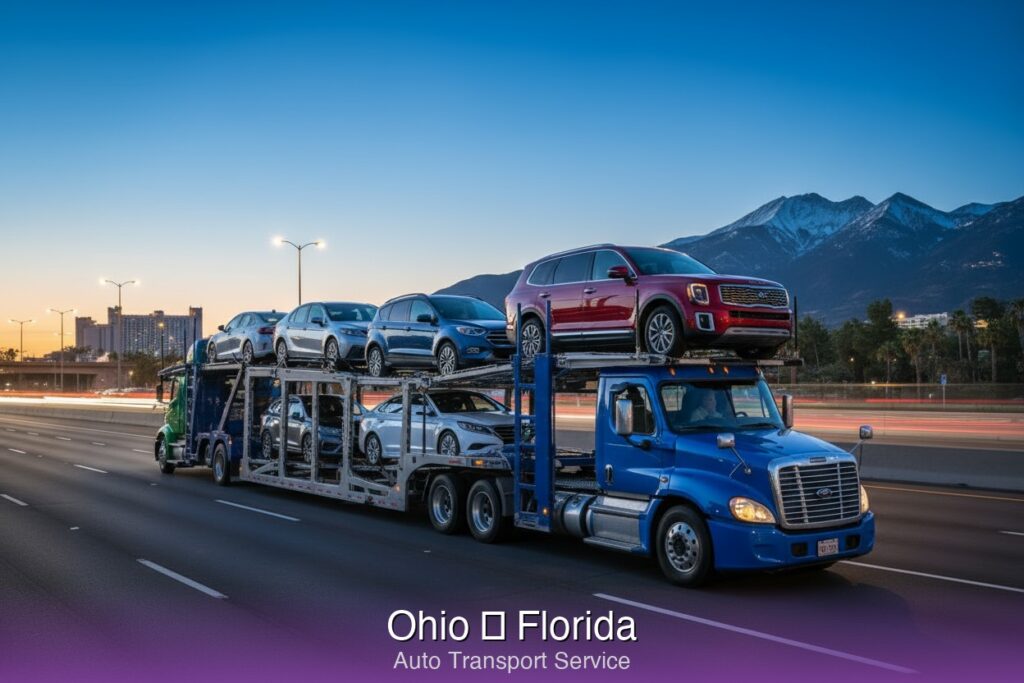
Ohio to Florida car shipping is a long-distance interstate move where the final price and schedule depend on the specific addresses, vehicle, transport type, dates, and current carrier availability.
A statewide estimate can be useful for planning, but it should not replace a quote based on the actual pickup and delivery ZIP codes.
How Ohio to Florida Car Shipping Works
The vehicle is collected in Ohio, loaded onto an auto transporter, and moved south toward Florida. Most everyday vehicles use open auto transport. Enclosed transport is available when the vehicle needs additional protection or specialized handling.
The carrier may have several vehicles on the same load. Pickup order, delivery sequence, traffic, weather, and other scheduled stops therefore affect the route and timing.
What Affects the Cost?
- Exact pickup and delivery ZIP codes
- Total route mileage
- Vehicle size and weight
- Whether the vehicle runs and rolls normally
- Open versus enclosed transport
- Seasonal carrier demand
- Pickup and delivery access
- How flexible the available dates are
Planning range for this distance band
For routes in roughly the 500-1,500 mile range, a general planning framework may be around $0.65-$0.90 per mile for open transport and $0.90-$1.40 per mile for enclosed transport.
These are planning ranges only. They are not live rates, national averages, or guaranteed Ohio-to-Florida prices. Actual pricing depends on the shipment details and the carrier market at the time of booking.
For more context, see our car shipping cost guide and cost-by-distance guide.
Ohio Pickup Considerations
Cleveland, Columbus, Cincinnati, Toledo, and smaller Ohio communities do not create identical transport routes. The difference is usually less dramatic than in very large states, but the pickup city still determines how the vehicle fits into the carrier’s southbound collection sequence.
Dense residential access, vehicle modifications, or a pickup outside the carrier’s normal corridor can affect the quote even when the state-to-state mileage appears similar.
Florida Delivery Considerations
Florida destinations can vary considerably. Miami, Fort Lauderdale, Orlando, Tampa, Jacksonville, Naples, and smaller communities can create different final-mile routes.
Gated communities, narrow streets, low trees, restricted loading areas, or rural delivery locations may require a nearby meeting point where a large transporter can unload safely.
Door-to-door service means the carrier aims to get as close to the requested addresses as safely and legally practical. It does not mean every transporter can enter every residential street. See our door-to-door versus terminal guide.
Route-specific planning
Planning to Ship a Vehicle?
Get a vehicle shipping quote based on your route, vehicle, and workable dates.
Get My Quote
Route Planning
Ohio-to-Florida is a substantial interstate move but is not a nonstop drive. The carrier may collect or deliver other vehicles before yours, and major metro traffic along the southbound route can change the schedule.
Plan around a delivery window rather than calculating arrival from highway driving time alone.
How Long Does Ohio to Florida Car Shipping Take?
For many routes in the 500-1,500 mile band, a broad planning range after pickup is around 2-4 days. Exact transit can be longer because of the specific city pair, driver schedule, weather, traffic, other vehicle stops, and access conditions.
This is a planning range, not a guaranteed delivery window. Carrier assignment happens before transit begins. Our car shipping transit-time guide explains that distinction.
Seasonal and Snowbird Demand
Ohio-to-Florida vehicle demand can rise during seasonal southbound migration. Carrier availability and pickup flexibility may tighten during those periods.
Instead of relying on a fixed October or winter premium, compare current quotes around the dates you can actually use. A slightly broader pickup window can give dispatchers more options.
For broader seasonal planning, see our snowbird car shipping guide and best time to ship a car.
Open vs. Enclosed Transport
Open transport is the standard choice for most daily-use vehicles. Enclosed transport may make sense for collector cars, rare vehicles, low-clearance cars, or vehicles where additional protection is important.
The route itself does not automatically require enclosed transport. Make the decision based on the vehicle and the level of protection you want. Compare both options in our open vs. enclosed transport guide.
Shipping a Non-Running Vehicle
If the vehicle does not start, steer, brake, or roll normally, disclose that before booking. The shipment may require winch equipment or a different loading setup, and fewer carriers may be compatible with the job.
See our non-running vehicle shipping guide.
How to Prepare the Vehicle
Before pickup, wash and photograph the vehicle, remove loose belongings, check the battery and tires, and tell the transporter about any mechanical or operational issues.
The driver’s pickup inspection and Bill of Lading should document the existing vehicle condition. Review that report before signing, and inspect the vehicle again at delivery before completing the final paperwork.
Use our full vehicle preparation checklist.
Insurance Questions to Verify
Once a carrier is assigned, verify the carrier’s cargo insurance certificate and ask about coverage limits, deductibles, exclusions, and the claim procedure.
Do not assume every carrier provides identical coverage. See our car shipping insurance guide for the questions to verify.
Can You Leave Personal Items in the Car?
Personal-item policies vary by carrier. Do not assume a universal weight allowance or that belongings are covered under the same terms as the vehicle.
Ask the assigned carrier what is accepted before pickup and read our personal-items guide.
Common Planning Mistakes
- Using a generic state-to-state price as though it were a live quote
- Ignoring differences between pickup cities within Ohio
- Planning a flight or appointment around the earliest estimated delivery date
- Waiting until pickup day to disclose a non-running or modified vehicle
- Choosing transport type without considering the actual vehicle
- Assuming the carrier can reach every residential address
- Skipping the pickup or delivery condition inspection
How to Get an Accurate Quote
Provide the exact pickup and delivery ZIP codes, vehicle year/make/model, operating condition, preferred transport type, and a realistic pickup-date window.
See how to get an accurate car shipping quote.
Frequently Asked Questions
How much does it cost to ship a car from Ohio to Florida?
The exact price depends on the pickup and delivery locations, vehicle, transport type, dates, access, and current carrier availability. For planning, routes in the 500-1,500 mile band may fall around $0.65-$0.90 per mile open and $0.90-$1.40 enclosed, but these are not live route quotes or guarantees.
How long does Ohio to Florida car shipping take?
A broad planning range after pickup is around 2-4 days for many routes in this distance band. The actual shipment can take longer depending on the exact route and operating conditions.
Does snowbird season affect the route?
It can affect carrier demand, pricing, and pickup flexibility. The effect changes with direction and timing, so use current quotes rather than assuming a fixed seasonal premium.
Should I use open or enclosed transport?
Open transport is suitable for most standard vehicles. Enclosed transport is generally chosen when the vehicle needs additional protection or specialized handling.
Do Cleveland, Columbus, Cincinnati, and Toledo price the same?
No. They may fall within a relatively narrow regional range, but the exact route, pickup sequence, vehicle, access, dates, and carrier availability still affect the final quote.