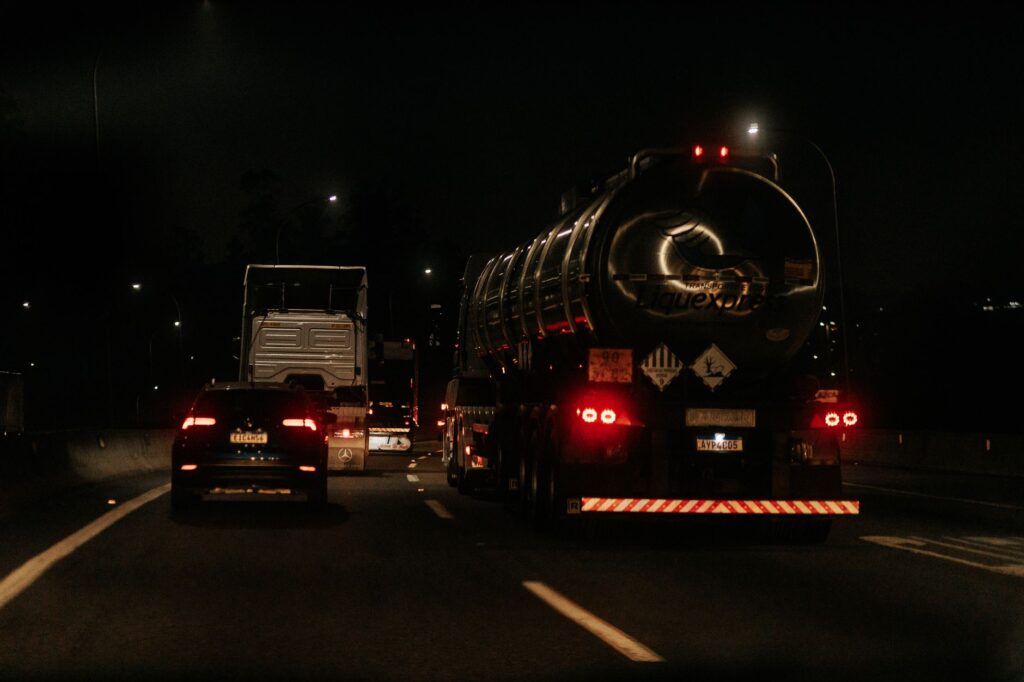
The American interstate system runs north-south and east-west. It does not run north-east to south-west, and Cleveland to New Orleans is exactly that.
There is no single road for this journey. A driver stitches it together — south on I-71 to Louisville, across to I-65 through Nashville and Birmingham, down to Mobile and west along I-10. Or I-77 and I-75 through the Appalachians, or west to Indianapolis and down I-65 from there. Three or four combinations, none of them obviously correct, all of them about eleven hundred miles.
Routes like this behave differently from routes with a road of their own. Carrier density is lower, because no trailer is running this exact line as a matter of course. Assignment takes longer. But the flexibility cuts the other way too: when weather or roadworks close one option, the driver takes another rather than waiting, which is not something a car on I-5 or I-95 can do.
Slower to book, harder to disrupt. That trade is the character of this corridor.
- What It Actually Costs
- City-to-City Price Breakdown
- How Long the Journey Takes
- Seasonal Pricing: When to Book
- Open vs. Enclosed Transport
- What a Cleveland to New Orleans Booking Looks Like
- The Complete Shipping Process
- Vehicle Preparation Checklist
- 7 Mistakes That Cost You Money
- Insurance and Liability Explained
- Frequently Asked Questions
What It Actually Costs
Cleveland to New Orleans: $700 – $900
Open Transport | 1,060-1,180 Miles | 3-5 Days Transit
Enclosed is $1,000-$1,100. Open transport comes to roughly $0.64-$0.76 per mile, which is unremarkable — the diagonal costs you in waiting rather than in money.
Why a Thin Lane Is Not an Expensive One
People expect a route with fewer carriers to price higher, and it generally does not. The cost of moving a car eleven hundred miles is the cost of moving a car eleven hundred miles: fuel, hours, deck space, insurance, equipment. Scarcity shows up in how long the load waits on the board rather than in what it eventually pays.
Which means the useful thing you can do here is give notice, not raise the rate.
By Vehicle
A saloon or hatchback is $700-$775 open and $1,000-$1,100 enclosed. A crossover adds about $50, a pickup or seven-seater $50 to $125 beyond that. Nine slots are sold on a deck and a tall vehicle intrudes on the one above.
Cars over $75,000 are $825-$950 open, reflecting the carrier’s exposure. Oversized vehicles run $900-$1,050 open and up to $1,500 enclosed, and on a lane with fewer trailers to begin with, an oversized booking narrows the field noticeably further.
What Moves the Number
- How much notice you give: $100-$150 inside five days, and here it also buys availability
- How wide your collection window is: nothing in money, and the most valuable thing you have
- Vehicle size: about $200 across the standard range
- Trailer type: roughly $300
- Which Cleveland-area address: about $50
- The month: $75-$125, plus a hurricane-season consideration at the far end
City-to-City Price Breakdown
A tight spread at the Cleveland end and a more interesting one at the delivery end.
Greater Cleveland
Cleveland to New Orleans is the floor at $700-$800 open, three to four days. Akron adds around $25 and Parma about $50, and none of those gaps reflects much more than where a driver happens to start their southbound run.
All three sit close to I-71 and I-77, which are the two roads a driver will use to get out of Ohio whichever combination they take afterwards. Collections here are straightforward.
New Orleans and Metairie
Metairie is quoted at about $25 above New Orleans proper despite being closer to the interstate, and that inversion is worth understanding. New Orleans is a delivery a driver can plan: industrial approaches on the east side, wide roads out toward the airport, and a clear route in.
The older parishes are a different matter. Much of the city predates anything resembling a modern truck, the streets are narrow, and the overhead clearances under oak canopies are genuinely marginal for a loaded car carrier. If you are delivering into the Garden District, the Marigny, or anywhere with that character, expect the driver to propose meeting elsewhere — and agree to it.
One Practical Note
A car park near the interstate on the east side of the city costs you a twenty-minute drive and removes the only access problem this route has. Arrange it when you book.
The realistic combined band is $700-$900 open and $1,000-$1,200 enclosed, at three to five days.
How Long the Journey Takes
Three to four days from Cleveland or Akron, four to five from the outer suburbs. Assignment takes two to four days, which is longer than a route of this length would normally need and is the diagonal at work.
Why Assignment Is the Slow Part
No trailer runs Cleveland to New Orleans as a matter of routine. A driver taking your car is building a route that connects the north-eastern Midwest to the Gulf, and they need eight other vehicles that fit that shape. That takes longer to assemble than a load running straight down I-75.
Nothing about this reflects the price. Widening your collection window helps considerably; raising the rate helps very little.
The Routes
Most commonly south on I-71 to Louisville, then I-65 through Nashville and Birmingham to Mobile, and west on I-10. Alternatively I-77 and I-75 down through Knoxville and Chattanooga, or west to Indianapolis and south from there. All arrive at the same place after roughly the same distance.
Why That Is Good News
Because the alternatives are genuine. A closure on I-65 does not strand a driver on this route the way a closure on I-5 strands one on the West Coast — they take a different road and arrive at much the same time.
The result is that once your car is actually moving, this is one of the more reliable corridors we run. Five to nine days from booking to delivery, with almost all of the variance at the front end.
Seasonal Pricing: When to Book
There is no migration on this corridor, so the pricing calendar is quiet. What the calendar does affect is the delivery end.
Price Across the Year
June through August adds $75-$125 as part of the national relocation season. February through April is cheapest, and September and October are close behind. Late December thins as drivers stop, which affects availability rather than rate.
On a thin lane the summer effect is felt as a longer wait rather than a bigger number, which is the same pattern as everything else here.
Hurricane Season
June to the end of November, with the genuine peak from mid-August to early October. It affects the last two hundred miles of this route rather than the whole of it — Cleveland and most of the journey are nowhere near a Gulf system.
What that means practically is that a driver may arrive in the region and wait rather than deliver, or reroute the final approach. It rarely changes the price and it does not usually cost more than a day, but a September booking should carry three days of slack at the delivery end.
Mardi Gras
Worth mentioning because people forget. For roughly a fortnight around it, large parts of the city are closed to through traffic and a car carrier will not attempt central deliveries at all. If you are shipping into New Orleans in that window, plan on a handover well outside the parade routes and arrange it in advance.
The Best Months
March through May, and November into early December. Cheap, no storm risk, no festival closures, and carriers reasonably available.
Route-specific planning
Planning to Ship a Vehicle?
Get a vehicle shipping quote based on your route, vehicle, and workable dates.
Get My Quote
Open vs. Enclosed Transport
About $300 apart. Nine cars on an open deck against two or three inside a box.
Open transport is how every new car in the country reaches its showroom, which is the most useful benchmark for the risk involved. Fewer than one shipment in a hundred picks up any damage at all, and what occurs happens at the ramps rather than on the road.
The Winter Half of the Journey
A January departure from Cleveland begins on heavily treated road and stays on it through Ohio and into Kentucky — roughly the first third of the journey. After that it is warm and clear all the way to the Gulf.
That is a meaningful exposure for a car with original underbody finish and no exposure at all for a vehicle that already winters on Ohio roads. As usual, the question is what the car is rather than what month it is.
The Availability Point
Enclosed trailers are scarcer than open ones on every route, and this lane is already thin. An enclosed booking here should be made two weeks ahead rather than a few days, or it will simply sit while you wonder why.
When Enclosed Is Right Regardless
- A front end low enough that the open ramp is itself the obstacle
- A car the standard per-vehicle limit could not replace
- Factory paint that no refinisher would match
- An insurer that has made covered carriage a condition
Full comparison: open versus enclosed auto transport.
What a Cleveland to New Orleans Booking Looks Like
Five illustrations built from what this lane carries rather than from named customers, priced from the ranges above. Each isolates one variable.
A relocation booked with two weeks’ notice
Saloon, Cleveland to Metairie, arranged fourteen days ahead in April with a four-day collection window. Around $775, assigned in two days, delivered on the fourth. Notice and flexibility did all the work; the price was never in question.
The same move at four days’ notice
Same car, same addresses, same month. Around $875 after the rush premium, and five days before a driver could build a route around it. The extra $100 bought nothing; the four days of waiting were the actual cost.
A delivery into the Garden District
Crossover, Akron to a residential street in one of the older parishes. The driver could not get a loaded carrier under the oaks and the handover moved to a car park near the interstate. Around $825, and it cost an hour rather than a day because the possibility had been raised at booking.
A September shipment
Saloon, Cleveland to New Orleans, booked with a five-day delivery window during hurricane season. Around $800. A Gulf system had the driver hold south of Birmingham for a day rather than run into it, and delivery landed on the fifth — inside the window, which is why it existed.
A February departure with a collector car
Low-mileage classic, Cleveland to New Orleans, booked a fortnight ahead. Enclosed, around $1,100. The ramp angle came into it, but so did the first four hundred miles of salted Ohio and Kentucky road, which on this route is a fair part of the argument.
The Complete Shipping Process
One carrier takes the car the whole way. Nothing is transferred in Nashville and nothing waits in a compound.
Booking
Both addresses, the vehicle and the dates you can work with. The load then goes to operators assembling routes toward the Gulf, and on this corridor that takes two to four days — the driver is building a diagonal that no standing schedule covers.
Raise the New Orleans delivery point at this stage if it is anywhere in the older parishes. Once claimed you will have the operator’s name, a number for the cab and a span of hours rather than a time.
Collection
The driver walks the car with you and every existing mark goes onto the Bill of Lading. Photograph it yourself first, outdoors. Those frames and that form together are the record both sides are held to, and your signature is what makes it agreed.
In a Cleveland winter, confirm the collection point is cleared the day before rather than on the morning.
In transit
Three to five days. A driver may not exceed eleven hours at the wheel inside a fourteen-hour window, and a good part of that window goes on the other eight cars. Ring the cab rather than watching a map — and if the route the driver describes is not the one you expected, that is normal here.
Delivery
A second walk round, and legally the only one that decides anything. Do it in daylight against your own photographs, check the lower door edges and behind the bumpers, and write down every difference before signing. An unqualified signature closes the matter for good.
Gulf humidity is worth a moment’s thought here — a car that has been sealed on a deck for four days will fog on arrival, and that is condensation rather than anything to note. Step by step: how car shipping works, start to finish.
Vehicle Preparation Checklist
Half an hour, and the bonnet stays shut.
- Photograph it outdoors before the driver arrives. Both sides, front and rear, all four wheels, the roofline, the glass, and a low shot along the sills.
- Wash it first, and after an Ohio winter that is not optional — a season’s salt film will hide precisely the marks you are trying to record.
- A quarter of a tank. Enough for the ramps at both ends and a run to a pump.
- Empty the interior. Carrying vehicles and carrying goods are separate permissions and this trailer holds only the first — and on a route ending in Gulf humidity, several days sealed in a car is unkind to almost anything you might leave.
- Take the E-ZPass off the screen. It reads perfectly well from a moving trailer across every state on the way down.
- Fold the mirrors, drop the aerial, remove roof bars and bike racks. Anything protruding can catch on the car beside it.
- Mention the quirks — slow to start, a drip, an awkward handbrake — before the driver meets them on a ramp.
- Check the tyres. It drives itself onto the trailer and off again.
If it leaves in winter, budget for rinsing the underside on arrival — the first four hundred miles are treated road. Full checklist: preparing your vehicle for transport.
What Actually Costs You Money on This Lane
Booking at four days’ notice
The defining mistake here. No trailer runs this diagonal as a matter of course, so a driver has to build a route around your car. Two weeks makes that easy; four days makes it somebody else’s problem. It costs $100-$150 in rush premium and several days in waiting.
Pinning the collection to a single day
On a thin lane a wide window is worth more than money. A driver who can fit you in whenever their route allows will; one who has to be at your door on Tuesday will decline.
Not mentioning an older-parish delivery
Narrow streets and low oak canopies are genuinely impassable for a loaded car carrier in much of historic New Orleans. Raised at booking it costs nothing; discovered on arrival it costs an afternoon.
Raising the price to fix a waiting problem
It works less well here than almost anywhere, because the constraint is route-building rather than rate. Notice and flexibility are the levers; money is not.
Booking a hard delivery date in September
The last two hundred miles are in the hurricane belt from June to November. A driver who holds short of a system is exercising judgement, and three days of slack absorbs it entirely.
Shipping into the city during Mardi Gras
Large parts of New Orleans are closed to through traffic for roughly a fortnight and no carrier will attempt a central delivery. Plan a handover well outside the parade routes, or ship before or after.
Signing the delivery paperwork without looking
The most expensive minute of the process. An unqualified signature ends any claim permanently.
The general list is in why car shipping prices vary.
Insurance and Liability Explained
The cover sits with the operator whose trailer the car is on. Federal law requires it of them, it applies for the whole time your vehicle is aboard, and there is nothing separate for us to sell you.
What is covered
Damage in transit and at the ramps. Operators differ in what they will pay on a single vehicle, so ask to see the figure on the certificate. On a corridor served partly by smaller operators building their own routes, that number varies more than it does on a large-fleet lane — which is a reason to ask rather than a reason for concern.
What is not
Late arrival, under every policy in the trade. On this route lateness usually means waiting for a driver to build a route, and occasionally a Gulf weather hold. Neither is a claim. Belongings left in the car are outside the policy too.
A point about the delivery inspection here
If the handover has been moved to a car park because your street was unreachable, do the inspection there properly rather than driving home first and looking at it later. Once the driver has gone, the difference between damage in transit and damage on the way home cannot be established by anyone.
A claim is settled on the gap between the two Bills of Lading and on nothing else. Full detail: car shipping insurance and liability.
Frequently Asked Questions
What does it cost to ship a car from Cleveland to New Orleans?
$700-$900 open and $1,000-$1,100 enclosed for an ordinary car over 1,060 to 1,180 miles — roughly $0.64-$0.76 a mile.
Why does it take a few days to get a carrier?
Because the interstate system runs north-south and east-west, and this journey is neither. No trailer runs Cleveland to New Orleans as a matter of routine, so a driver has to build a route that connects the north-eastern Midwest to the Gulf and find eight other cars that fit it. Two to four days is normal.
Would paying more speed that up?
Not much. The constraint is route-building rather than rate. Giving more notice and offering a wider collection window both help considerably, and both are free.
Which road will the truck take?
Most often I-71 to Louisville, I-65 through Nashville and Birmingham to Mobile, then west on I-10. Sometimes I-77 and I-75 through Knoxville instead, or west to Indianapolis first. All are about the same distance and the choice depends on where the other cars are going.
Is that variability a problem?
The opposite. Once the car is moving, having several viable roads means a closure gets routed around rather than waited out. This is a more reliable corridor in transit than most — almost all the variance is at the front end.
How long does it take?
Three to four days from Cleveland or Akron, four to five from the outer suburbs, plus two to four days to get assigned. Five to nine days from booking to delivery.
Can the truck reach my address in New Orleans?
In the newer parts and out toward the airport, yes. In the older parishes, often not — the streets predate anything like a modern truck and the clearance under the oak canopies is marginal for a loaded carrier. Agree a car park near the interstate when you book.
Why does Metairie cost slightly more than New Orleans?
About $25, and it is where a driver ends their run rather than how far they have travelled. New Orleans proper has clear industrial approaches on the east side; Metairie is a short additional leg after them.
Does hurricane season affect this route?
Only the last two hundred miles, from June to November with the peak between mid-August and early October. A driver may hold short of a system rather than run into it. It rarely changes the price; a September booking should carry three days of slack.
Is there any time of year I should avoid?
Mardi Gras, if you are delivering centrally. Large parts of the city are closed to through traffic for about a fortnight and no carrier will attempt it. Ship before or after, or arrange a handover well outside the parade routes.
When is the best time?
March through May, and November into early December. Cheap, no storm risk, no festival closures and carriers reasonably available.
Should I ship enclosed?
Only if the car warrants it. A January departure does spend its first four hundred miles on treated Ohio and Kentucky road, which is a fair part of the argument for a vehicle with original underbody finish. Book it two weeks ahead — enclosed trailers are scarce and this lane is already thin.
Should I just drive it?
About seventeen hours, so two days honestly done. Fuel, a night away, meals and 1,100 miles of wear come to roughly $500-$550, against $700-$800 to ship plus a fare home. Driving is cheaper; shipping buys the two days.
Is my car insured in transit?
Yes, under the cargo cover every carrier is federally obliged to hold, from loading until it comes off. Ask what the certificate states per vehicle — on a lane served partly by smaller operators that figure varies more than usual. Nothing insures a late arrival.
Can I leave things in the car?
No. Carrying vehicles and carrying household goods are separate permissions and this trailer holds only the first. On a route ending in Gulf humidity there is a second reason: several days sealed in a car is unkind to almost anything you might leave.
Ready to ship your car from Cleveland to New Orleans?
Get your free instant quote and see exactly what your route costs in 2026.
Before You Book
- our cost guide for shipping a car
- deciding which trailer your car needs
- the process from quote to delivery
- our overview of the whole process
Related reading
Other Gulf destinations: Houston to Miami runs along the coast this route arrives at, and Detroit to Houston is the same diagonal problem one state over.
Departures from the same region: Ohio to Florida takes the straightforward southbound funnel instead, and Ohio to Arizona heads south-west.
On the mechanics: getting an accurate quote, transit times by distance and what the carrier’s cover includes.